
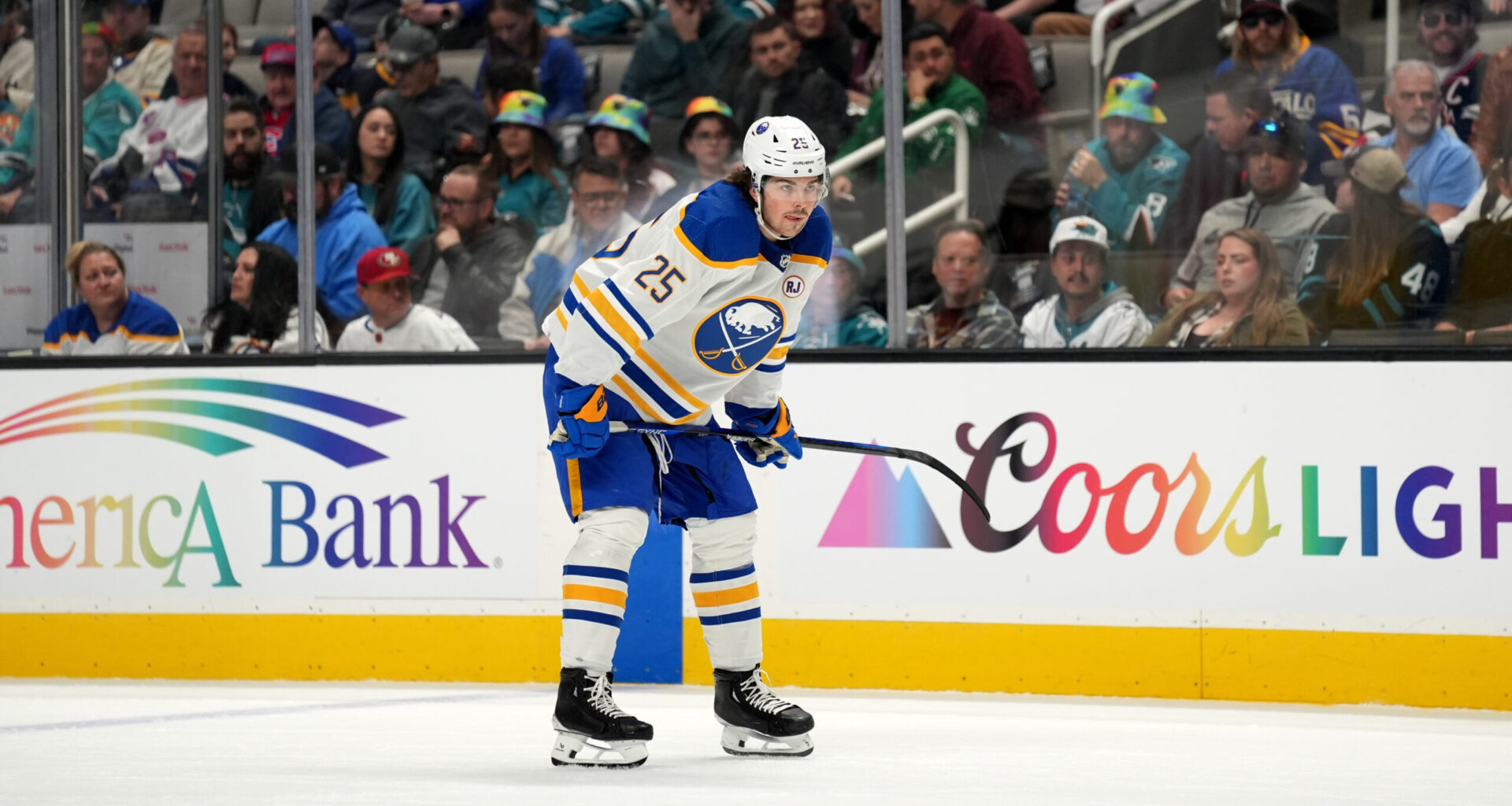
Of all the players on the Buffalo Sabres who frustrated fans during the regular season, Owen Power was one of the names that continued to stand out as things kept going along. He was fresh into year one of his new, very large contract, and expectations were high for the talented young defenseman, as head coach Lindy Ruff was expected to get some much-needed physicality out of him. Sadly, Power was simply another gentle giant for the Sabres, but he found other ways to contribute. While his physical prowess continues to need work, he made some strides in his offensive game. That did, however, come at a slight cost to some of his usually better defensive numbers.
Owen Power Needed to Play Bigger
In multiple senses of the word, Power needed to play much bigger this past season. His physicality was lacking, mostly in regards to his willingness to fight for pucks along the boards, and to move opposing players from the front of his own net. Physical does not mean that he needs to be throwing hits every two minutes, but it does mean that he should be using the large frame that he does possess in order to impose his will a lot more. Standing at 6-foot-6, 226 pounds, the 22-year-old defender has the stature to be an immovable object that should be commanding more of a presence in his own zone. Instead, he plays like a 5-foot-9 finesse player who glides around the ice. This is a testament to his skating abilities and his offensive instincts for sure, but it leaves a lot to be desired when it comes to opposing forwards constantly skating past him because he is out of position, or he just cannot stop them from taking the position from him. The amount of times that he got outplayed last season was honestly embarrassing.
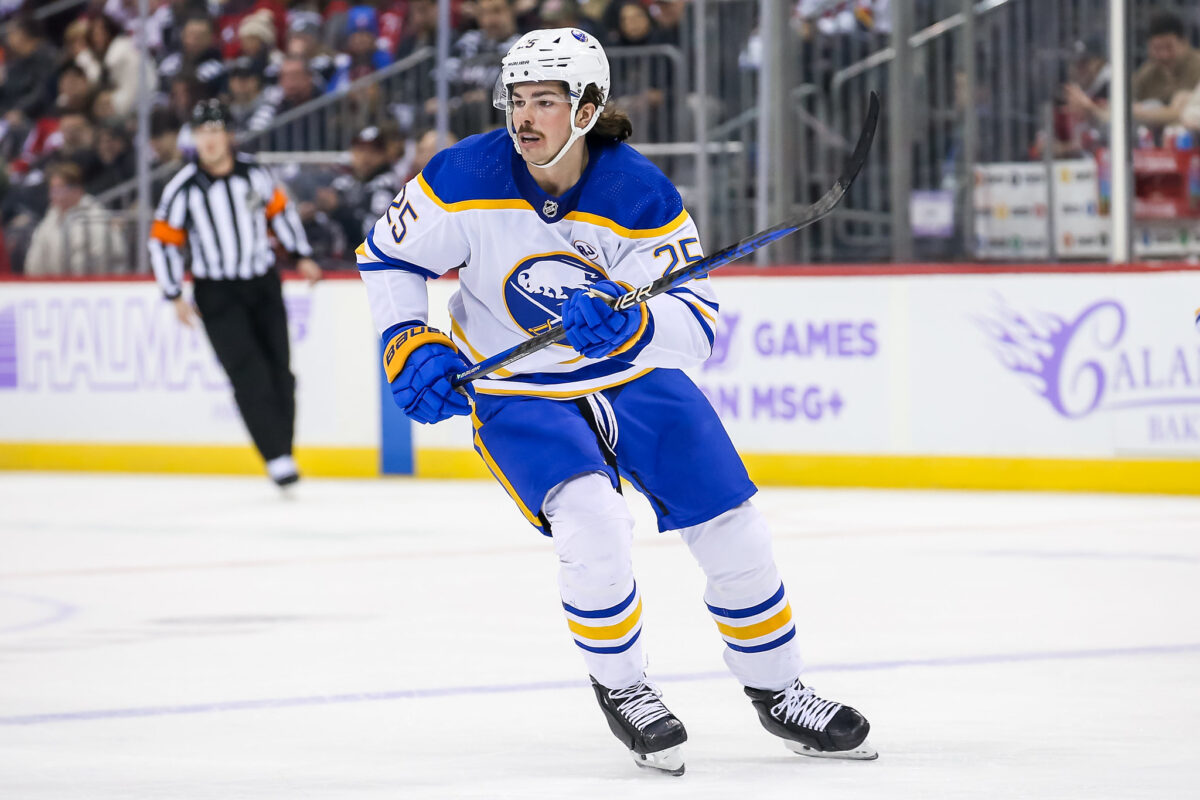 Owen Power, Buffalo Sabres (Jess Starr/The Hockey Writers)
Then there were the big moments; the times where Power should have been the player to step up, and be the “big-time player,” but he either cracked under the pressure, or was absent altogether. There were multiple times this season when key players in the Sabres’ lineup were out with injury or illness (notably Rasmus Dahlin and Tage Thompson), and the team really needed a star to emerge. This was the time for Power to really show his talents and put everything he had out on the line. Unfortunately, he, like many others on the roster, did not rise to the occasion, and Buffalo suffered dearly for it. Youth can only be an excuse for so long. At some point, the players who are meant to be stars need to act like them, and Power missed his mark this season.
Grading Power
Where he missed marks in his physicality and game sense, he made up for in his offensive production in some ways. His base statistics all improved for the most part as he tied his career high in games played (79), set career highs in goals (7), assists (33), points (40), and shots (139), all while staying out of the box (16 penalty minutes) and averaging 21:19 of ice time per game; which was over a minute less than his career average. The defensive numbers did not look as good. This was the first time in his career that he was a minus in the plus/minus column, as he posted a minus-13. Considering his offensive numbers were all better, and he still ended up with a minus in his differential, just goes to show how often Power was on the ice for goals against this season. It was obscenely noticeable. With those things being said, Power’s grades would look like these:
Scoring – B-plus
Defense – C-minus
Leadership – C
Playmaking – A
Teamwork – B
Power is one of the best playmakers that the Sabres have from the back end, and he is a decent scorer when he decides to shoot the puck. He functions well in their team scheme, but could be utilized better if he had a more suitable defensive partner. His defense this season was downright awful, and it felt like every replay with a goal against the Sabres was just a search for the number 25 on the Sabres and figuring out how he was so far out of position. He needed to be a bigger player in every sense of the word, and he could have established himself as a much more valuable piece of this organization, but as things stand right now, Bowen Byram may have him beat.
Power’s Future With the Sabres
The simple answer is that he is not going anywhere because of his contract locking him here until the 2030-31 season, however, as it happened to Dylan Cozens this past season, long-term contracts can be moved if the player is not the right fit. His contract does not have any trade limitations on it until the 2029-30 season begins, so the Sabres would be free to move him if they wanted. Right now, the Sabres have to make the choice if they want to keep Power or Byram, since they likely will not be able to afford both of them along with their other young players that will need contracts (namely J.J. Peterka, and eventually, Devon Levi).
Related: Buffalo Sabres 2024-25 Player Report Card: Jack Quinn
While I am personally of the opinion to trade Power for a bigger haul and upgrade this team as best as possible, and moving out a defender that does not play the right brand of hockey is needed, the likelihood of him remaining in a Sabres sweater while Byram gets shipped out is much more likely. That is not to say that it would be disappointing to continue seeing Power play for the Sabres, but it would mean that some real changes and progress would need to be made by him in the coming seasons. The playoffs have been an illusion to the Sabres for 14 years, and if Power steps up and becomes the player he was drafted to be, they could finally become a reality. The pressure is still on him, but the real question is if he will break under that pressure this time, or if it will mold him into something better.
