

Follow us on Twitter: @AlexC_NJD, @NJD_OnTheRush
Follow me on Bluesky
What the New Jersey Devils’ blue line looks like next season remains to be seen.
There’s no question that new general manager Sunny Mehta will try to make some changes to the team’s defensive unit. Among the question marks that remain on defense is what happens with Dougie Hamilton.
Hamilton did not speak to the media on cleanout day and has not spoken to the media since he was a healthy scratch in January.
Perhaps the writing is on the wall, but Mehta should do everything in his power to mend the relationship with Hamilton. That’s because he’s still their best defenseman, and it’s hard to see a path where the Devils’ blue line improves without him next season.
It was a tale of two seasons for Hamilton: pre-healthy scratch and post-healthy scratch.
Before the healthy scratch in early January, Hamilton had just five goals and 10 points in 40 games. There was some poor luck involved, though.
Hamilton had a career-low on-ice shooting percentage of just 5.6 percent, so the Devils were barely scoring when he was on the ice. Most of his underlying metrics suggested he should have been scoring more, too.
Hamilton had an expected goals share (xG%) of 53.49 percent through his first 40 games. The Devils were averaging 2.87 expected goals per 60 minutes during his five-on-five minutes and allowing just 2.5 per 60.
The numbers suggested Hamilton was due to bounce back, and boy, did he ever after he was a healthy scratch.
Hamilton finished with seven goals and 29 points across his final 37 games, a 15-goal, 64-point pace over 82 games.
What was most impressive about Hamilton’s close to the season (and really the whole season in general) was his stout two-way game.
Hamilton totaled an xG% of 53.11 percent across his final 37 games, and his per-60 rates were almost identical to his first 40 games of the season.
He’s never been known as a stout two-way defender, but the 2025-26 season was one of the best defensive seasons of Hamilton’s career.
At least early in the season, Sheldon Keefe was also deploying him in difficult defensive minutes. He handled it well and looked like a true No. 1 defender. He’s also still the Devils’ best threat as a power-play quarterback.
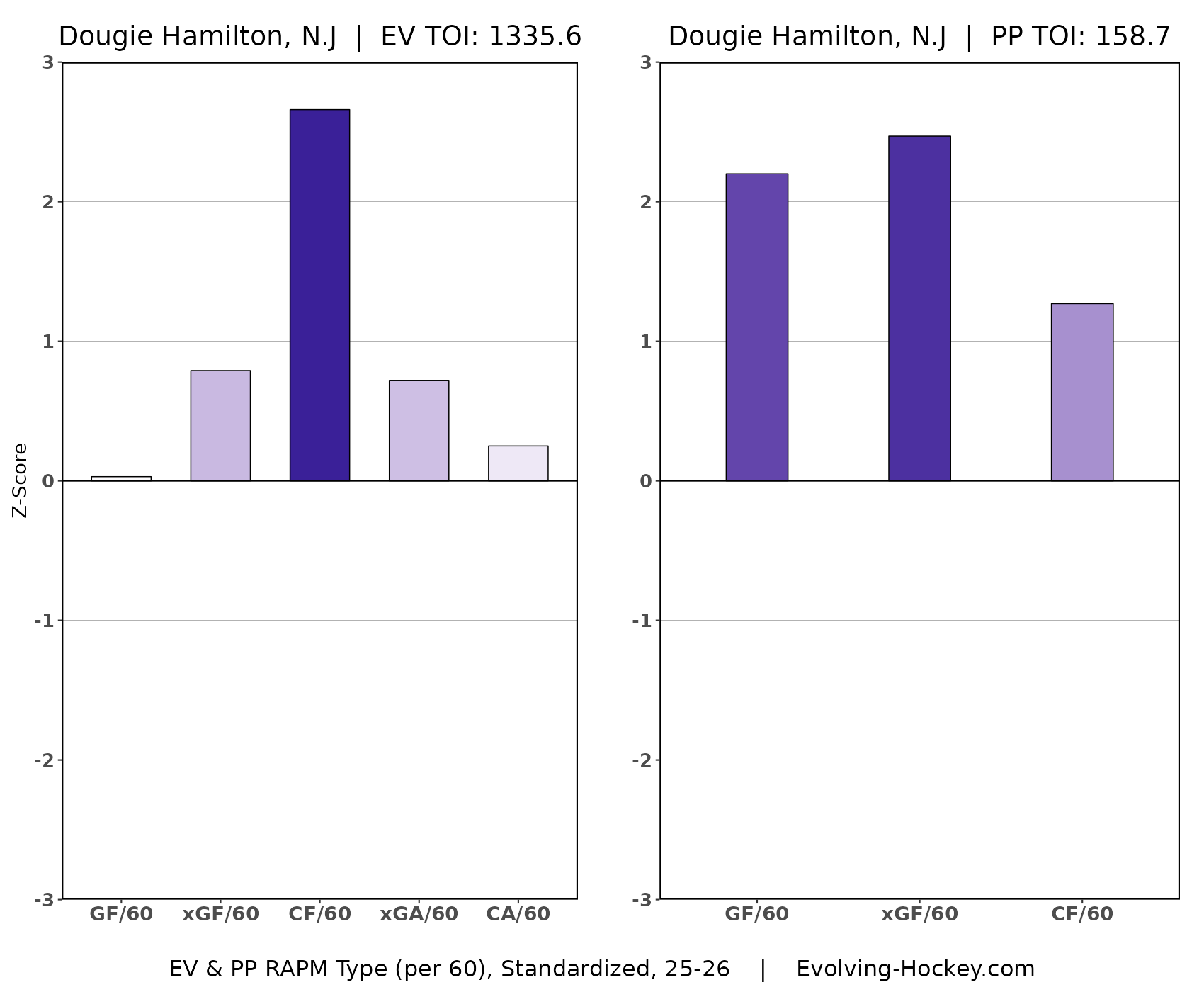
Hamilton may turn 33 in a couple of months, but there are no signs of significant decline in his game. He remains the closest thing the Devils have to a No. 1 defenseman, and it will be challenging to replace him if they trade him this offseason.
The best the Devils can hope for is that Luke Hughes takes a significant jump forward next season and starts developing into the defenseman they drafted him to be.
That’s because you’re unlikely to find a No. 1 defenseman on the trade market this offseason, and there certainly aren’t any available in free agency. But even then, the Devils should want Hughes AND Hamilton anchoring their defense.
Perhaps you can net a defenseman in return for Hamilton, but he’s unlikely to be the caliber of defenseman that Hamilton is. That’s why Mehta needs to make an effort to mend the relationship that former GM Tom Fitzgerald seemed to damage.
One argument for trading Hamilton is that the Devils need cap space. They have just over $13.1 million cap space entering the offseason, and that’s without an Arseny Gritsyuk extension.
Trading Hamilton’s $9 million cap hit would give Mehta plenty of financial flexibility to make the improvements the Devils’ roster needs. But that shouldn’t be the only path to freeing up cap space.
We’ve talked about this plenty in recent months, but the Devils’ blue line needs an overhaul. There are too many defensive defensemen and not enough puck-moving ability.
I’m not saying Mehta should trade all of Jonas Siegenthaler, Brett Pesce, Johnathan Kovacevic, and Brenden Dillon, but a couple of them need to be on the move.
No-trade and no-move protection may complicate matters. All four of those defensemen have no-trade or no-move protection of some kind. But let’s say Mehta finds a path out of Siegenthaler and Kovacevic’s contracts.
That would open up $7.4 million in cap space, and there are more moves Metha can make. I’d be surprised if Stefan Noesen is a Devil next season. Moving his contract would free up an additional $2.75 million.
Combined with Siegenthaler and Kovacevic, that gives the Devils an additional $10.15 million in cap space, more than what’d you get from trading Hamilton alone.
Aside from the cap space you’d get from trading those players, you also open up some spaces to make improvements to a roster that needs it. That’s probably the best path forward rather than trading Hamilton.
Judging by Hamilton’s not speaking to the media, perhaps this situation is at a point of no return. But Mehta should still make every effort to mend this relationship that Fitzgerald damaged.
Hamilton is still the Devils’ best defenseman. I don’t care what anyone says. Sure, there’s value in freeing up cap space, but there should be other ways to gain some financial flexibility.
The Devils are also almost surely guaranteed to lose any Hamilton trade. This isn’t likely to be a scenario where they net a top-six winger for him. It’ll likely be a pick or two or a pick and a prospect.
Mehta could flip those assets to replace Hamilton on defense, but he will not be getting the same kind of defender in return.
Hamilton is worth more than a pick or two and a prospect to the Devils. The goal next season is to be competitive and back in the playoff race, and trading Hamilton takes them further away from that goal.
Mehta is a data-driven GM, and I’m sure he knows what value Hamilton can provide the Devils.
Hopefully, with Fitzgerald gone, the two sides can repair the damage done and get off to a fresh start for the 2026-27 season.
Advanced stats from Natural Stat Trick