
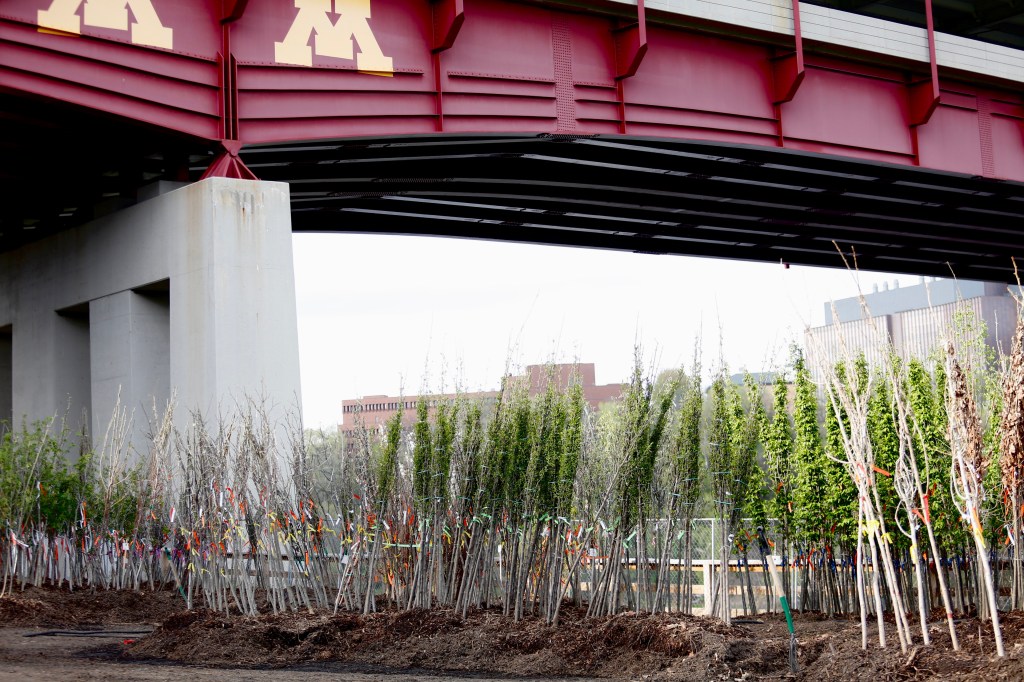
The Minnesota Wild are working to reduce the carbon emissions from their cross-country travel by planting trees across the metro area.
The team, along with Grand Casino Arena and St. Paul RiverCentre, partner with Green Cities Accord, a Minneapolis-based nonprofit with a mission of creating climate-resilient communities by investing in tree canopy infrastructure.
The Wild first partnered with Green Cities Accord in 2025. Kate Setley, vice president and general manager of St. Paul RiverCentre, said the team had been examining its environmental impacts and looking for ways to improve sustainability.
According to the U.S. Environmental Protection Agency, transportation was the largest contributor of nationwide greenhouse gas emissions in 2022, accounting for 28%. This category included cars, trucks, commercial aircraft and railroads.
“We looked at the hockey side of our business and said, ‘We’ve got to fly our team around. We can’t avoid that,’” Setley said. “So how can we get creative to offset that impact from our organization?”
Last season, Setley said the Wild offset more than 1,300 metric tons of carbon dioxide by purchasing carbon credits from Green Cities Accord, the equivalent of removing hundreds of cars from the road for a year.
The nonprofit uses these purchases to plant trees around the Twin Cities and restore the urban tree canopy. Trees remove carbon dioxide from the atmosphere through photosynthesis, offsetting the carbon emissions from transportation.
Trees for Travel program
The Wild’s tree-planting initiative led St. Paul RiverCentre to create Trees for Travel. The program allows events at the Grand Casino Arena, St. Paul RiverCentre and Roy Wilkins Auditorium to offset attendees’ travel emissions by purchasing carbon credits from Green Cities Accord.
Setley said St. Paul RiverCentre works with event planners to collect attendee travel data, calculate the collective distance traveled and purchase carbon credits. The program doesn’t require any effort from attendees.
“Sustainability success is best when you can make it easy for people,” Setley said. “People inherently want to do the right thing, right? But how do you make it easy for them?”
McGough Construction was the first organization to purchase carbon credits for a meeting in April 2025 at the St. Paul RiverCentre. Setley said McGough Construction offset emissions equivalent to 12.6 cross-country car trips.
“A construction-based company, your brain might not always go straight to sustainability. But come to find out, McGough is a very sustainable organization,” Setley said. “Doing things collectively is where progress is made.”
Green Cities Accord
Green Cities Accord works with private companies and municipal partners such as the Minneapolis Park & Recreation Board and the city of St. Paul to fund tree planting in the Twin Cities. The nonprofit’s carbon-offset program is the largest in the state, according to executive director Michaela Neu.
“The amount of trees that these municipalities want to plant is hindered simply by lack of funds,” Neu said. “We work on their behalf to find or generate new funding specifically for tree planting.”
Neu said the St. Paul RiverCentre is the first organization to provide the carbon-offset option to outside event planners.
“Trees for Travel is really unique,” she said. “It’s a value-add to events coming in, and I think it makes them really competitive.”