
In 2024 and 2025, the Edmonton Oilers and Florida Panthers clashed for the Stanley Cup, with the 2024 seven-game series arguably being one of the greatest of all time.
The teams that missed the playoffs were done in April, and the majority of others were done by May. But as the Cup finalists’ seasons stretched into late June, their off-seasons were compressed.
In 2026, the Oilers went out meekly in the first round, after an inconsistent regular season. The Panthers never got close to the playoff race. Both teams were hit with major injuries to key players.
The question: Were their seasons doomed from the beginning? There’s a lot of armchair critics who will point to analytics and roster decisions, but was this simply a case of asking too much of two exhausted teams in the modern NHL?
At his team’s end-of-season post mortem, Panthers’ coach Paul Maurice said that the jump that should come with a new season quickly gave way to fatigue. The Panthers had been to three Cup finals in a row. A fourth was a bridge too far.
“I’m not saying we were faking it into training camp,” said Maurice. “Everybody came in jacked up for training camp. We were fit. We were ready.
“I would just say that your well, your reservoir, isn’t as deep.”
Some fans are old enough to remember a time when the off-season was a time for players to hang by the lake and drink beer. Some who are even older might remember a time when players had to go home in the summer and work odd jobs.
In the era of the millionaire entry-level player, the summer for building fitness, muscle and endurance. The regular season and playoffs see players exhaust their physical resources. Summer is the time to build it back up. So, for the teams that get to the Cup final in late June, the players have to fast-track their off-season training.
Oilers forward Leon Draisaitl said that, optimally, a player can take a couple of weeks after the season ends simply to decompress. But, after two Cup runs, the Oilers players weren’t able to do that.
“The last two seasons, everyone took seven days off working out, and then you’re back at the gym,” he said. “That’s not a lot of time. ”
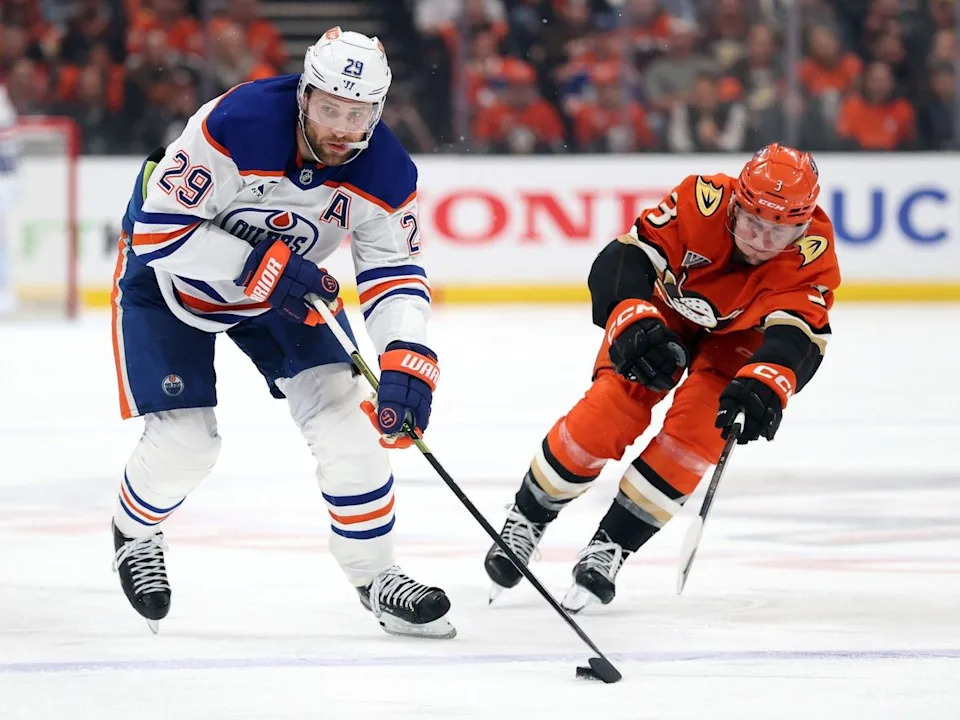
Leon Draisaitl #29 of the Edmonton Oilers skates with the puck against Ian Moore #3 of the Anaheim Ducks during the third period in Game 6 of the first round of the 2026 Stanley Cup Playoffs at Honda Center on April 30, 2026 in Anaheim, Calif.
The incredible shrinking player
Matt Yaworski is an assistant lecturer at the University of Alberta’s Faculty of Kinesiology, Sport, and Recreation. In the summer, he trains professional hockey players.
He said that when NHLers come to him after their seasons end, they are smaller.
“For many of the professional hockey players I work with, we do, they leave us at a certain weight in the summer, and they’ll often come back at a lower weight after the season, because they haven’t been able to maintain the same amount of muscle mass that they’ve built over the summer,” said Yaworski.

Matt Yaworski, Assistant Lecturer, Faculty of Kinesiology, Sport, and Recreation at the University of Alberta, trains athletes at an offsite curling rink on Friday, May 8, 2026. Photo by Shaughn Butts – Postmedia
The rigours of the season erode their fitness and their muscle. And because of the tight travel and practice schedules, there just isn’t room in the timetable for off-ice training.
“Throughout the season, it’s very difficult to make any forward progress on on strength or size,” said Yaworski. “You often are just trying to maintain it or reduce the loss as much as possible.
“In the summer, for athletes who aren’t in the playoffs, they can get maybe about three really good months of resistance training and working on their deficiencies to be prepared for the next season. If you look at the guys who go to the third week of June, they might get six to eight weeks, if they’re lucky, before they’re preparing for camp again. And so it absolutely suffocates that window to regain what has been lost over an exceptionally long season.”
Erin Baker is the owner of True Movement, a workout system based in Edmonton that has expanded across North America. It promotes strength, flexibility and balance. Baker consults the Denver Broncos of the NFL, and works with a number of NHLers and NFL players across the continent.
She said when an off-season is compressed, an athlete has to build mass on a tired body. There’s no time to “restore and recharge,” which should be the first order of business after the season ends.
“So, there may be things that an athlete wants to work on,” she said. “But then they have to ask themselves, ‘do I need to prioritize?’ There might not be time for restoration and recovery, or bringing the body back to its proper posture. There might not be time to build a proper foundation.
“And building on an exhausted body, well, that’s not going to help anyone.”
After the Broncos lost a heartbreaker in the AFC Championship Game, the team gave the players some extra time off to both physically and mentally recover, because the NFL off-season is long enough to allow for the buffer zone.
“The NFL guys I work with are in disbelief over how short the NHL off-season is,” said Baker.
So, are there lessons to be learned from this year’s burned out versions of the Panthers and Oilers? Like Sebastian in Fight Club, these teams collectively looked like a photocopy of a photocopy.
Is it time for scheduled games off?
The answer could be to make sure no player comes close to appearing in all 84 regular-season games, as the NHL schedule grows in 2026-27. Sure, we celebrate the “iron man” player, but in this era of massive travel and more and more games, is it sensible?
In other sports, there is a culture of resting players during the season. But the culture doesn’t exist in hockey, even though the Olympics plus the World Cup of Hockey will compress the schedules in some seasons to come, meaning lots of back-to-backs and three-games-in-four-nights scenarios.
In the NBA, fans have become used to “load maintenance” a euphemism for resting star players. To deal with the grind of a long schedule, a coach will give a star player a night off here, a night off there. In fact, the practice became so common that the NBA had to create rules for resting players: no team is allowed to rest more than one “star” player, and no “star” player can be rested for nationally televised games. So, if the Celtics are in Charlotte on a Tuesday night, a star can be rested, but not for game against the Lakers on Saturday night’s NBC match-up.
In baseball, managers regularly make sure players get days off during the season. And, in international soccer, “squad rotation” can see managers switch out multiple players from game to game. Even if a team is healthy, it’s a rarity to see the same starting 11 two games in a row.
The NHL requires injured players to be medically certified, and then they go on the injured reserve list. This is to ensure teams do not manipulate their salary caps. But teams are permitted three healthy scratches from their 23-man rosters. But everyone would know something was up if the Oilers healthy scratched Connor McDavid.
With fans paying hundreds of dollars for game tickets, it’s a blow if visiting teams rest players. This came to a head in Major League Soccer, when the Vancouver Whitecaps were successfully sued by ticket holders for Inter Miami’s 2024 visit to BC Place. Tickets were priced at a premium, because Lionel Messi had recently moved to Miami, and was advertised to be the star attraction. But Messi mania was stifled because the veteran was held out of the game. The Whitecaps were ordered to pay $475,000 to charity.
Yaworski said, if scheduled with the coordination of teams’ medical staffs, load management could work in the NHL.
“This theory is sound to me,” he said. “If we think about the NHL, I can certainly state the teams have exceptional staff in place on their performance side and their medical side, and they monitor how these athletes are responding to the day-to-day. And they make these decisions within to maybe reduce their practice time or adjust what they’re doing in their off-ice activities to accommodate for that load management. But we haven’t really seen that (overtly resting players) in the NHL. It’s a valid point there, in the sense that it’s bad for business; people are paying a premium to go to a piece of entertainment, and they want to see the people that they want to see.”
Imagine the family from Lloydminster who goes to one Oilers game a year; they make the drive to Edmonton, only to find out McDavid has been given the night off, not because of injury, but just to be rested. That’s the scenario that has been tough for hockey’s bosses to break down.
Could the playoffs be shortened? Unlikely, as national TV partners like the games spread out so they can get as many eyeballs on the games as can be. TV is also why Oilers playoff games often started close to 8:30 p.m. local time, so a clear window could be established between the early games in the Eastern time zone and the late games out west.
So the grind isn’t going to be alleviated. But it might serve all of us couch critics to understand that being an elite athlete is a 12-month-a-year job, and that schedules and fatigue aren’t excuses, they’re reality.
Baker has the last word: “Everyone has unrealistic expectations of these guys.”

The Edmonton Oilers’ Leon Draisaitl (29) and Connor McDavid (97) during third period NHL playoff action against the Anaheim Ducks at Rogers Place, in Edmonton Monday April 20, 2026. The Oilers won 4-3. Photo by David Bloom
Related
Bookmark our website and support our journalism: Don’t miss the news you need to know — add EdmontonJournal.com and EdmontonSun.com to your bookmarks and sign up for our newsletters here.
You can also support our journalism by becoming a digital subscriber. Subscribers gain unlimited access to The Edmonton Journal, Edmonton Sun, National Post and 13 other Canadian news sites. Support us by subscribing today: The Edmonton Journal | The Edmonton Sun.