
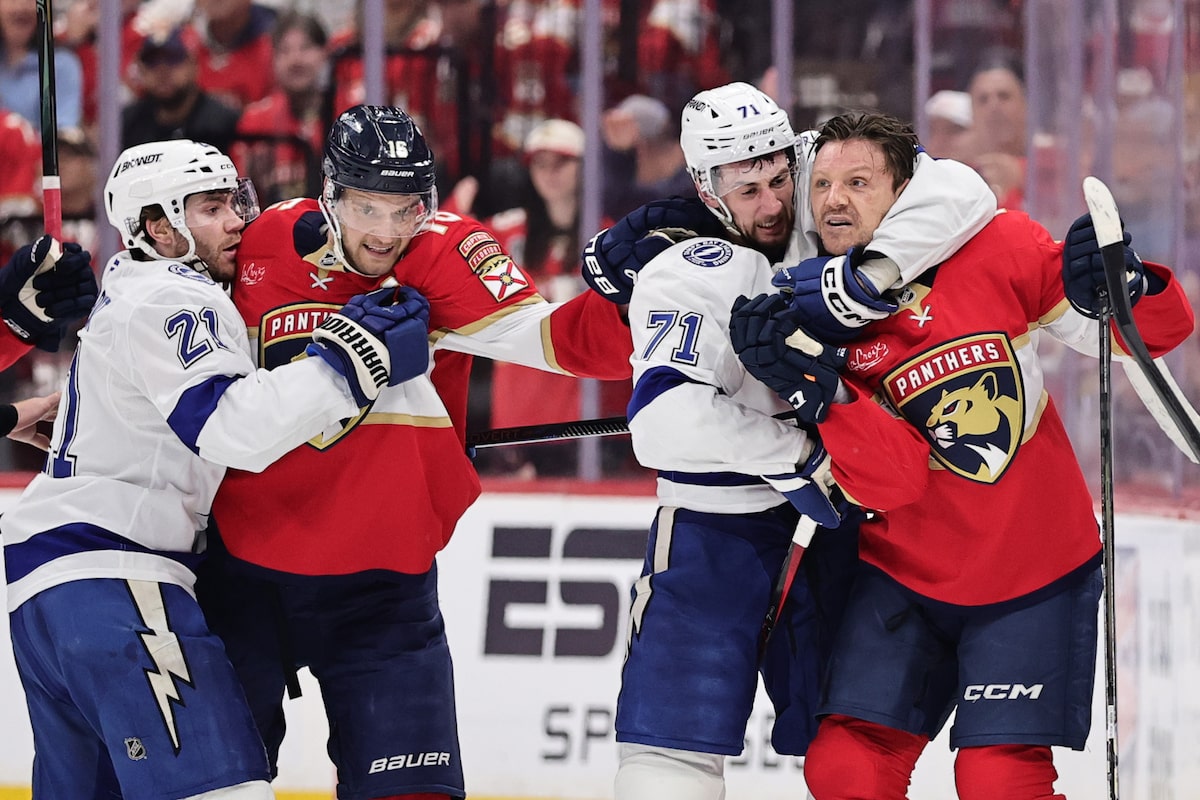
Anthony Cirelli, second-right, of the Tampa Bay Lightning fights against Sam Reinhart, right, of the Florida Panthers in Game Three of the First Round of the 2025 Stanley Cup Playoffs at Amerant Bank Arena in Sunrise, Fla., on April 26.Carmen Mandato/Getty Images
The notable thing about Florida’s Aaron Ekblad annihilating Tampa’s Brandon Hagel with a forearm/elbow to the face in Monday’s game isn’t that it happened.
The Panthers are bullies. Not just a few of them, all of them, including the goalies and the guy who drives the team bus.
It’s a strategy that’s worked since the first Canadian pulled the first L-shaped branch off a tree in winter and thought, ‘I know what I should do with this – use it to hit a friend in the head.’
What is notable in the Ekblad/Hagel case is that as it happened, an official was 10 feet away watching it happen. No penalty.
There have been some other edgy collisions in this postseason, but none in which the refs were so obviously aware of what went down. So it’s going to be those sort of playoffs, is it?
The NHL’s department of player safety was busy on Tuesday, setting up a hearing with Ekblad and fining his teammate Niko Mikkola U.S.$5,000 for boarding Tampa’s Zemgus Girgensons in Game 4.
The people who are offended by violence in hockey yet continue to watch hockey aren’t even bothering to raise an alarm. Whack-a-mole is hard on the brain, as well as the arms.
So everyone’s finally on the same page again. In the Age of Trump, unfettered aggression is cool again.
With that in mind, the officials understand this year’s marching orders – jumping on face-offs absolutely forbidden; shots to the head on a case-by-cracked-skull basis.
In the Hagel instance, he had to leave the ice, but his head was still attached. So.
If that’s the standard, they should think about giving Florida the Stanley Cup now. The league will lose a bundle on broadcast revenue, but imagine how much will be saved in health-insurance premiums. It might be a wash.
Coming into the postseason, the Lightning were the hipster pick to become champions. They are older where it matters (goal, defence), and young where that’s better (offence). They got better as the season went on. They’ve done this recently a couple of times, and so are less likely to get ahead of themselves.
Then Florida hit them like a truck, often literally. Tampa has tried to hit back, but with less sustained success. The most awful thing you can say about a hockey team may now be true of them – they aren’t built for this level of intensity.
Both teams in this series are coached by self-effacing Canadians whose off-ice suavity is contrasted by the Marquis de Sade approach they bring to the rink. Tampa didn’t win two Cups because they’re so good. They did it because they were willing to go to the dirty places – ethically and geographically.
Both coaches have mastered the art of being vicious without seeming vicious, which has turned the series into a battle of press conference wits.
In Game 2, Hagel wiped out Aleksander Barkov with a raised elbow to the cranial region. Since Barkov is taller than Hagel, that one was a little more obvious. Hagel was suspended for a game.
Afterward, Florida coach Paul Maurice said, “The only players we hit are the ones who have pucks.”
You’ll note there that Maurice’s problem isn’t the elbow to the head. It’s the interference.
The next game, Panther Keith Tkachuk attempted to divide Jake Guentzel into two roughly equal parts at the end of a lopsided loss. As all the players on the ice then tried to tear each other’s faces off, game ops played Olivia Newton-John’s Physical.
Asked about the hit, Tampa coach Jon Cooper shrugged and said, “The only players we hit are the ones with pucks.”
Maurice’s retort to Cooper’s riposte: “Well done.”
Is violence making a comeback in the NHL? No, because it never left. Understanding that media fuzz had it under surveillance, violence skipped town for a while, becoming a seasonal rather than year-round concern. Everyone in the league was in on it.
What’s changing this year is that the violence is once more fun to talk about. That’s not because of the Hagels, Ekblads or Tkachuks. It’s because of the Maurices and Coopers.
The most effective promoters of NHL rough stuff during its golden age weren’t the players. The coaches made brutality poetic.
After the ’76 Flyers terrorized the Red Army team – possibly the most famous mugging in hockey history – Philadelphia coach Fred Shero wrote an op-ed in the New York Times defending his men. (Imagine a modern coach writing anything by himself.)
Shero’s take: “We did not brutalize the Russians, nor have we ever brutalized any team. It is true that we do get more penalties than other teams, but that is not because we are animals or goons. It is because we have more courage than any other team.”
Pretty good.
Violence ebbed because no one was willing to support it, particularly coaches. That’s changing now. If you think the pure goonery cannot return, you’re not paying attention to the reaction to the banter between Maurice and Cooper. People love this. They don’t just find it acceptable. They find it charming.
For now, confining hockey’s most ferocious tendencies to two months a year is working for everyone. It gives the playoffs an added frisson of danger. It makes it more likely the stars can get through a whole year in one piece.
But eventually, the regular season will need some marketing help. That’s just the circular way of things. Something’s getting more popular, and then it’s not. When that happens, you don’t reinvent the wheel. You go back to the old wheel.
When it’s time to return to the old ways, it won’t be a matter of finding the right thuggish personnel. Hockey’s minor leagues are rotten with boxers who can sort of skate.
The important thing will be finding a new generation of Maurices and Coopers to sell the change in a way everybody finds endearing.