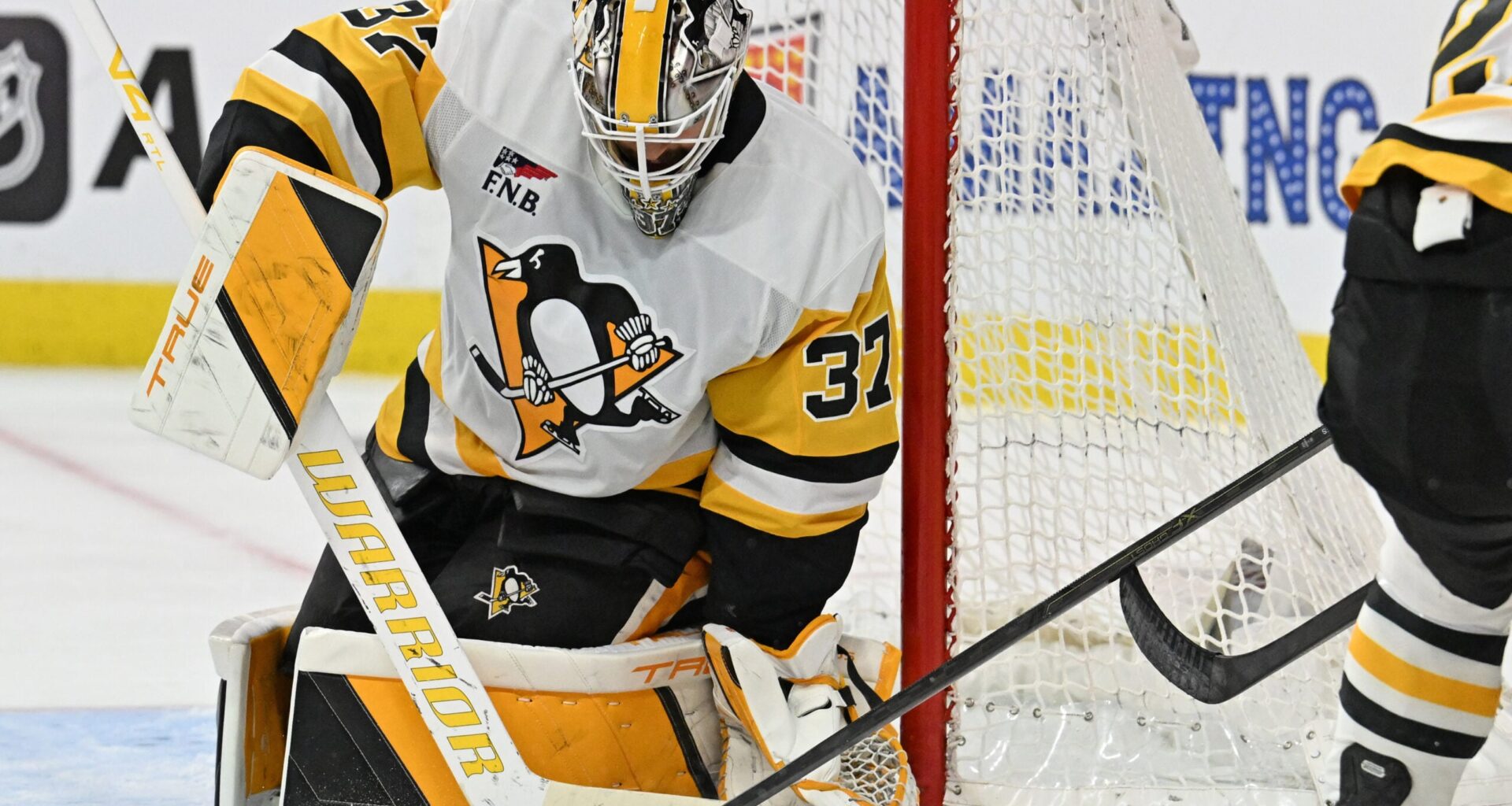
Tristan Jarry submitted some of his very best at the beginning of the season and gave Pittsburgh Penguins general manager Kyle Dubas a window to swing a franchise-changing trade, freeing the Penguins from the future obligations of a contract that Dubas regretted. Arturs Silovs was hot and cold, Stuart Skinner was good, and Sergei Murashov got his first taste of NHL shooters.
Indeed, glimpses of the Penguins’ goaltending future were often visible.
To put some of the conflicting statistics and analytics into context, the Penguins’ goaltending stats were inextricably linked to the play of the team, but the stats and performances were often independent of the other. When the Penguins were good, their goaltenders posted good numbers, and not coincidentally, when the team played with careless abandon, the goalies bore the brunt.
Penguins fans may need to sit down for this, but in 14 starts for the team, Jarry posted a .909 save percentage, which was 21 points higher than either of the Penguins’ starting goalies, and posted a .692 quality start percentage, which would have been a career best.
Of course, Dubas seized that opportunity to flip Jarry and the remaining two years of his contract that carries a $5.275 million salary cap hit to the Edmonton Oilers for the gregarious Skinner and reliable defenseman Brett Kulak.
Dubas also gets an A for that one.
Tristan Jarry grade: A
Jarry stole a few points in his brief season with the Penguins. He was steady, athletic, and looked healthy. It looked like he had resurrected his career before his play cratered in Edmonton. Still, his play lifted the Penguins, and his trade made the team better, too.
Arturs Silovs: B-
To grade Silovs, expectations must be factored. Lost in the shuffle this season was a very simple fact: Silovs was a rookie. Never had he faced NHL shooters every night, and never before had he been through the arduous regular season, which greatly differs from the weekend heavy regional travel of the AHL schedule.
Silovs, 24, was at times stellar, and in stretches—several stretches—not good enough. In fact, later in the season, his play fell off significantly. In fact, Skinner had obviously taken the net even before coach Dan Muse awarded it to Skinner .
It wasn’t pretty in his final 12 games. Silovs limped to the end with an .862 save percentage in four April appearances, and an .862 rate in eight March appearances.
Fortunately for the goalie and the team, Silovs thrives under pressure. After the team nearly flatlined in Round One of the Stanley Cup Playoffs against Philadelphia, Silovs rode to the rescue, which raised his grade from a C to a B-.
At this point in his career, Silovs has issues with rebound control, but he showed improvement on long-range shots and further progression can be expected, and he may be called upon to have the net in a more primary role next season.
Silovs finished his rookie campaign with a disappointing .888 save percentage, but a 19-12-8 record. Among his challenges to refine his game, will also be the challenge to raise the floor of his performances so there is less of a gap between his best and worst.
To be the No. 1 goalie that he very much aspires to be, consistency will be paramount.
Silovs is a restricted free agent, but all signs indicate Silovs will return, even though Dubas didn’t declare a decision between him and Skinner in his post-season press conference.
Sergei Murashov: Incomplete
Murashov could have claimed an NHL spot this season because Skinner was a pending unrestricted free agent and exemplary play would have allowed Dubas to deal Skinner. However, Murashov wasn’t ready, and he lasted only five games, the last of which was a rough five-goals against outing against the Utah Mammoth on Dec. 14.
There are some rough edges that still need to be sanded.
On the positive side, Murashov posted a 21-save shutout during the Global Series games in Stockholm, Sweden, in November. But in fairness, those games were lethargic and on bad ice; they were some of the worst games of the season.
Murashov’s potential is not in doubt. The athletic and heady netminder has backstopped the Wilkes-Barre/Scranton Penguins to the Eastern Conference Final with a playoff save percentage of .943. An NHL spot is his for the taking next season.
Stuart Skinner: B+
Compared to expectations and perceptions before he arrived in Pittsburgh, Skinner was Dominik Hasek.
If one were to purely look at the stat sheets, he was even worse in Pittsburgh than he was said to be in Edmonton. An .885 save percentage doesn’t exactly scream starting goalie. So, how in the world could we deliver such a good grade? The final analysis is fairly simple: The praise from his teammates after the Penguins were often terrible defensively, and he held them in plenty of games.
What Skinner did for the team was provide steady, reliable goaltending. And occasionally, he submitted some remarkable goaltending, too. He absorbed shots to prevent rebounds, made the necessary saves, and some key saves, too. Without drama or a scrambly presence, Skinner allowed his team to breathe.
Given the situation and Skinner’s more comfortable personality and competent professionalism, Dubas would be well within bounds to choose Skinner as a mentor for Murashov, but it doesn’t seem that is under consideration.
Sure, there were some softies, but predominantly Skinner looked infinitely better than his .885 save percentage. He was a popular teammate and earned the net for Game 1. Skinner did well to raise his stock ahead of July 1 free agency.
Future Implications?
Silovs’s performance in the playoffs was crucial. Beyond winning a couple of games, it should erase some of the doubts that had to be raised by his late season difficulties, and based on the assumption that Murashov will have to ease into NHL work through his development process, the Penguins will probably have to lean on Silovs for a majority of the starts.
Silovs has plenty to work on, as both he and Murashov have to improve their rebound control, or the Penguins defensemen might suffer whiplash from the number of shots that rocket into the goalies and rocket off the goalies.
The Silovs-Murashov tandem looks to be a future strength, as one or both could elevate to No. 1 goalies, but it also could be a weakness until the netminders’ games mature.
Tags: arturs silovs Penguins Analysis Pittsburgh Penguins sergei murashov
Categorized:Penguins Offseason Analysis