

It began with a conversation, and cemented a brighter future for Linus Karlsson.
The Vancouver Canucks’ winger was at a career crossroads in Abbotsford and needed more than a nudge to take his game to another level. He needed to be challenged. And Manny Malhotra provided the incentive.
The head coach of the Canucks’ AHL affiliate knew if Karlsson led by example he would punch his ticket to becoming an NHL roster mainstay, and the trickle-down effect would have teammates pulling harder on the competitive rope. And they did, en route to capturing the Calder Cup championship in 2025.
That is why Malhotra is in contract negotiations and will soon be named the 23rd head coach in Vancouver — because his fingerprints are all over a roster that could sport seven players he guided in Abbotsford.
He commanded respect and afforded it in prepping players for the NHL by making better decisions under pressure, forechecking ferociously, and better defensive diligence. And puck possession was a priority.
Above all, Malhotra was big on belief in systems and structure, and in each other. He reinforced the positivity of progress that pushed players and encouraged willingness to embrace the buy-in — as opposed to being critical of mistakes — which suits the daunting roster rebuild that awaits in Vancouver.
Karlsson built on 39 points (23-16) in 32 regular-season games by leading playoff scoring with 26 points (14-12) in 24 outings. He knew the AHL is filled with snipers who have a hard time carving out a niche in The Show, so he had to show more and do more.
So, what did Malhotra tell the Swedish winger?
“He pushed me to be more of a leader, and that’s helping me more in my game,” Karlsson told Postmedia. “Make sure I’m on guys, set screens, be around the net and be good defensively.”
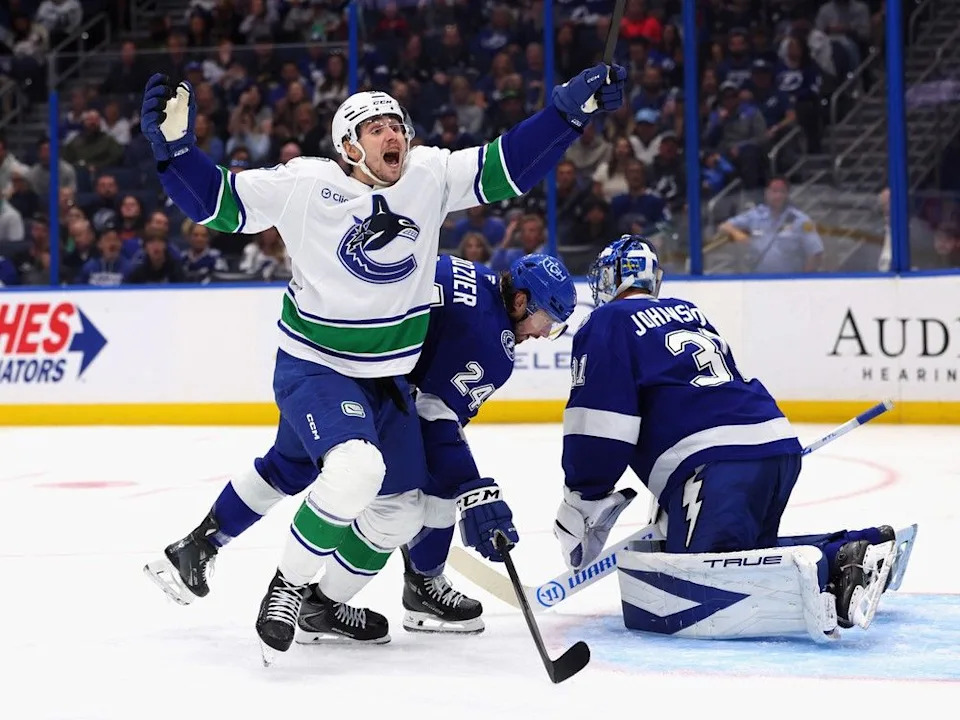
Linus Karlsson celebrates his goal against the Lightning at Benchmark International Arena on Nov. 16, 2025 in Tampa, Fla.
Following a breakout AHL campaign in 2023-24 with 60 points (23-37) in 60 games, Karlssson could have found a comfort zone, but Malhotra knew he had to get dialled in on details. He was wise to rely on Henrik and Daniel Sedin, who are now co-presidents of hockey operations, to help show Karlsson the way.
“I was more of a half-wall guy on the power play and working down-low has been a good fit,” said Karlsson. “And that’s where Daniel and Hank have been good with details around the net, tips, and finding the soft areas. That’s where I will grow the most.”
Karlsson had 35 points (15-20) this tumultuous NHL season where everybody was challenged to endure a condensed schedule, constant losing, and a last-place finish. Before head coach Adam Foote was fired, he tossed Karlsson late-season bouquets. It was also a salute to what he learned from Malhotra.
“He’s really coachable,” Foote said of Karlsson. “And his conditioning and where to move around the ice have improved. He’s a good wall player at both ends, and is way more consistent with it.”
Karlsson, 26, can help show the way in the rebuild. He’s quiet and reserved, but his game made the right kind of noise to earn a two-year contract extension that has $2.25 million US in annual average value.
“I don’t really think about it much, I just try to be myself,” added Karlsson. “I’m not going to dangle three guys to try and make a play. I played with guys in Abbotsford and they know who I am. I don’t do anything different. I’m good at the net and on the boards, but I know I can do better.”
Max Sasson is another example of Malhotra’s influence and guidance.
The versatile forward knew that in order to take the next career step, his stride and commitment had to improve in Abbotsford. And as a centre, he embraced that two-way challenge to the point where his speed this season made him more valuable on the wing to help drive the Canucks’ offence.
He responded with 13 goals in 66 games, and has two years left on his deal at $1 million annually.
Sasson also became that locker-room bridge guy at age 25, a conduit to younger players in helping easer their NHL transitions. He strived to create a better environment where players weren’t afraid to speak up or just be themselves. That’s where constant communication and even dinners on the road matter more than you think.
That’s culture. And it’s crucial. Whether in Abbotsford or Vancouver.
It was another result of the Malhotra effect that will carry on here.