
In February 2025, Dallas business and civic leaders gathered outside Neiman Marcus’ downtown flagship to celebrate a temporary reprieve for the iconic retailer and show that downtown could keep moving forward.

New housing projects were planned or underway. City leaders promised progress on long-standing challenges. Supporters were hopeful about the future of the city’s urban core.
Pedestrians walk past the Neiman Marcus store June 1 in downtown Dallas.
Angela Piazza/The Dallas Morning News
Today, the outlook is far less certain.
Article continues below this ad
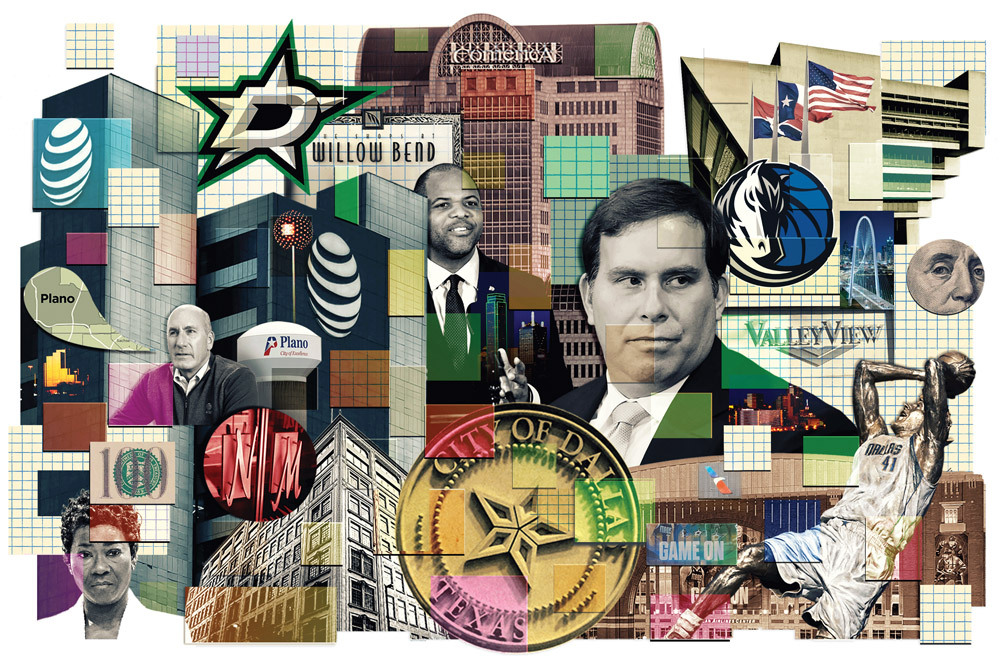
Neiman Marcus is leaving downtown. The Mavericks plan to move to North Dallas. The Stars have chosen Plano for a new arena. Earlier this year, AT&T announced plans to relocate its headquarters to Collin County and Fifth Third Bank selected a campus on the northern edge of town for its regional headquarters.
The decisions are largely unrelated. But together they’ve stirred anxieties about whether Dallas is keeping pace with a region where neighboring cities increasingly are competing for jobs, investment and prestige.
“The wolf is not in this room,” Mayor Eric Johnson said at last week’s City Council meeting. “The wolf is up the tollway.”
As suburbs gain ground, downtown Dallas continues to struggle with empty offices, changing work patterns and pressure to keep pace. City leaders are scrambling not only to keep major employers and institutions, but also to attract new ones.
Article continues below this ad
The latest blows have been jarring, said Walter Bialas, head of research at Goodwin Advisors, a local real estate firm.
“There’s a shot to the kidneys, and there’s one to the midsection. Then there’s an uppercut, then there’s another one to the midsection,” he said. “Oh my goodness, this is just crazy.”
With a statue of Mavericks legend Dirk Nowitzki in the foreground, an exterior view of the American Airlines Center in Victory Park, home of the Mavs and Dallas Stars.
Tom Fox/The Dallas Morning News
That doesn’t mean downtown is in decline. Supporters point to billions of dollars in planned projects, a growing residential population and confidence the city’s core can rebound, even if it looks different than it once did.
“Downtown Dallas is not going away,” said Christopher Penney, associate professor of management at the University of North Texas, noting it has faced challenges in the past. “It will come back from this. I have no doubt about that.”
Article continues below this ad
Some of the city’s most influential developers and business leaders believe the recent setbacks demand a more aggressive push to remake downtown for a new era.
“The city is going to have to, instead of leading from behind as it apparently did on the arena issue, get ahead” and be more proactive, said real estate developer Ray Washburne.
Washburne was among the developers and business leaders who backed moving City Hall and redeveloping that property as part of a downtown arena and entertainment district.
Remaking the core
For much of the past decade, civic leaders have said Dallas’ prosperity depended on strengthening downtown.
Article continues below this ad
Yet the signs of strain are easy to spot.
As of early this year, nearly 27% of downtown Dallas office space sat unused, and that’s expected to climb to about 35% after AT&T and Comerica exit. That would be the nation’s highest vacancy rate of any central business district.
Downtown can’t rely on office workers anymore, and developers say it needs more residents. They see its future in housing, entertainment and attractions that bring more people to the city center.
Already, old office buildings are being converted into housing and new apartment projects are rising across downtown.
It is now home to nearly 16,000 residents across many residential properties, according to Downtown Dallas Inc. That’s roughly the population of Addison.
Article continues below this ad
Dallas isn’t failing but evolving, said Brad Cheves, president and CEO of the Dallas Regional Chamber.
The AT&T and Comerica buildings in downtown Dallas are seen at dusk, Jan. 7, 2026.
Tom Fox/Dallas Morning News
“People focus on the things that we see in this 48-hour news cycle,” he said, stressing that the city and region remain in a strong position overall. He said the city should focus less on what downtown has lost and more on what it already has and can become.
Boosters point to a growing list of projects they believe can help do that, including the $3.7 billion redevelopment of the Kay Bailey Hutchison Convention Center, the expansion of Dallas College, transportation upgrades, the planned Interstate 30 deck park and an $800 million Therme wellness resort proposed for the Cedars.
Washburne, the developer who owns Founders Square and other key downtown sites, called some of the half-empty buildings “zombie towers” that suck the life out of the city.
Article continues below this ad
He suggested imposing new costs on owners of surface parking lots and aging office towers. The goal would be to spur redevelopment rather than allow owners to sit on underused properties.
Rivals next door
Dallas once enjoyed advantages that came with being the unquestioned economic center of North Texas. Today, the region’s growth has created new rivals.
Plano, Frisco, Irving, Arlington and other suburbs have become powerful draws in their own right.
Just last week, Samsung Electronics gave Plano another win with plans to move its U.S. headquarters there from New Jersey.
“There’s so many points now — there’s so many little job nodes out there, you know, clusters of buildings, jobs,” said Ted Benavides, a former Dallas city manager and professor at the University of Texas at Dallas. “The competition’s gone up.”
Dallas City Manager Kimberly Bizor Tolbert speaks Feb. 25, 2025, at a news conference outside the downtown Neiman Marcus store.
Juan Figueroa/Dallas Morning News
With Neiman Marcus, city leaders moved quickly to resolve a lease dispute that threatened the downtown store with closure in March 2025.
The agreement kept the flagship open through the holiday shopping season and gave Saks Global, which had acquired Neiman Marcus, time to explore “a reimagination of the location in collaboration” with the city.
But after Saks Global entered bankruptcy this year, the downtown store’s fate grew increasingly uncertain. Word came last week the storied site will close Sept. 30, as it focuses on the stronger-performing NorthPark Center store.
Among the most significant losses is AT&T, which generated about $125 billion in revenue last year and once bet heavily on downtown Dallas through its headquarters and Discovery District investment.
The company chose Plano for its next home, a move CEO John Stankey linked in part to concerns about Dallas’ long-term governance and years of inconsistent efforts to improve downtown, according to emails reviewed by The Dallas Morning News.
AT&T spokesperson Jim Kennedy said the firm considered multiple sites in 2025, including other downtown locations and renovating its current campus.
City Manager Kimberly Bizor Tolbert said Dallas had worked “tirelessly, strategically and collaboratively” to keep the company within city limits. Demolition has already begun at AT&T’s new Plano site.
A city spokesman did not respond Friday to a request for comment.
The Mavericks and Stars illustrate how the balance of power in North Texas has shifted.
The two sports franchises, whose leases at American Airlines Center expire in 2031, both announced plans last week to leave downtown’s urban core.
The site of the demolished Valley View Mall (left) and The Shops at Willow Bend mall.
Angela Piazza and Smiley N. Pool/The Dallas Morning News
As growth shifted north and suburban cities gained the wealth and political influence to pursue marquee projects, downtown Dallas found itself competing from a weaker position than it once enjoyed.
The Mavericks are pursuing a move to the former Valley View Mall site, leaving Victory Park but at least staying in the city.
The vacant mall site would give the team control of a large tract of land where it can build a basketball arena as well as hotels, restaurants, retail and other revenue-generating uses.
The Stars, meanwhile, have set their sights on Plano.
The Shops at Willow Bend could be turned into a mixed-use district around a new hockey arena while putting the team closer to a fan base that is shifting.
Even so, Tolbert said Dallas will continue working to keep the Stars in the city. And the mayor said Thursday that both teams may still stay in the AAC.
Dallas Stars fans stand for the national anthem as the lighted star retracts to the rafters at the American Airlines Center in Dallas. The Star are now looking to move to Plano.
Tom Fox/The Dallas Morning News
What is clear is Dallas can no longer take its position for granted. For years, the city could assume it would win most regional competitions simply
That doesn’t mean downtown is doomed, said developer Jack Matthews, whose firm Inspire Dallas was hired to oversee the $3.7 billion convention center redevelopment.
“No matter what, downtown is transitioning from what it was to what it’ll be,” he said. “Do you want to lose a sports team? No, you don’t. Can you recover from it? Absolutely.”
The power shift
Marquee departures: AT&T, Neiman Marcus and two pro sports teamsare leaving downtown or choosing neighboring cities.
Downtown under pressure: Empty offices, shifting work patterns and the loss of major employers are accelerating calls to remake the urban core.
Power shift: Other cities now have the wealth, land and influence to compete for headquarters, sports franchises and investment.