
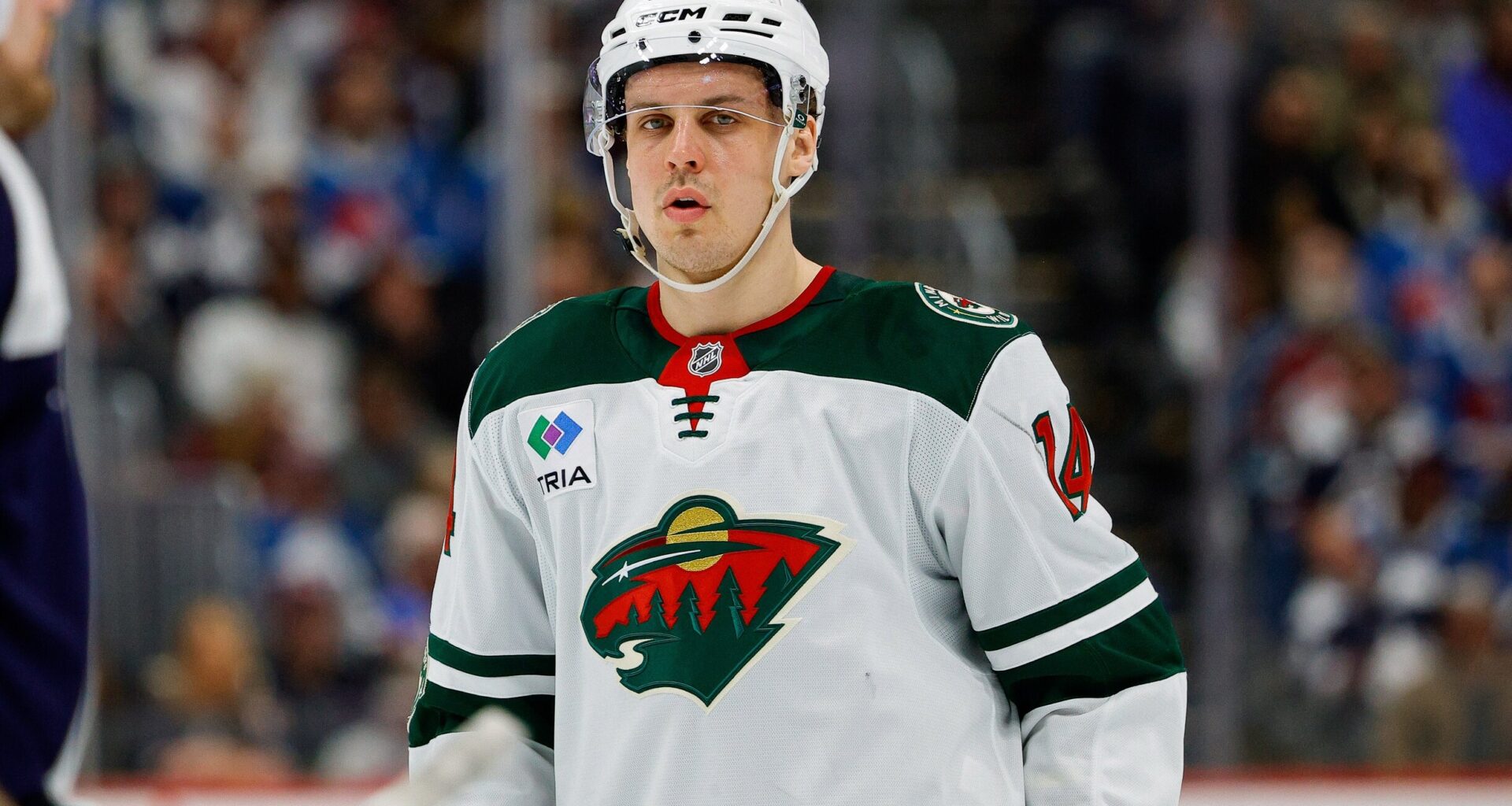
Bill Guerin has been forthright in saying he’s trying to add a No. 1 center, so naturally there’s a lot of speculation about who the Minnesota Wild are targeting. While bringing in a new player will be exciting, it’s also vital to examine the other part of those transactions.
What the Wild will have to give up.
To get something of value, Minnesota will have to give something of value up. That’s an unfortunate reality of trading for star players. Still, the team must ensure they don’t go too far. Joel Eriksson Ek is one name that’s been floated as a potential asset in a trade for a No. 1 center. However, the Wild would be giving up too much by moving him.
Michael Russo recently brought up Eriksson Ek’s name in an Athletic Q&A article, where a fan asked which Wild forward could be part of a package for a No. 1 center. Russo mentioned Eriksson Ek as a player he doesn’t want to see traded, but Minnesota could move him given his limited trade protection and evident value.
While Russo specifically stated that Eriksson Ek is a player he hopes isn’t leaving, even mentioning his name means it isn’t entirely out of the question. However, before the Wild consider moving him, they should realize that they’d be making a decision that causes far too much damage to be worth it.
Before diving into why trading Eriksson Ek is a bad idea for the Wild, given their current roster construction, it’s important to highlight that trading a player of Eriksson Ek’s quality is hard to swallow, no matter the context.
Eriksson Ek is a stalwart two-way center who has been a valuable player for years. He regularly receives Selke votes as one of the best defensive forwards in the league, puts up solid possession stats (career 51.8 Fenwick-for rating), and is an offensive contributor with 350 points in 614 career games.
While trading a player like Eriksson Ek is rarely a good idea, it would be especially unwise for Minnesota right now.
To get to the core of why trading Eriksson Ek would be a major problem, let’s recontextualize the Wild’s current need for a center. The narrative is that the Wild need the true impact of a No. 1 center. Instead, think of it this way: Minnesota needs that player to address its center depth.
To see how this played out, look no further than when Eriksson Ek suffered an injury in the playoffs. The two-way centerman didn’t play in the second-round series, and the team was forced to play with centers like Ryan Hartman and Danila Yurov in their top six.
Those are both effective players, but it’s a huge disadvantage to use them that heavily against the best teams in the league, who are often built with center depth in mind.
The lesson from Eriksson Ek’s playoff absence wasn’t that Minnesota needed a better first-line center. It’s that Minnesota lacked enough quality centers to absorb the loss of one. Trading Eriksson Ek to acquire another center leaves the organization with the same problem.
While the Wild need depth to cover for injuries, even with a healthy lineup, the team would benefit from greater center depth. Strength at the center position has been vital for recent cup-winning teams.
The Florida Panthers won the last two Stanley Cups with a battery that included Aleksander Barkov (a multi-time Selke Award winner), Sam Bennett (the Conn Smythe Award winner in 2024-25) and Anton Lundell (a Selke Award vote-getter).
Similarly, the Tampa Bay Lightning won back-to-back Cups with Olympians Brayden Point and Anthony Cirelli. The Vegas Golden Knights won the Stanley Cup in the 2022-23 season. That season, they had three centers – Jack Eichel, Chandler Stephenson and William Karlsson – who received votes for individual NHL awards and scored more than 50 points.
That’s just a cursory glance, but it’s clear that the league’s best teams generally employ more than one standout centerman. To join that echelon of teams, the Wild need more than just one top center. They need center depth, which they lose if they trade Eriksson Ek.
Eriksson Ek seems to profile very well as a secondary centerman on a winning team. Eriksson Ek is a tenacious defender and play-driver who can chip in offensively when needed. He may not be the team’s superstar, but that profile still carries significant value. He’s a fairly strong comparison for defensive specialist depth centers that have hoisted the Cup in recent years, like Nazem Kadri, Chandler Stephenson and Anthony Cirelli.
One may argue it could be necessary to trade Eriksson Ek if the package is worth it, but the names that are being discussed seem too risky to give up a player of that value. Minnesota has already been linked to Mathew Barzal and Dylan Larkin. Those are both great players, but questions remain as to whether they’re true top centers for a contending team.
The value in a Larkin or Barzal comes from teaming them up with another strong centerman – Eriksson Ek in this case – to form a strong duo at the top of the lineup.
Minnesota also has to be careful in this transaction and in all future hypothetical transactions, because it’s running out of assets. For better (the Quinn Hughes trade) or worse (the David Jiříček acquisition), the Wild have spent the last several seasons unloading future assets to open their Stanley Cup window.
The Wild still need to improve their roster, but they’re running out of prospects and draft capital. If Minnesota trades Joel Eriksson Ek and other assets for a center now, the team will have even fewer chances to address other areas of need as they arise.
That leaves Bill Guerin in a situation where he must acquire an impact center but cannot afford to overpay. Getting that piece of business done quickly may be enticing, but Minnesota must be careful not to further damage the real problem: the team’s center depth. Trading Joel Eriksson Ek could be taking one step forward and two steps back.