
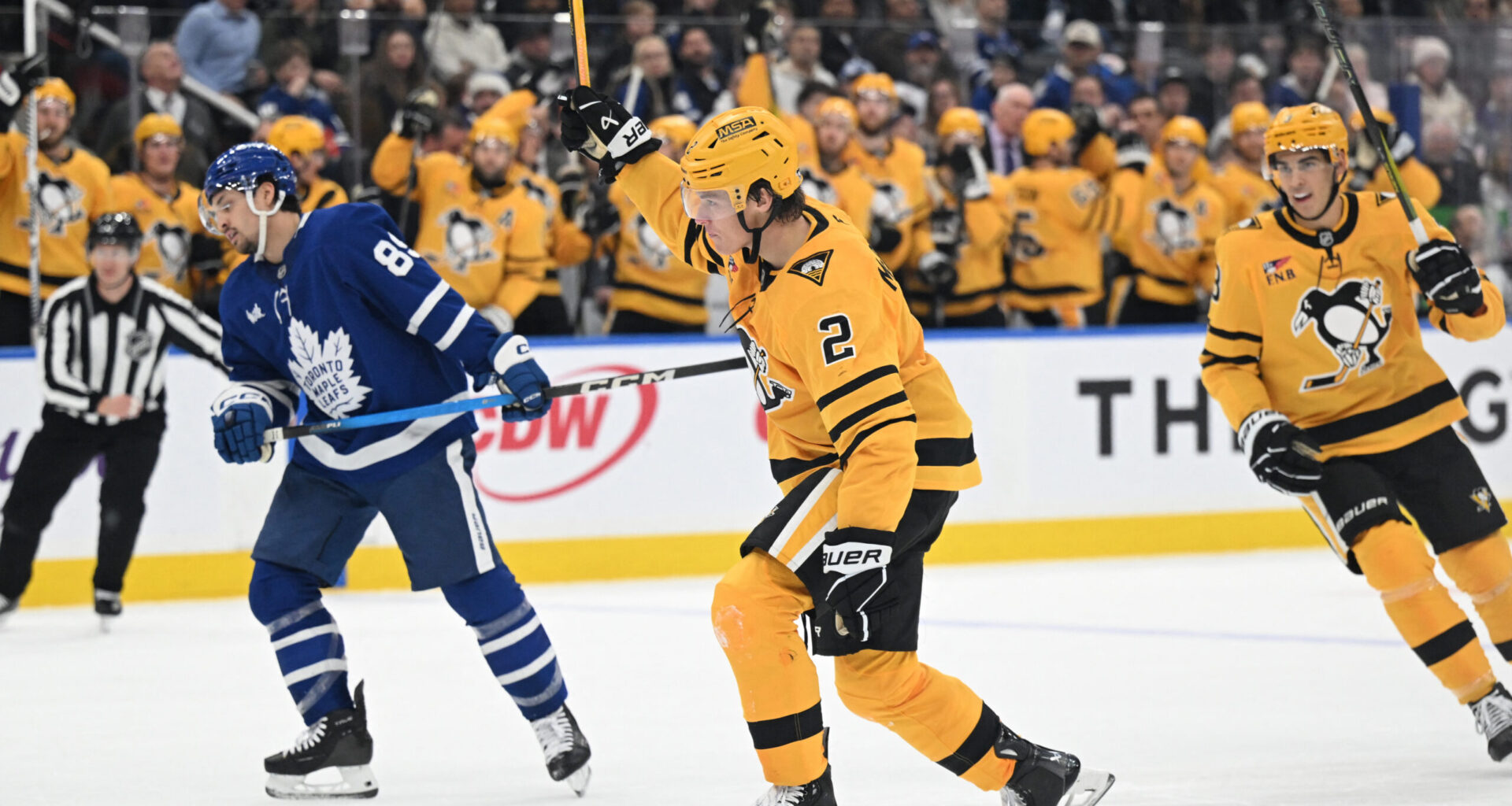
The Pittsburgh Penguins’ youth movement this season ended with oddly little youth. And the young players who hoped to play in the NHL were angry, not with the organization, but with themselves.
Through the course of the 2025-26 NHL season, the Penguins deployed 12 rookies in their lineup, from Tristan Broz who played just one game to Ben Kindel who played 77. Despite the highway of opportunities large and small for young players to stick in the NHL lineup, only Kindel and rookie Arturs Silovs ran the gauntlet and lasted throughout the season.
There were five rookies who had extended looks or would have had those looks. Technically, Filip Hallander also counts as a rookie but his season ended early when blood clot issues forced him to halt his season in November, and Broz’s remarkably timed bad luck continued as his turn was skipped for the second consecutive season due to his own injuries, which seem to occur just before he’s needed in the NHL.
Even if the players didn’t necessarily understand the depth of their emotions Monday as they cleaned out the locker room in Wilkes-Barre, intrinsically, a piece of the hunger that fueled the Wilkes-Barre/Scranton Penguins’ playoff run to the Eastern Conference Final was about those players who failed to stick in the NHL fighting to prove themselves.
And when it was done, the reactions of several of the senior prospects were superficially different, but shared a common core of frustration with not only their playoff loss but their setbacks in sticking at the highest level.
Rookies Report Card
For the purpose of this report card, we’ll also include the prospects’ time in Wilkes-Barre and their development from the beginning of the season to the end.
Rutger McGroarty: C, Ready
The Penguins are waiting patiently for McGroarty to arrive. Following the ECF loss, he was one of the players able to muster a smile the following day during exit interviews. In total, McGroarty played in 37 NHL games this season, but his lack of production earned him a drive back up I-80 to Wilkes-Barre in March.
He knew why, too.
“I think this was a year of learning, and I think that being between two teams, kind of having two different roles, helped me a lot mentally, on and off the ice,” McGroarty said Tuesday. “I think just growing, going through those growing pains of going up and down, playing well here, maybe playing well there, not producing, or playing well here and not producing, just there are a lot of different things that went into this year, and I definitely took a lot from this year.
In the playoffs, McGroarty was able to increase his offensive output from chances to goals, and notched a six-game points streak, which extended into the ECF. He was served a giant slice of humble pie with his last demotion later in the season, and it took a minute or two for him to regroup. Most importantly, he ended the season with a sharp clarity of what it will take to stay in the NHL.
“I would just say consistency. I think that bringing it, I know I bring it every day, but the execution every day,” said McGroarty. “I think that execution is the biggest thing in pro hockey, and I think that being able to execute the little plays (like) the stick on puck, just the small details that the normal person might not see, add up to huge things.”
Reason for the grade: McGroarty played well enough to stay in the NHL on a rebuilding team, but didn’t produce enough offensively to stay with a team fighting for a playoff spot. He kills penalties, is a decent playmaker, and has the ingredients of a power forward. It’s a C because he didn’t stick, but a solid grade for a player who has not wasted his time in Wilkes-Barre or sulked.
Projection: The NHL all season. He might only slot as a fourth-liner to start next year, but he’s good enough to stay and to elevate in the lineup.
Owen Pickering: C+, Improving
Pickering’s grade might appear to be a couple of letter grades too high. He lasted only four games in the NHL this season, struggled in the AHL after his demotion following training camp, and suffered some doubts after his demotion at mid-season.
Yet in the late season push, perhaps for the first time, Pickering looked it all clicked. Make no mistake, he looked very good in the first part of his NHL tryout in 2024-25 before fading a bit at the end, but the end of the 2025-26 season was his best hockey.
That’s the good news and perhaps Pickering will appreciate that in the coming weeks, but like the rest, he too was wearing the disappointments, too.
“I mean, it’s obviously tough to kind of step back right now. I feel like the back half of the year was pretty good for me, and what I kind of had to do in the playoffs, personally. I feel like I was playing pretty well,” Pickering said sullenly. “There are always things you can get better at. Keep pushing myself, but I think given time to kind of let it settle a little bit, I’ll be able to look more on how the year was and kind of reflect a little more.”
Reason for the grade: So, why a C+? Because in academic terms, Pickering aced the final exam. He put it all together to become the team’s bedrock defenseman. Harrison Brunicke took over a No. 1 D-man’s role with huge minutes and points, but Pickering was the shutdown defenseman playing big minutes in all situations, and did so very well.
“Like, honestly, from knowing Pick now for two years, from where he was when I saw him in Buffalo in 2024 to right now, he’s grown by leaps and bounds,” MacDonald said. “I know everybody (thinks) he has to be in the NHL tomorrow, but I think he’s gotten a lot better. He’s going in the right direction. I think he’s going to get there.”
Projection: From his draft day, Pickering was a project. His rapid growth spurt that began at 15 didn’t end until he was about 19. He’s only played two seasons in the AHL and for a raw defenseman, that’s not uncommon or disappointing. Sometimes it seems the organization has been down on him, but his play at the end of the year, as well as playing in playoff games despite still needing a walking boot at exit interviews, should shine a bright light on the lefty defenseman. He may not make the team out of training camp in the fall, but he’ll be up to Pittsburgh sooner than later, and we bet he sticks around.
Tristan Broz: B-
Broz, 23, has achieved some success (NCAA national championship), suffered injuries at the worst moments, shown real growth, and a visible dogged intensity.
In his first pro year, mononucleosis wiped him out for about half the season. Even when he returned, he was depleted and had to rebuild. He wasn’t available when the Penguins needed a center. This season, he was pushing toward an NHL spot, got a call-up, played one game which went OK (he made a defensive mistake that led to a crucial goal against), watched a couple of games and was returned.
Later this season, when both Sidney Crosby and Blake Lizotte were injured, Broz had already suffered an injury and was again unavailable for his big moment. Dubas admitted that had Broz been healthy, he would have been called up.
Broz is intense. He does not take losing well, and he can be brutally hard on himself. In fact, Broz swatted away a softball question from PHN Monday after exit interviews. This writer asked simply, was there one facet of his game that he was proud to have improved this season?
“Not really, to be honest. I think I honestly fell way short of the expectations that I have for myself, and for a myriad of different reasons. So no, not really,” said a still crestfallen Broz. “I think there’s obviously a lot more work to be done, and I think I got closer to taking it to the place that I want to go, but it wasn’t quite what we needed to have happened.”
His voice trailed off, not finishing his answer, but the sentiment was also still tightly bound in the searing disappointment from the night before.
Indeed, Broz has grown as a player, even if he was still too raw to step back and see it.
Reason for the grade: The best ability is availability, and Broz has missed his chances, but he is learning to play center in the pro game. He spent most of his career at the University of Denver as a bottom-six winger, and his transition to the middle was as much about the organizational need as it was unlocking his game, which also included allowing him to generate more speed.
Projection: He has a bit more work to do because he will not be a No. 1 center in the NHL. He will need to learn the bottom-six role in the NHL, which includes hard defensive work, killing penalties and how to generate offense from that. We’re betting on him to do it by mid-season and to become a mainstay.
“He skates so well. He gets on pucks. I think it’s (about) simplifying his game and (getting) the consistency of playing at a high level, right,” said MacDonald. “Like, in finding a role, understanding he’s probably going to be in a bottom six role at (the NHL) level, to start at least, and embracing that and going out and using what he has, a skating ability.
“He can get on people and check with his feet, and I think he’s done a really good job elevating himself as a penalty killer, and those kinds of things, to give himself an opportunity to just stay. And then at that point, hopefully build some offense into his game at that level.”
Harrison Brunicke: A
Brunicke, 19, is a tale of player development. Perhaps he flew too close to the sun in training camp, and things crashed in the regular season. He was obviously not ready to go past his nine-game NHL tryout in the fall, but the Penguins did everything they could to delay sending him back to Kamloops of the WHL. The organization sent him to WBS for a conditioning assignment, then loaned him to Team Canada for the World Junior Championships before sending him back in mid-January.
Brunicke was ineligible to play in the AHL until after his junior season, but when he returned to Wilkes-Barre/Scranton, he was a changed player. Beast mode, really.
Brunicke looked stronger, more decisive, but also stiff on the puck in the defensive zone. He led the play on the rush and was back on defense to nullify chances.
Reason for the grade and Projection: Because he developed more than any player in the organization and will be in the NHL from the beginning next season. It was impossible to watch the WBS Penguins games and not come to that conclusion. Brunicke left no doubt.
Ville Koivunen: D-
Koivunen, 22, was not able to sustain his growth that brought him to the NHL at the end of the 2024-25 season. Playing beside Sidney Crosby, Koivunen notched seven assists in eight games.
However, he admittedly did not work hard enough over the summer. In fact, the winger told PHN that he thought he did, only to find out how much more work is required for the NHL players, and quickly realized he was not ready. After just two games at the start of the season, the team returned him to WBS.
Koivunen kept working, both on the ice and in the weight room in Wilkes-Barre. Unmistakably, he is an agitating, pot stirring, irritating winger with some offensive pop and exceptional playmaking skills. But another problem arose at the NHL level: confidence.
Koivunen also admitted to PHN that his game changes in the NHL because he didn’t feel he was able to be an agitator or as physical.
“It feels like if you don’t do it enough first, then it’s like no one cares. What are you gonna say there?” Koivunen said in February. “So first, you have to be better on the ice and stuff, and then maybe you can start doing that more.”
Reason for the grade: In 39 NHL games, Koivunen tallied just seven points, with two goals. He played well is spurts, but disappeared for others. The physicality and infuriating play were not there, and that took him out of his game, also adversely affecting his offensive output.
Perhaps no player had a shorter runway to the Penguins lineup than Koivunen, but it all went sideways.
Projection: It’s entirely up to the smiley Finnish kid who is terminably likable. By all accounts, he is eager to get a second chance at a strong summer. From there, he will have to throw caution to the wind and be the player MacDonald lovingly referred to as, “a prick.” When Koivunen is physically engaged in the game, he won’t disappear, and the belief is that his offensive production will reappear.
But if he doesn’t do all of that, then he will quickly find himself in that 4A role, forever a fan favorite in Wilkes-Barre.
Tags: harrison brunicke Owen Pickering Pittsburgh Penguins rutger mcgraorty Tristan broz Ville Koivunen
Categorized:Penguins Prospects Penguins Report Card