
The NHL is a copycat league, or at least that’s what all the talking heads around the game of hockey tell us. Whoever wins the Stanley Cup instantly becomes the template for every other franchise to use for their own advancement. This is something us Devils fans know all too well, as while it’s never been fully confirmed, it seems pretty safe to say at this point that former general manager Tom Fitzgerald chased grit and physicality after two specific things happened in 2024. First, the Devils had a woefully disappointing 2023-24 season in which they missed the playoffs the season after setting a franchise record in points and winning a playoff round. And second, the Florida Panthers, one year after marching all the way to the Stanley Cup Final but falling short against the Vegas Golden Knights, got over the hump and won a title of their own a couple months after New Jersey wrapped up their miserable campaign.
Now, chasing elements such as grit and physicality is not inherently a bad thing. But the problem was that Fitzgerald took his team in that direction at the expense of other key traits, such as speed and skill. The Devils got traditionally “tougher to play against”, except the scoreboard often indicated that they were not, in fact, tougher to play against. But Fitzgerald saw the Panthers reach soaring heights playing an extremely physical and aggressive style of hockey with players that were big and strong and mean (and, let’s be honest, dirty), and decided that his own team needed to just copy that. After all, if the champs are doing it, then it must be the correct way, right?
Well the Tampa Bay Lightning and Colorado Avalanche played an entirely different style than the Panthers, and they combined to win three straight Cups from 2020-2022. It’s not like those teams completely lacked toughness and physicality, it’s just that those were secondary elements to their more important traits like speed and skill. It seemed as though the Devils started to copy that identity for a bit, culminating in that magical 2022-23 campaign in which New Jersey bludgeoned teams with a high-octane attack, then pulled the plug after Vegas and Florida made grittier hockey sexy again.
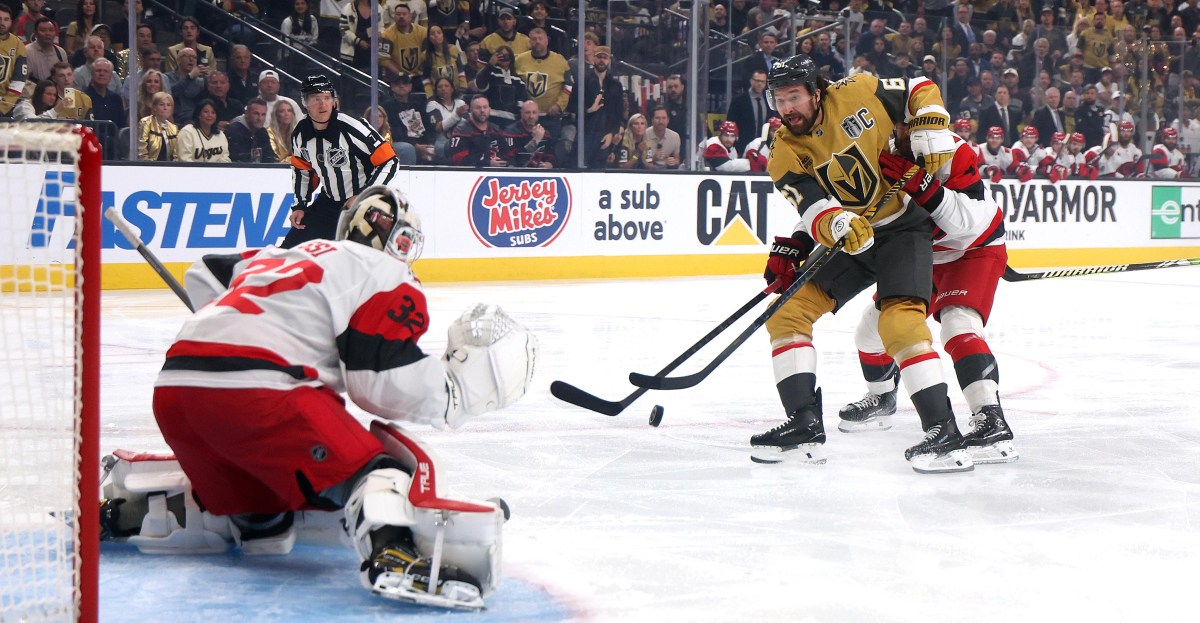
The thing is, there are always lessons to be learned from the most successful teams in the league. It’s just that I don’t think “simplistically copy whatever the most recent champion did” is a good lesson. Take this year’s Stanley Cup Final. There are absolutely a lot of things New Jersey can learn from Vegas and Carolina, without resorting to superficial duplication. So what exactly are those lessons? Let’s run through a few of them today and see if we might be able to find a winning formula that new general manager Sunny Mehta can implement.
As alluded to above, there is more than one way to skin a cat. I’ve said it before and I’ll say it again: You can win a track meet like the Lightning or Avalanche, or a bar fight like the Golden Knights or Panthers, so long as you go all in on whatever identity you want to commit to.
Perhaps an example of the exact opposite would help illustrate the point. Look at a team like the Toronto Maple Leafs. In their “Core Four” era, where they featured genuinely incredible star power in the form of Auston Matthews, Mitch Marner, John Tavares, and William Nylander (to say nothing of Morgan Reilly on the blueline), the Leafs’ top six and top pair generally played a style of game that emphasized their speed and skill. But after constant playoff failures to the likes of the Bruins and Lightning, Toronto decided that what they needed was, you guessed it, more sandpaper. What they ended up with was a mismatched roster, where the top forwards and defensemen played one way, and the bottom of the lineup played another.
Perhaps you disagree, but I’m convinced that this two-faced identity went a long way toward making the Leafs a worse team. There’s being versatile and well-rounded, and there’s becoming less than the sum of your parts. To me, Toronto fell firmly into the latter camp.
There is perhaps no better example in the NHL of committing to an identity and trusting it than the Carolina Hurricanes. Rod Brind’Amour’s system that emphasizes a heavy forecheck, relentless puck pressure, and shots from all angles, is unique. It’s also highly effective, as they’ve experienced some amazing success since the pandemic. It’s true that they haven’t been able to climb over the Conference Final wall until this season, but I believe that was mostly due to their lack of star power (put a pin in that for now), not their specific system. The front office only brings in players who they believe can fit Brind’Amour’s system, and in turn, those players give their coach complete buy-in up and down the roster. If the Maple Leafs were less than the sum of their parts, the Hurricanes are much greater than the sum of theirs. It doesn’t matter if your identity is speed and skill or grit and toughness. The important thing is to go all-in an whatever it is you choose to do, no half measures like the Maple Leafs. Having a holistic vision for your team can go a long way.
Depth, Specifically Center Depth, Wins
That being said, we can talk all we want about if grit and physicality is better than speed and skill, the value of identity, and so on. But at the end of the day, you know what’s even more important than all of that?
Just having a bunch of really good players.
It really is that simple. If you have a team with a cohesive identity, but all the players stink, you’re not going anywhere. Looking at the Golden Knights and Hurricanes, they just have a bunch of really good players. This is why I wanted you to put a pin in Carolina’s lack of star power over the years. Their commitment to their identity took them pretty far over the years, but adding more talent is what got them over the top. Their free agency signing of Nikolaj Ehlers last summer has paid huge dividends this season. So has their roundabout acquisition of Logan Stankoven. Meanwhile the Golden Knights are the poster children for bringing in more talent (hey look at that, something else I want you to put a pin in for now). From Mark Stone to Mitch Marner, Vegas has a lengthy history of infusing the roster with so much talent. Their identity helps them win, but so does the incredible amount of talent up and down the roster.
And while we’re talking about having depth of talent, I should mention that center depth specifically is probably the most important thing to have. We’ve seen this from every past champion since the pandemic, and it’s true in this Final as well. Vegas has frankly ludicrous center depth in Jack Eichel, Tomas Hertl, and William Karlsson. Carolina moved Stankoven to center this season and watched him blossom behind Sebastian Aho and in front of Jordan Staal. Center depth is crucial.
But center depth alone isn’t enough. Vegas has ridiculous depth on the wing. Carolina is absolutely loaded on the blue line. Again, it really is as simple as just have really good players. Be smart about player acquisition, invest in player development, and reap the rewards.
The Vegas Golden Knights have made a complete mockery of the salary cap in their brief history. They acquire every star player that’s anywhere close to available, and they somehow always find a way to fit their roster under the salary cap. They’re ruthless about it too, willing to ship out longtime players and make cruel and, frankly, unethical decisions, all in the name of winning hockey games.
While I certainly don’t endorse the lack of morality that Vegas tends to operate with, especially since I think teams can be bold without being bad people about it, I do admire their willingness to take big time swings. The Lightning and Avalanche rode bold decisions to glory, the Knights took their turn in 2023, the Panthers were next up the last two years, and now Vegas has a chance to do it again. If they win the Cup this year, it will be in large part thanks to their willingness to take risks. How many times over the years did we lament how Tom Fitzgerald was seemingly too scared to make any sort of bold move? The man was scared of his own shadow and stuck in the traditional “Hockey Man” way of thinking, and it cost this franchise prime years of contention.
Meanwhile the Hurricanes aren’t as ruthless and they’re not quite as bold, but I actually think we have evidence that they learned this lesson as well. After years of being patient and trusting the process, they finally decided to take some big swings last year. Remember, before Mikko Rantanen made his way to the Dallas Stars, it was the Hurricanes who traded for him first, shipping Martin Necas to Colorado. When Rantanen made it clear to Carolina that they were not a desirable destination for him long term, they doubled down on the boldness and sent Rantanen right back out of town for Stankoven. Then last summer, they made their first major free agent signing in years, reeling in the biggest fish on the market in Ehlers. Carolina recognized they had plateaued and needed some more star power. They took bold action to accomplish just that.
Goaltending Really Is Voodoo
Yes, sometimes you need a star like Andrei Vasilevskiy or Sergei Bobrovsky to help you win a Cup. But sometimes all it takes is a goalie like Darcy Kuemper (with a little Pavel Francouz sprinkled in), Adin Hill, Frederik Andersen, Brandon Bussi, or Carter “No means no” Hart getting hot at just the right time.
Take this year for example. Andersen has been an erratic goaltender over the years. During his time in Carolina, he’s experienced magnificent highs and cratering lows. Injuries have played a role in that, which is part of why he’s never reached the level of star goaltender. And in fact, while he was playing lights out prior to the Cup Final, he’s struggled mightily in this series. So much so that the net now belongs to Brandon Bussi, who the Hurricanes essentially picked up off the couch prior to the season.
(As a quick aside, let me just say that it is very possible that the sudden and unexpected passing of Claude Lemieux, Andersen’s agent, has a lot to do with his struggles in the Stanley Cup Final. I certainly don’t mean to be cruel and unreasonable in my criticisms of Andersen, and I absolutely hope he gets whatever love and support and help he might need in such a difficult time.)
On the other side, Vegas was having all sorts of goaltending trouble during their season between Adin Hill and old friend Akira Schmid. So in their desperation, they turned to the recently reinstated Hart to help stabilize things. He actually didn’t really do that in the regular season, putting up a terrible .891 save percentage in 18 games. But in the first three rounds of the postseason, Hart was a big reason why Vegas made it to the final round. Now, it’s true that he’s completely embarrassed himself in this round, becoming the first goalie EVER to concede four or more goals in the first five games of a Stanley Cup Final. But he held it together long enough for Vegas to make it here.
Andersen is an up-and-down veteran. Bussi went from the couch to the crease. Hart went from the courtroom to the crease. None of these players are a star goaltender.
So what’s the lesson here? Part of it is that star goalies are hard to come by, and even some of those stars (looks in the general direction of Winnipeg) are notoriously unreliable in the postseason. And part of it is that sometimes, goalie magic can happen out of nowhere. So while I certainly don’t think it’s a bad idea to try and find upgrades in net, I think the Devils might be better off strengthening the team in front of the net and just try to find goalies who have the potential to put together a few strong weeks.
Final Thoughts And Your Take
These certainly aren’t all the non-copycat lessons the New Jersey Devils can learn from this year’s Cup finalists, but they’re the most prominent ones that come to mind for me as I watch Vegas and Carolina engage in an all-time classic series. You don’t need to emulate a championship team perfectly in order to win. But you do need to take some lessons from the more successful franchises. Who knows if Sunny Mehta will actually implement any of these lessons, but if he does, he’ll have at least one person singing his praises in me.
What do you make of these lessons? What do you agree or disagree with? What other lessons would you add to this list? As always, thanks for reading!