
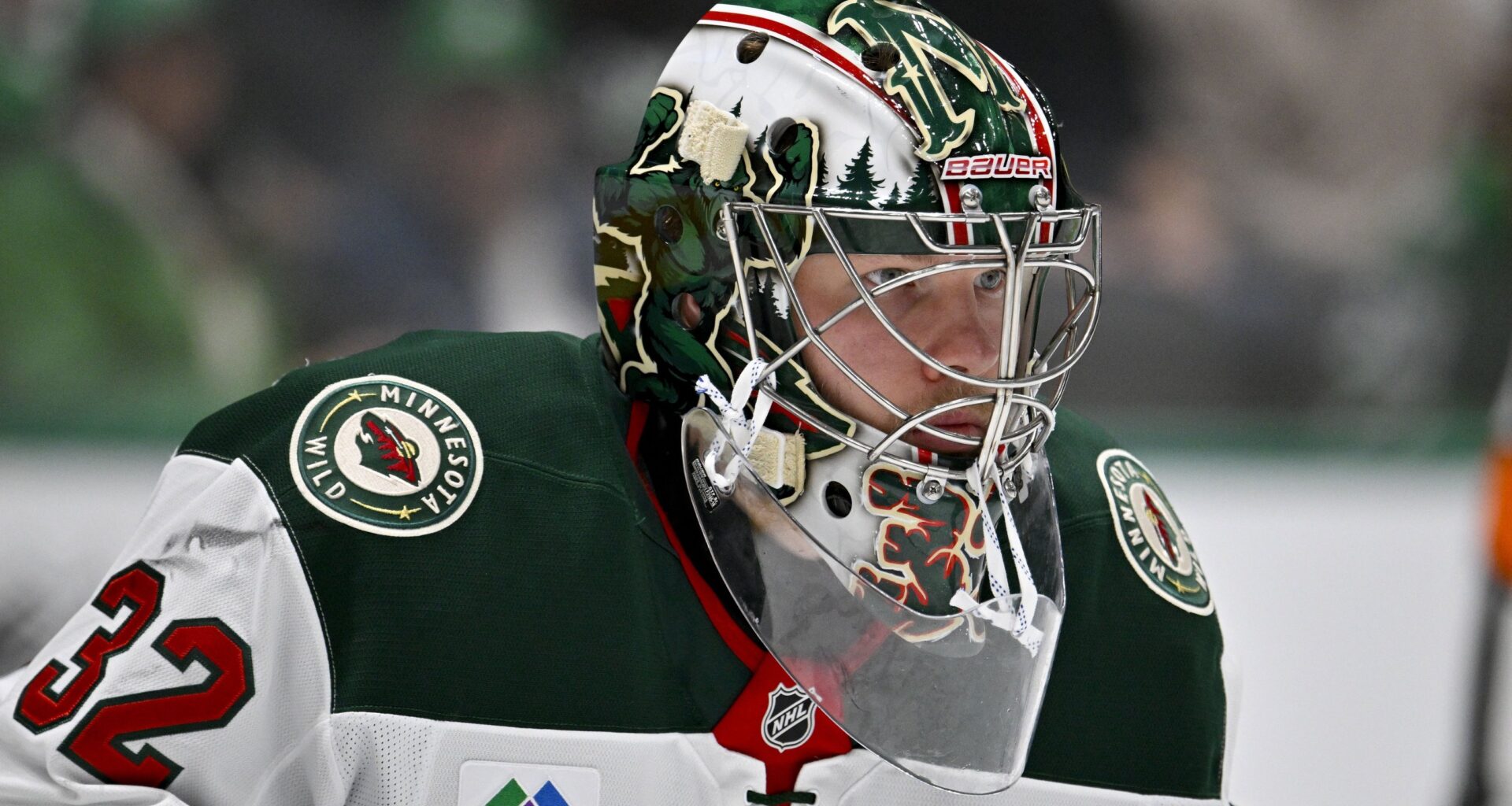
While Minnesota Wild fans waited with bated breath for Game 4 of the playoffs, they apparently decided that there wasn’t enough to complain about. Well, good thing The Athletic published a bullet point in one of their articles that spurred on an entire morning’s worth of idiotic discourse.

Wait, What Happened?
Nothing happened, really. But Filip Gustavsson was asked for an interview, and he “respectfully declined, saying, ‘Talk to the players who are playing.’”
That seems simple on the surface, right?
But no, Minnesota fans needed to try to read subtext into a sentence that didn’t need any. Immediately, speculation ran rampant about how Gustavsson was bitter and should be traded.
Well, What Did He Mean Then?
Almost always, Gustavsson says what he means. He doesn’t sugarcoat things, and he can be incredibly blunt. So when he said to “talk to the players who are playing,” it’s more likely that he meant “the story is on the ice, not the bench.”
The reporter who asked the question even confirmed that he took the statement to mean just that. The important things are happening on the ice, and the focus should be there.
Fans also need to keep in mind that while Gustavsson speaks great English, it isn’t his first language. He may not be as blunt in his natural Swedish, but that’s just how he speaks in English. In fact, that’s how almost all of our Swedish players speak.
Listen to Jonas Brodin, Joel Eriksson Ek, or Jesper Wallstedt speak, and they are all just as blunt. Perhaps this is just how Swedish people communicate in English and isn’t a big “there must be more behind the statement” type of puzzle.
But What About Cam Talbot?
Listen, I understand why Cam Talbot earned a few strays in this whole thing. I was very present for the entire “Bring in Marc-Andre Fleury, Push Cam Talbot to the Back, Talbot Complains and Gets Traded” saga. But Gustavsson is not Talbot, and these situations are not similar.
Gustavsson has always been very aware that his role as a starting goalie has been a fluke of his own making. When Minnesota traded for him, he came in with a bad record from a team that didn’t invest in him as it should have. The Wild saw the potential, but even they were surprised at what came.
When he came to Minnesota, the Wild had already drafted Wallstedt. As a fellow Swedish goalie, there is no way that Gustavsson didn’t know that Wallstedt had been drafted as the future franchise goalie.
That’s why Minnesota chose him, and that has been his future from the moment it was announced. In fact, that seems to be part of why the Minnesota two-goalie solution works so well. Gustavsson knows that Wallstedt is the franchise’s future, while Wallstedt fully understands that Gustavsson is older and more experienced. They have both been able to depend on each other.
When the Cam Talbot situation went down, it seemed from the outside that he was a bit blindsided by the entire situation. Talbot went from starting goalie to backup with no warning, and he did not handle it well.
After the playoffs, when he was seemingly sacrificed on the altar of the St. Louis Blues, his wife was a bit snarky on social media toward the franchise, making it abundantly clear that the Talbot family was unhappy with the team. In return, the team decided to trade him for a then-unknown Gustavsson.
He Could’ve Just Answered
Sure, Gustavsson could’ve. But he didn’t want to, and he doesn’t have to. He’s probably feeling a bit disappointed, as anyone would. But right now, he has to focus on keeping his mental health in check because, as the playoff run gets deeper, Gustavsson will need to get back into the net, and he will need to be able to put his slump behind him. Dredging up his feelings about it right this minute would not be helpful.
A few people have chastised the reporter for asking Gustavsson the question, but there’s nothing wrong with asking. And Gustavsson had every right to refuse.
So, Should We Be Worried?
No. Is it bad to have two goalies who can be trusted to carry this team? Is it bad to have goalies who can balance each other out through their slumps? Is it bad to have players who understand their mental health is important and take steps to maintain it? Is it bad to ride the hot goalie during the playoffs? Is it bad to have goalies who seem to truly care about each other and depend on each other?
Obviously, the answer to all of these questions is no.
I can’t see the future, but it seems unlikely that the Wild would trade Gustavsson for respectfully turning down an interview. It also seems unlikely that a goalie who has been through ups and downs, but always maintained a humble personality, would suddenly decide that he wants to be a diva about something that he’s dealt with his entire career.
So instead of trying to read into a very surface-level statement by a beloved goalie, let’s focus on how good the Wild played during that series-tying game on Saturday.