
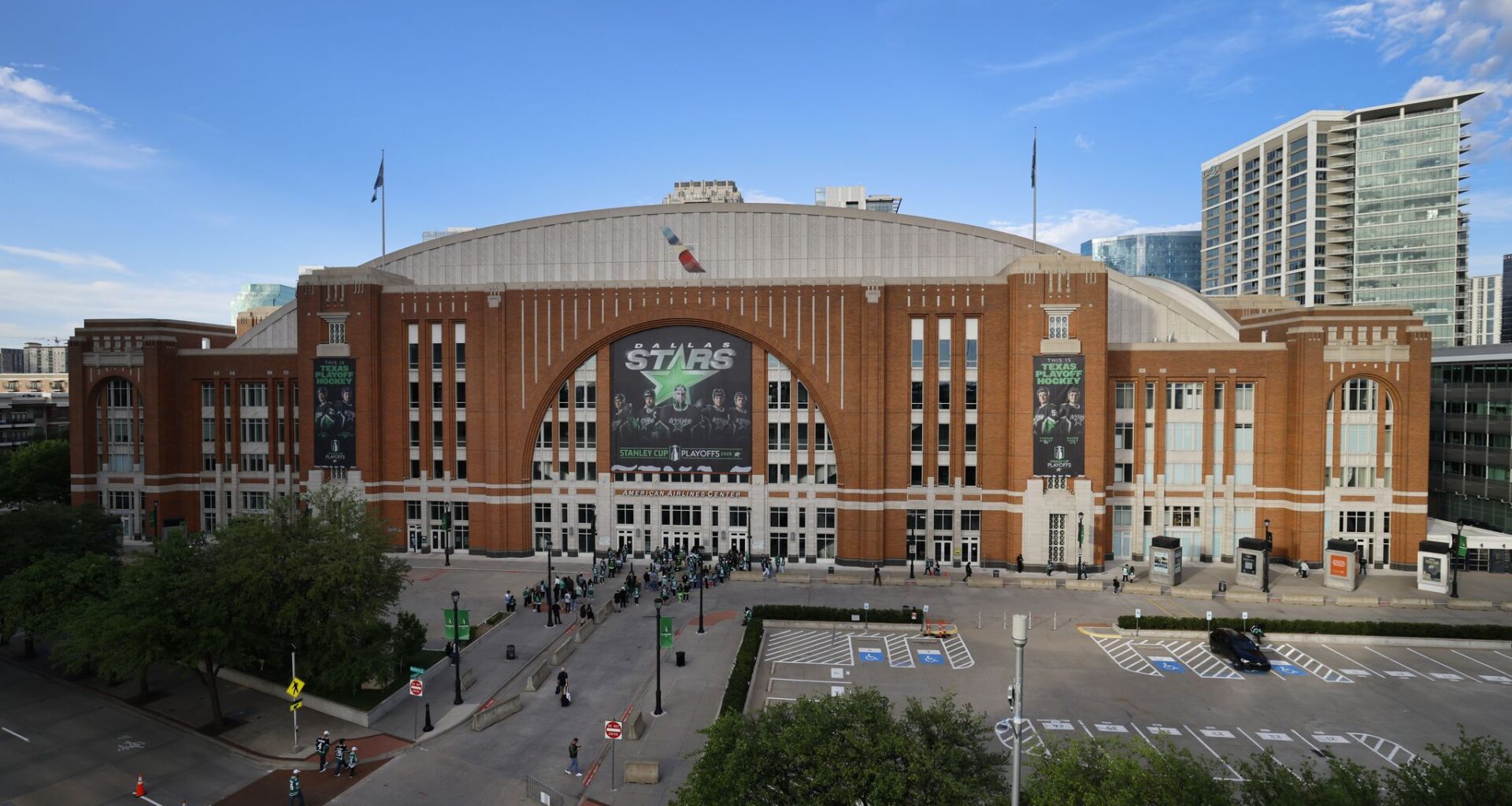
An exterior view of the American Airlines Center in Dallas before a Stars playoff game.
Tom Fox/The Dallas Morning News
The Dallas Mavericks and Dallas Stars haven’t agreed on much in recent months, but they agree on this: American Airlines Center is outdated.

The Mavericks have decided on Valley View as the site for a new arena and entertainment district. The Stars have also made their decision, choosing to build their new arena and mixed-use development in Plano.
Dallas Mavericks fans celebrate a basket by guard Luka Doncic during the second half of a victory over the LA Clippers in 2021 in Dallas.
Smiley N. Pool/Staff Photographer
It begs the question: How can an arena become obsolete in just 25 years?
Article continues below this ad
Stadium experts say the answer reflects a larger industry trend and has as much to do with societal changes as it does with business. As tech advancements accelerate and expectations of modern-day sports fans evolve, the life span of many arenas is increasingly shorter.
“It seems like the life cycle of a stadium or arena is moving towards 20 to 25 years,” Craig Sloan, the CEO of Playfly Sports, which has worked on numerous stadium projects and mixed-use development districts, told The Dallas Morning News.
Franchises are striving to create in-venue fan experiences that rival at-home viewing experiences, which have never been more convenient and sophisticated. Modern-day fans, particularly from the Gen Z demographic, are not merely looking to go watch a game, they are in search of a social experience. And teams are looking to bolster their revenue by tapping into dollars from mixed-use districts, which surround arenas with 365-day-a-year entertainment options.
Mark Williams is partner and executive vice president at Dallas-based HKS, which designed prominent stadiums like AT&T Stadium and Los Angeles’ SoFi Stadium, among many others. While times and technology have evolved, the arena remains a coveted destination, one where the transformation of the fan experience requires a transformation of the venue itself.
Article continues below this ad
“It’s still the buildings that people want to be in more than any other building,” Williams told The News. “And the sophistication and diversity of what we want, what we want to see, what we want to have access to, and what information we want to have is just layered on top of that. It’s been that way since the Roman Coliseum. … These buildings are magnets for people.”
Teams are reimagining arena configurations to keep pace with changing habits of their fans. But as the Stars and Mavs plan to build “next generation” arenas, what does that look like, and why couldn’t the American Airlines Center meet those demands?
“I think if Dallas had it all to go over again, I think there might have been a little bit of a different approach on American Airlines Center,” Mavericks CEO Rick Welts said in recent weeks. “It does not serve … the needs or the expectations of a sports fan in 2026 who goes to a professional sporting event. We don’t have any of the hospitality amenities [high-class food and beverage and social areas] that one would expect in other markets, and I think we’re really looking forward to that.”
The Mavericks on Monday signed option agreements to purchase approximately 104 acres of the former Valley View Mall site in northern Dallas where they plan to build their new home to move into when their lease with the American Airlines Center expires in 2031.
The Stars, who have called Dallas home since 1993 and have played at American Airlines Center since it opened in 2001, have decided to build an arena at The Shops at Willow Bend Mall in Plano, expected to open in 2031 as well.
Article continues below this ad
The Stars announced Tuesday they have signed a nonbinding letter of intent to build an arena and entertainment district at the Willow Bend site. The letter was submitted to the Plano City Council and placed on the agenda for a vote during Monday’s meeting. The council will vote on a landmark agreement to help fund and incentivize the Stars’ planned move to a new billion-dollar arena and entertainment district.
The joint moves by the longtime cotenants will leave downtown Dallas without a major professional sports team and American Airlines Center without a primary tenant. In the arena world, the winds of change are strong — and, in many respects in the eyes of industry experts, American Airlines Center is already old news.
Brad Alberts, president and CEO of the Stars, told The News months ago that, barring unforeseen, wholesale renovations that would cost in excess of a half-billion dollars, the Stars needed to build anew or be left behind.
“If we’re going to stay in a hockey-only arena [when the Dallas Mavericks leave when the AAC lease expires in 2031], you’ve got to significantly reimagine that arena,” Alberts said. “You’ve got to be prepared to position this arena for the future, not where it’s been — and that’s going to take a significant financial investment in order to do that.”
Bob Heere, a University of North Texas professor of sports management and director of UNT Sports Innovation Space, said consumer habits and advancing technology have rendered AAC outdated since it opened in 2001.
Article continues below this ad
“American Airlines Center is beautiful, it’s historic, but it’s very limited in meeting the demands of the 21st century,” Heere said. “I understand that even if [the Stars] would be the sole operator of the building, that does not solve all their challenges, because it’s still a somewhat outdated facility that doesn’t meet all consumer demands.”
Dallas Mavericks fans cheer during an NBA first round playoff basketball game in 2022 in Dallas.
Smiley N. Pool/Staff Photographer
An industry ‘bullrush’ to premium seating
Deron Nardo is a Philadelphia native. His introduction to stadiums involved the now demolished Veterans Stadium, which was distinguished by its unforgiving turf, often unruly fans and cookie-cutter design.
Some 95% of its seats were plastic with the requisite suites layered in, Nardo said. The home of the Philadelphia Phillies and Eagles wasn’t exactly a beacon of architectural or creative brilliance, much less a vibrant social ambiance.
Article continues below this ad
He’s now president and chief commercial officer of 4Topps, a premium seating North Carolina-based company that helps teams and colleges reshape their fans’ stadium experience.
And he’s at the forefront of this industry transformation.
The social media age has placed a premium on venues with areas more conducive to taking aesthetically pleasing and sharable photos. And a new generation of fan has no interest being “stuffed into an 18-inch-wide stadium seat” for three hours, Nardo said.
Premium seating is all the rage in the stadium business. Nardo said there is a “bullrush” toward providing fans more premium seating. In the past, he said, only 7% of a stadium’s seating was considered premium. Now teams look to make 17% to 20% of their seating premium.
In the past, “you had your general seating — upper and lower bowl — welcome to the game,” Sloan said. “Don’t let the door hit you on the way out, right?”
Article continues below this ad
Now, the trend in some NBA arenas is to offer hospitality areas designed more like a resort.
Atlanta’s State Farm Arena, with its chef-driven Hawk Walk Market, and Brooklyn’s Barclays Center, with its Brooklyn Market and popular neighborhood food vendors, have enhanced food hall concepts. Sacramento’s Golden 1 Center and Milwaukee’s Fiserv Center offer standing-room social decks.
Miami’s Kaseya Center offers South Beach-inspired nightlife vibe. State Farm Arena offers the so-called tunnel club called the Players Club: fans standing near the players entering the court, a DJ, an Instagram-friendly setting.
Playfly Sports has served as a commercial advisor and partner for the NHL’s Nashville Predators, assisting with the commercialization and fan experience engineering for major developments and mixed-use spaces connected to the arena. The venue is currently undergoing a $750 million transformation project known as “Smashville’s Next Stage: Broadway 2030.”
With the Mavericks’ new arena, Welts told The News in recent weeks he has lofty ambitions: He wants the franchise to shape both the future of sports and live entertainment in North Texas.
“The best NBA facility that’s ever been created,” Welts said. “To create a facility that will hopefully set a new bar for fan experience as well as player experience.”
Asked again about that grand vision, Welts said, “That’s why I’m here.”
Welts said the new arena will offer the best premium hospitality experiences, including clubs and social venues. He said the current design of American Airlines Center limits those possibilities and does not cater to the expectations of the modern-day fan.
The pursuit of a so-called “next-generation” venue encompasses innovation, technology and enhancing the fan experience, Welts said. Paul Danforth, whose CAA Sports company is working with the Mavericks on the arena project, said Mavericks Governor Patrick Dumont, Welts and team president Ethan Casson want to create one of the league’s best fan experiences in “one of the most luxurious buildings ever built.”
Dallas Mavericks fans wear all blue as they cheer during the first quarter of play against the Los Angeles Lakers in 2011.
Staff Photographer
Young fans seek a communal experience
The goal is to create an experience so alluring that people don’t just want to come — they want to stay.
The focus now, Sloan said, is to entice fans to come earlier and extend their experience. The longer you spend at the venue, the better it is for revenue.
“So how can they program that experience better before and after the game, and rather than have you bleed back out into Dallas or a major city and spend your money elsewhere?” Sloan said. “So everyone’s realizing it, the fans want it because they want to have a curated experience. They want to be in a communal experience, not just during the three-hour event. And the teams want it because they want to obviously extend the revenue possibilities there.”
Heere, the UNT professor, echoed the Stars’ Alberts’ sentiments regarding the AAC’s premium club offerings, saying there are “very few” inside the arena.
“The butts-in-seats [model] is really the 20th-century model,” Heere said. “Now, the younger generation, they don’t want to sit in their seat for three hours. They want a more hospitality-driven experience. So you see that with the new Globe Life Field [in Arlington] being a very good example of it. There’s much more standing — you can see the field from everywhere. You can walk around.
“It’s a party, and there happens to be a game. You see that even in stadium design — it’s changing. So American Airlines Center is a very old-fashioned model. The concourse, they’re completely separated from what’s happening on the [ice or court]. If you get a drink or food, you have no clue what’s going on, other than on these tiny little screens. In new arenas, it’s much more flowing and open and you can grab food without having to miss what’s happening.”
Fan demand exists for more premium seats, Alberts stressed, but what is handcuffing the franchise is the design of American Airlines Center, constructed before in-venue clubs became en vogue.
Across the NHL, the Edmonton Oilers are among the preeminent franchises, replete with high-end club offerings inside their arena, Rogers Place. It offers an array of premium clubs, including CIBC Chairman’s Club, located just outside the Oilers’ locker room, and Sky Lounge, which offers a two-level social ambience.
“There are people, many people, that don’t necessarily want to go and even see the field [or ice], but they want to be on the site, they want to be in the building,” Williams from HKS said.
Williams, whose HKS is working on stadium projects for the Cleveland Browns and Washington Commanders, said he is planning this month to address NFL leaders on a variety of stadium configuration trends related to fan experience innovations.
To address the Stars’ economic pain points, Alberts believes the AAC needed what would have amounted to a full internal makeover rather than upgrades on the margins. Aside from the arena’s outer shell, little would have remained untouched.
Capital One Arena in Washington, D.C, is undergoing a multiyear renovation expected to be completed by 2028. Premium seating will increase from 15% to 30% of total capacity. Some 30 new premium spaces will be added, including a dual-level, 24,000-square-foot club.
The price tag? Approximately $800 million.
New York’s Madison Square Garden, albeit several decades older than AAC, underwent a three-year transformation from 2011 to 2013 to modernize the fabled venue. Among the wholesale changes were the additions of the Delta Sky360 Club, 1879 Club and Madison Club.
That project’s cost: $1 billion.
Under the proposed agreements for the Stars’ potential arena in Plano, the city would own the site and the arena and enter into an initial 30-year lease agreement with the team. The terms are to be negotiated, according to city documents.
The cost of constructing the arena is estimated around $1 billion or more, according to city documents, and the city plans to contribute $700 million in funding through bonds backed by revenue from a tax increment reinvestment zone.
If an arena is not adequately equipped to maximize premium seating, revenue takes a hit.
In American Airlines Center, the Stars significantly lag behind fellow NHL teams in revenue per game from premium seating. Despite the size and affluence of the D-FW market, the Stars rank 29th out of 32 teams, generating $257,000 per game. That’s less than half the league average of $520,000 per game.
“Look, this is an arms race on the revenue side, right?” Sloan said.
The Dallas Stars take the ice against the Minnesota Wild in Game 2 of the first round of NHL playoffs.
Tom Fox/The Dallas Morning News
A Dave & Busters or an arena?
Industry leaders caution that the fan experience pendulum can’t swing too far in the other direction, with some saying that the arena can’t include so many bells and whistles it looks more like a Dave & Busters than a sporting venue.
The broader questions: Is the game still the centerpiece? And should it be?
A balance needs to be struck, industry leaders said, between appealing to the casual fan who craves a more social experience and the long-entrenched fan whose focus is squarely still on the game.
“What’s interesting is every individual conversation we have with teams or schools, there is a line they’re trying to walk,” Nardo, of 4Topps, said. “You don’t want to alienate John Q fan. It’s a delicate balance, for sure.”
There’s no such thing anymore as a typical fan.
Jessi Sanchez, senior vice president of consulting and valuation at Playfly Sports, said when you look at the younger fans in general, the way they consume and become fans is wildly different than the older demographics.
“However, as we’re thinking of building these new venues, all the fan segmentation, you need to make sure you are satisfying your true fan, because they’re the ones willing to come back and invest and be part of the full experience,” he said.
To that point, Sloan said, any bells and whistles are welcomed that enhance the game experience and are not looked on as intrusive. For instance, you can have it sponsored or commercialized, and if it enhances the game experience, it’s looked at favorably.
“But if you make more communal spaces, more interactive, people walk around and you can do more of the hospitality angle,” Heere said. “You can actually approach people. People can approach you. They can walk by your activation booth. They can walk into your hospitality space. There’s a lot more opportunities now to sell assets.”
The Mavs’ new arena is expected to operate about 175 days a year with a variety of events, particularly entertainment and basketball games. Welts expects it to be a prime venue for NCAA Tournament regionals and potentially the Women’s Final Four.
Welts has pledged to build the best NBA arena in history. But he stressed that the new arena will not be another version of San Francisco’s $1.6 billion Chase Center, a project spearheaded by Welts during his time as president and chief operating officer of the Golden State Warriors.
Instead of Chase Center 2.0, Welts said he wants fans to walk into the new Mavericks arena and see and feel that it captures the vibe of D-FW.
The Mavericks view San Francisco’s Chase Center as the blueprint in terms of the quality they want the new arena to possess. But he pledges to build a Texas-flavored arena that captures the feel, personality and culture of North Texas.
Williams with HKS said that’s the formula they followed with SoFi Stadium, giving it a unmistakable Southern California vibe. And Overland International pledged to give the San Antonio Spurs’ new arena a distinctive San Antonio aura.
Welts referenced resort properties that Las Vegas Sands Corp., where Dumont serves as CEO and chairman, built in Singapore and Macao, saying Dumont is “used to building some of the best and most luxurious properties in the world, and I think this is going to be one of those as well.”
When the Stars build a new arena, they envision innovative, improved digital assets for sponsors, plus the ability to weave brands — much like the Dallas Cowboys have done at The Star in Frisco — into the mixed-use development.
It creates nongame day opportunities for sponsors, Alberts said, expanding brands into experiences beyond hockey.
The mixed-use district revenue stream
Numerous franchises nationwide have gone the mixed-use development route, surrounding venues with everything from restaurants and retail to hotels, apartments and offices — tapping into additional revenue streams 365 days a year.
Victory Park, the entertainment district surrounding the AAC, does not provide the Stars or the Mavericks with revenue because the franchises do not own the real estate.
Welts also outlined his vision for a 50-acre entertainment district. It will include the team’s corporate headquarters, practice facility, restaurants, retail, a 4-star hotel adjacent to the arena and a potential 4,000- to 5,000-seat entertainment venue.
Mixed-use developments have come in all shapes, sizes and locations.
For the Stars, the larger mixed-use district, being advanced jointly with Levin Holdings and Cawley Partners and Centennial, could include sports, entertainment, retail, dining and public gathering spaces centered around the new arena. The letter of intent submitted to the Plano City Council includes design plans for the arena.
The city imagines “a vibrant destination that complements the arena and delivers long-term value to the surrounding community,” according to city documents.
The Stars have said they harbor ambitions larger than what the Texas Rangers created with their mixed-use district, Texas Live!, in Arlington. Restaurants, apartments and a hotel have been on the Stars’ wish list for months, possibly along with a brick-and-mortar Stars Hall of Fame.
The proposed agreements require the redevelopment to include a multipurpose facility “for a premier national level professional sports team,” at least one conference hotel and a visitor’s center for tourists, among other terms.
In particular, the Stars’ Alberts said, what the Atlanta Braves have done with The Battery Atlanta, the more than 60-acre development surrounding Truist Park, is a blueprint the Stars have been examining.
Atlanta Braves Holdings Inc. reported mixed-use development revenue increased 41% to $26 million in the first quarter of 2026 compared with the prior year, primarily due to increases in rental income and tenant recoveries associated with an April 2025 acquisition of real estate assets adjacent to The Battery Atlanta.
More than just making a mixed-use district adjacent to the stadium, Williams said, it’s important to integrate and embed the other uses in the mixed-use development into the stadium.
“How do we leverage this with this entertainment venue that we’re next to?” Williams said. “And how does that influence a hotel brand? How does that influence a chef or a restaurant? How does that influence things that you’re doing? Those are the key. Because, can things be next to it and be similar to the same version of that hotel 25 miles away? Yes, but is that really the right thing to do?”
Playfly Sports supported the commercialization of the sprawling $4 billion to $5 billion mixed-use district surrounding Anaheim’s Honda Center. The company’s advisory and valuation services spanned the district’s multiphase rollout featuring dining, entertainment venues and new plazas.
“You need to make sure you have the core of what the fans and the market need, but also the flexibility to adjust as time goes on, because these are very large investments that you need to kind of be able to build as they grow,” Playfly’s Sanchez said. “L.A. Live is the best example of that, where it wasn’t anything. They built one hotel and then everything started coming together afterwards.”
Even more than the in-venue experience, a mixed-use development would be the critical element for the long-term sustainability of the arena project. And within that development, executives said, it would be crucial to find the sweet spot for the appropriate retail mix for the demographic.
“You want to be very purposeful in your design on how to develop it so that it actually maximizes the spin off, and people want to be there regardless of whether there is a game going on or not,” Heere said.
The fan experience, both in and around the venue, has evolved since the Roman Coliseum ambience that HKS’ Williams referenced. And technology and consumer habits are further changing what an arena needs to look like, rendering relatively new facilities like the American Airlines Center outdated.
As the Stars and Mavericks embark on building new venues, they know constructing arenas to meet the expectations of the modern-day fan is critical.
“People still want a better game-day experience,” Sloan said. “That is, generally speaking, the feedback that we get on a regular basis. If they still want more, whatever that more is, we usually can then go further. If they are spending this kind of money, people expect more out of the entertainment value.”