
As a 16-year-old rising hockey player with the Notre Dame Hounds living far from home in the small town of Wilcox, Saskatchewan, Norm Bazin didn’t have to look far for a role model.
It was impossible for the young man from Manitoba to not notice the kid one year older, a rugged skater named Rod Brind’Amour.
Bazin, UMass Lowell’s hockey coach, marveled at Brind’Amour’s drive on and off the ice.
He said Brind’Amour was Notre Dame’s top player, the school’s top student and its fittest athlete.
“That’s a pretty good package,” Bazin said.
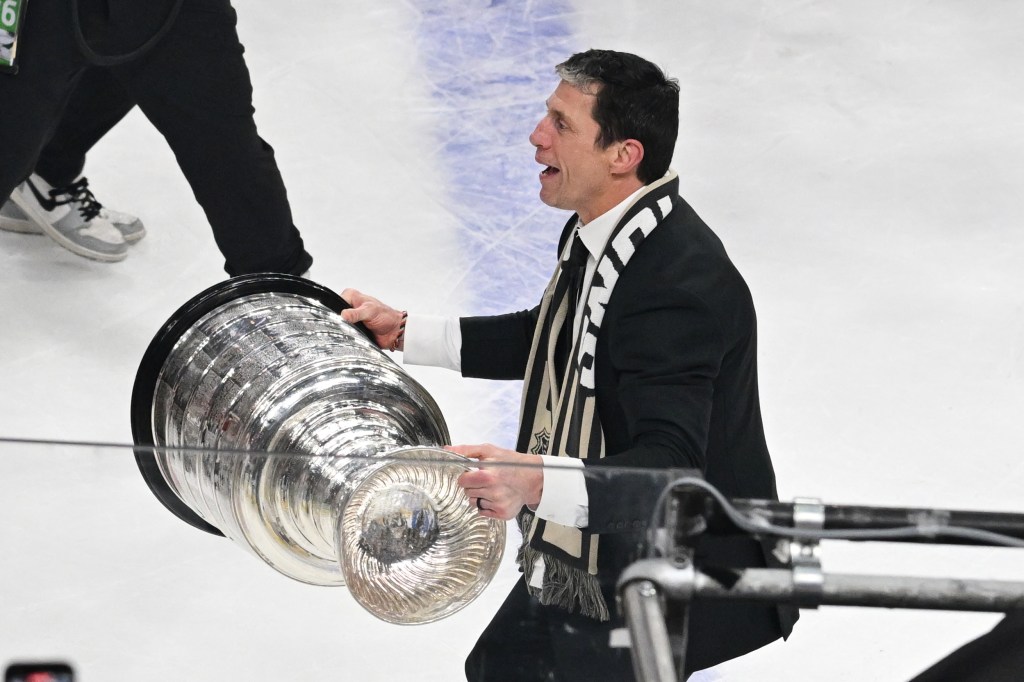
Bazin and the rest of the hockey world looked on as Brind’Amour coached the Carolina Hurricanes to the Stanley Cup championship with a six-game defeat of the Vegas Golden Knights last Sunday.
Bazin was thrilled for his former schoolmate and impressed by the level of play in the finals.
It got him recalling his time at Notre Dame and having a front row seat to Brind’Amour’s exploits. Brind’Amour would have succeeded in anything he set his mind to, according to Bazin. It just so happened to be in hockey.
Brind’Amour led Notre Dame, which he attended from 1985-88, to the Centennial Cup title in his final season. He would go on to be selected with the ninth overall pick in the 1988 NHL Draft by the St. Louis Blues.
After attending Michigan State, Brind’Amour embarked on a lengthy NHL career which saw him star for St. Louis, Philadelphia and Carolina. In 1,484 regular-season games, Brind’Amour netted 1,184 points.
He captained the Hurricanes to the 2006 Stanley Cup championship and his work behind the bench enabled Carolina to hoist the Cup 20 years later. Only four people have won a Stanley Cup as a player and coach with the same franchise.
“He was awesome,” Bazin recalled. “He was strong. He had been weightlifting for a long time. He was one of the top five of his age in Canada. He was really, really jacked. He was a unique individual.”
They were not teammates. While Bazin honed his skills on Notre Dame’s midget team, Brind’Amour starred for the school’s junior team.
Notre Dame has produced such NHL stars as Brind’Amour, Vincent Lecavalier, Brad Richards, Wendel Clark, Sean Couturier, Curtis Joseph and former Bruins defenseman Gord Kluzak.
The Hounds also developed three players who would go to win Stanley Cups as coaches – Brind’Amour, Jon Cooper and Barry Trotz.
Harvey a hero
Caroline Harvey has a chance to become a face of the Professional Women’s Hockey League.
Harvey, whose local roots run deep, was drafted first overall this week by the Vancouver Goldeneyes.
A native of Salem, N.H., the elite defenseman and Olympic gold medalist grew up in Groton and famously took boxing lessons between the ages of 10-13 at Ramalho’s West End Gym in Lowell.
Harvey’s list of accolades runs longer than a hockey rink. A three-time national champion at the University of Wisconsin, the 5-foot-8 puck-moving defenseman led the U.S. to the gold medal at the 2026 Winter Games.
She led the U.S. with nine points and was named the tournament MVP. She won the Patty Kazmaier Award as the best women’s college hockey player in the nation. The honor came as little surprise. She netted 18 goals and 64 points for the national champs and leaves Wisconsin as the program’s all-time leading scorer among defensemen.
A two-time Olympian, the 23-year-old heads to Vancouver with tons of fanfare. Vancouver finished sixth out of eight teams last season and the PWHL will expand to 12 teams for next season.
It’s an exciting time for the league. Expect Harvey to elevate her game — and the league — over the next couple of seasons.
Labor perspective
Billerica native Tom Glavine, known as a cerebral pitcher during his 22-year Major League Baseball career, also earned a reputation as a leader off the field, especially during labor negotiations.
Glavine recently told ESPN’s Jeff Passan he’s fearful of an impending work stoppage.
The Hall of Famer, who won 305 career games, mainly as a member of the Atlanta Braves, was a MLB Players Association executive subcommittee member during the 232-day strike in 1994.
The players went on strike that season and the league canceled the 1994 World Series.
Glavine told Passan he’s “100 percent” concerned the players and owners are on a collision course much like more than 30 years ago. The current collective bargaining agreement expires Dec. 1.
Glavine acknowledged the significant growth in the payroll gap between top and bottom teams. But the former Billerica High star told Passan he believes a salary cap is not necessary to solve it.