
It’s Hockey Hall of Fame announcement day, which means three things. First and most importantly, we’re about to find out which players and builders are going to receive the sport’s highest honor. Second, it’s a good day to avoid that one fan you know who has very strong feelings about Rod Brind’Amour.
And third, it’s time for us to induct a new class in our Hall of Very Good.
This is an annual tradition, kind of, which started back in 2022, when we inducted a full roster highlighted by names such as Saku Koivu, Al Iafrate and Tim Kerr. The second class was another full roster, featuring Ziggy Palffy, Brian Rafalski and Miikka Kiprusoff. In 2024 we scaled back a bit but still found room for Rick Nash, Shane Doan and Olaf Kolzig.
And then last year, uh, I think I forgot.
But that’s OK, because there’s nothing quite like a double cohort to juice up an induction meeting. So today, we’re going to welcome the Class of 2026. As always, these are players who have no realistic shot at the real Hall of Fame, meaning we’re not going to look at guys like Patrik Eliáš or Henrik Zetterberg. These guys are a tier below, but still deserve recognition.
You’ll often hear fans use “Hall of Very Good” as an insult, meant to imply that the HHOF is too lenient. But today, it’s a compliment — a chance to remember some guys who were all sorts of fun.
We’ll find room for six forwards, four defensemen and two goalies. Each will be inducted representing a specific team, because I’ve always liked that about baseball’s Hall. And of course, if one of your favorites hasn’t made the cut yet, feel free to nominate him in the comments for future induction.
How to win a Stanley Cup without superstars
Harman Dayal
Forwards
Reggie Leach, Philadelphia Flyers
Previous HHOVG inductions have been heavy on players from the late 1980s and early 1990s, because those were pretty much the best decades to be a fan, said the guy who grew up in that era. But we haven’t shown enough respect to the stars of the 1970s, so let’s make up some ground with a couple of today’s names.
We’ll start with Leach, a two-time 50-goal man who peaked with 61 in 1975-76; he added 30 assists that year, setting a mark that still stands for fewest points in a 60-goal season. That was also the year he became the first forward to win the Conn Smythe in a losing effort after scoring 19 goals in the playoffs. His total for that regular season and postseason combined: 80 goals, 35 assists. Easily one of the funniest stat lines of all time.
Also, his nickname was The Riverton Rifle, which is an absolute A+ in a sport where that’s tragically rare.
Rick Middleton, Boston Bruins
Speaking of great nicknames, let’s honor Nifty Rick Middleton. He went from the New York Rangers to the Bruins in 1976 and quickly established himself as a consistent 40-goal threat, a mark he reached five consecutive times. His best stretch came from 1980 to 1984, a four-season stretch when he hit 100 points twice and scored 191 goals, with a career-best 105 points in 1983-84 that earned him a fourth-place finish in Hart voting.
He ultimately ended up just short of 1,000 points with 988, of which 898 came with the Bruins, for whom he ranks seventh in all-time scoring.
Also: That flow.
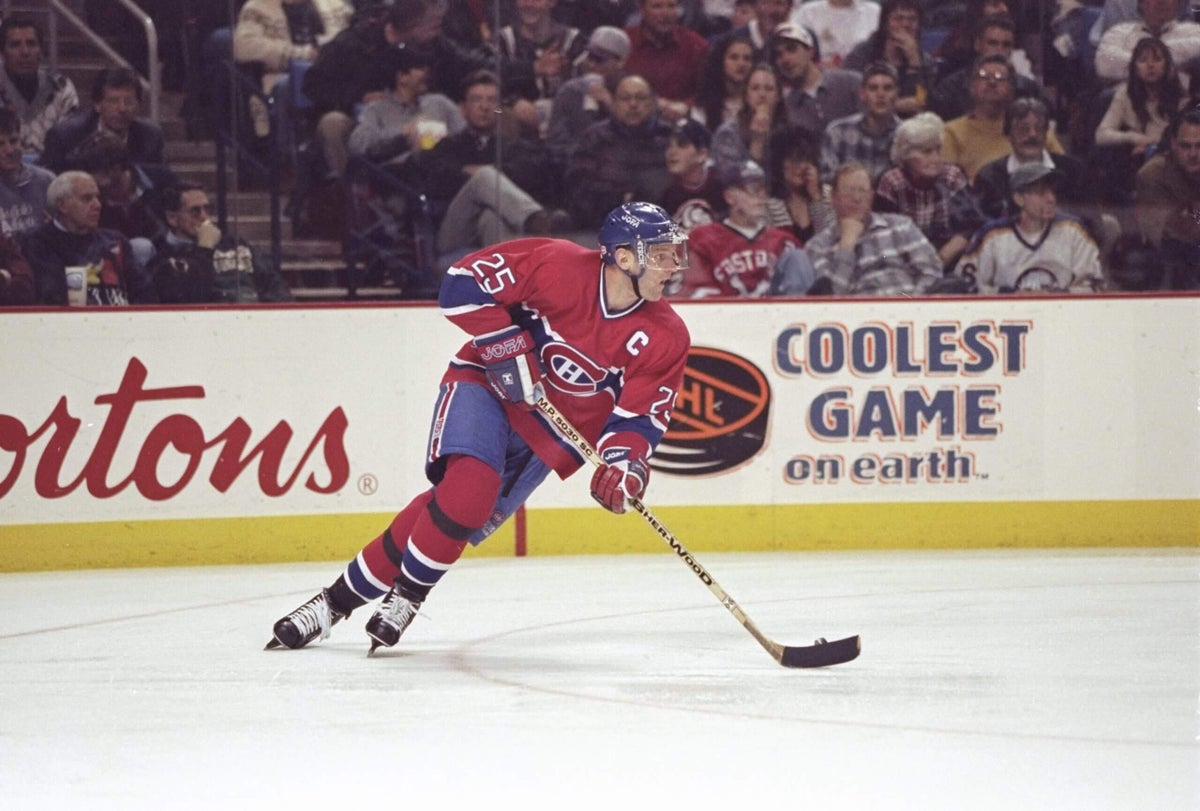
Vincent Damphousse, Montreal Canadiens
I had to triple-check, but it’s true: Damphousse has somehow not yet been inducted into our Hall. We’re fixing that now.
The sixth pick in 1986, Damphousse debuted with the Toronto Maple Leafs that year, at which point I called him “Damp House” for roughly the first 60 games of his career because I was dumb. He topped out at 94 points with the Leafs, was dealt to the Edmonton Oilers as the key piece in the Grant Fuhr blockbuster and went to the Canadiens the year after that. He was the leading scorer on that championship Habs team with a career-best 97 points — one of three times he’d hit 90 in Montreal, where he’d eventually serve as captain.
He never received a single Hart vote in his career, but he did finish fourth in Selke voting in 1996. That always amused me because it was the only year he received any Selke votes at all, and it came exactly halfway through his 18-year career. According to voters, he took nine years to learn how to play defense, got really good at it for one season, and then immediately forgot again.
After a successful late-career act in San Jose, he retired with 1,205 points, which trails only Bernie Nicholls’ 1,209 among eligible players who aren’t in the Hall.
Brian Propp, Philadelphia Flyers
Our second Flyer inductee holds a record that nobody wants to break: most Stanley Cup Final losses without ever getting a ring. Propp went to the final and lost with the Flyers in 1980, 1987 and 1989, and apparently liked it so much he decided to do it with Boston in 1990 and the Minnesota North Stars in 1991. You could hardly blame him, though, especially when he scored 26 goals combined in the Flyers runs in 1987 and 1989.
He ultimately finished his career with 425 goals, and just snuck past the 1,000-point mark; his 1,004 mark is the lowest among the 103 members of that exclusive club, but when you’re in you’re in.
Adam Graves, New York Rangers
Through his first four NHL seasons, Graves scored just 23 goals in 217 games. But he found his scoring touch once he arrived in New York via an offer sheet in 1991, scoring 26 goals in his first year and 36 in his second before exploding for 52 in 1993-94. That set a new Rangers record, since broken by Jaromir Jagr and matched by Chris Kreider, and was a big part of the team’s Stanley Cup run. It was easily the best year of his career, as he finished eighth in Hart voting, fifth for the Selke and won the King Clancy while firmly establishing himself as a fan favorite.
He also broke Mario Lemieux’s wrist that one time, but I’m sure Penguins fans are over it.
Rob Ray, Buffalo Sabres
It’s become a tradition to use our final forward spot to honor an enforcer, with Bob Probert, Basil McRae and Tiger Williams getting previous nods. It was only a matter of time before we got to Ray, who spent 13 seasons in Buffalo, during which he played 889 games, scored 90 points and fought Tie Domi 6,000 times (estimate).
He also had a short stint in Ottawa that would be largely forgotten if he hadn’t been a key figure in that wild game that produced the most penalty minutes in NHL history. Ray just had that effect on people.
Congratulations, and welcome to the Hall, Sugar. Please try really hard to keep your shirt on for the entire ceremony.
Defense
Andrei Markov, Montreal Canadiens
Markov is one of the names that’s constantly being nominated by readers, and rightly so. He played 990 games, all for Montreal, and peaked with back-to-back sixth-place finishes for the Norris in 2008 and 2009. And Habs fans absolutely love the guy — he finished his career with 572 points, and roughly the same number of fan-made YouTube tribute videos.
Also, I have no idea what’s happening here, but I kind of love it.
Niklas Kronwall, Detroit Red Wings
I wanted to get a Wing in here, since HHOF induction day is always tough on Detroit fans. Maybe they’d enjoy a chance to take a break from spamming Chris Osgood comments on every Hall article to appreciate one of the last open-ice bodycheck artists we may ever see.
He played 15 years and only got Norris votes in three of them, peaking with a tenth-place finish in 2013. He wasn’t much of an offensive threat, although he did crack 50 points once and had a couple of seasons with double-digit goals. But any offense you got from Kronwall was just a bonus, because when your name becomes a synonym for a crushing highlight-reel hit, you’re earning your keep. Were all those hits clean? Eh, they were mostly clean-adjacent. If anyone has a problem with it, that’s what Rob Ray is here for.
Brent Seabrook, Chicago Blackhawks
He’s pretty much the prototype Hall of Very Good guy, in that even the most die-hard Chicago homer doesn’t think he belongs in the real Hall but you could argue they don’t win any of those three Cups if he’s not there. Hawks fans, where are we at on retiring his number? They already have a 7 hanging for Chris Chelios, but plenty of teams have honored the same number twice.
Also, this is your near-annual reminder that the first round of the 2003 draft might be the greatest collection of Hall of Very Good guys ever assembled in one place.
Mattias Öhlund, Vancouver Canucks
Before Quinn Hughes showed up and ruined everything, it was always fun to try to figure out who’d been the best defenseman the Canucks had ever had. Öhlund’s name came up a lot in those debates, which was simultaneously a weird look for 50-plus years of franchise history and a reminder that he was an excellent and often-underrated stud back there.
A bonus fun fact: Öhlund played almost his entire career with the Canucks, then finished with a brief stint in Tampa that saw him serve as Victor Hedman’s first partner.
Goalies
Mike Liut, St. Louis Blues
With the very important caveat that goaltending wasn’t invented until Patrick Roy came up with the concept of being able to drop to your knees and get up again without falling over in 1986, Liut still had a heck of a run. He’s one of only three goalies to ever win the Lindsay (which was then the Pearson), and the only one to do it without also winning the Hart. That came in 1981, when he was also a first-team All-Star. And he was no one-hit wonder, finishing as Vezina runner-up and Hart finalist in 1987 with the Whalers.
Was there anything this guy couldn’t do? OK, sure, but was there anything other than make a save in a Canada Cup final?
Nikolai Khabibulin, Tampa Bay Lightning
We started our Class of 2026 with some all-time great nicknames, so let’s end the same way. The Bulin Wall loved nothing more than showing up somewhere, providing four seasons of above-average goaltending, and then moving on to his next stop. That would ordinarily make him a tough inductee to choose a specific team for, but his championship with the Lightning makes this an easier call, even if he gave up a Cup-winner and you’ll never convince me otherwise.
All told, Khabibulin finished his career with 333 wins, tied with Gump Worsley and ahead of several Hall of Famers. He also had plenty of international experience. And now he has a Hall of Very Good plaque. They’ll never be able to take that away from him, unless Viktor Tikhonov steals it.