
There’s a chance that you’ll see the Pittsburgh Penguins drop the price of single-game tickets for the 2025-26 season.
There’s also a chance that you’ll see a paisley unicorn with a rainbow-striped horn dancing in the fountain at Point State Park.
Which of those is more likely to happen is open to debate. (Editor’s note: Smart money is on the unicorn.)
The Penguins aren’t expected to announce single-game prices until the NHL schedule has been released, but those for season-ticket packages were put out a while ago.
Per the team’s website, those range from $1,210 for a half-season (22 games) in the top rows of the upper bowl to $12,232 for a full season (44 games) in the Casamigos Club.
It’s reasonable to think that some fans who have the passion to be at every game simply don’t have the financial resources to do so.
And it’s not just the cost of tickets. Throw in the dizzying price of parking and concessions and it might seem more prudent to spend a few more bucks so you can buy a car and drive to a five-star restaurant.
Attending NHL games these days doesn’t just require interest. It might necessitate getting a second mortgage.
That won’t change anytime soon, if ever, but it behooves a lot of teams, including the Penguins, to make games somewhat affordable for as many fans as possible.
Here are four reasons they should reduce the cost of single-game seats for the coming season. Or, at least, not raise them:
1. Don’t ignore history
The inescapable reality is that the Penguins have sat out the Stanley Cup playoffs for three consecutive years, which means their league-leading run of 16 consecutive postseason appearances is a fading memory.
Another hard truth is that successful teams generally have larger, stronger followings than those that are struggling.
Since the current Penguins fall into the latter category, charging fans more to watch a team that figures to be a long shot to get into the playoffs for at least another season doesn’t give people (and their disposable income) much reason to show up at PPG Paints Arena.
2. Read the (somewhat empty) room
The Penguins set an NHL record by selling out 633 games in a row, but that streak ended Oct. 19, 2021.
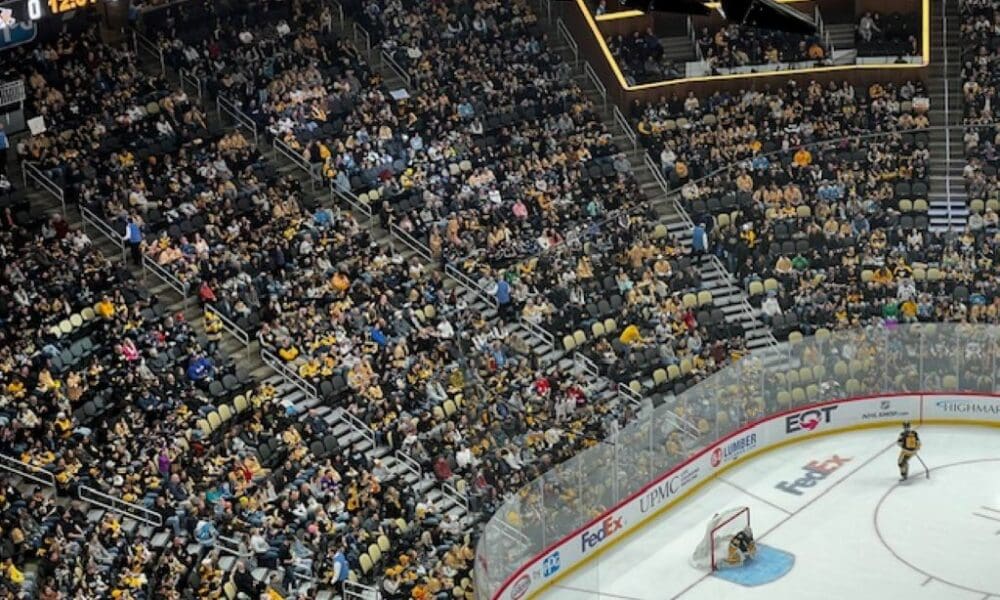
In recent years, capacity crowds have become more than exception than the rule at PPG Paints Arena.
And even though there rarely, if ever, are more than a few thousand empty seats on game nights, the hockey adage that you fail to score on 100 percent of the shots you don’t take can be modified to fit this situation: You fail to earn so much as a penny – be it on tickets, parking or concessions – from seats that go unoccupied.
3. Mind your money
President of hockey operations/GM Kyle Dubas appears to have ownership’s permission to again spend to the salary-cap ceiling for 2025-26.
That doesn’t mean he has to.
Dubas is a hockey executive, not a sorcerer or alchemist, so it’s a reach to suggest he can magically transform the Penguins into a solid playoff team, let alone a Cup contender, by next spring.
While the corporate accountants might place ticket revenues and the player payroll in separate buckets, at some point, there has to be a financial bottom line for the franchise.
Why not take money that might be spent on a third-pairing defenseman or bottom-six forward and use it instead to rein in ticket prices?
4. Think long-term
It’s been several decades since the Penguins introduced the Student Rush, a promotion that made it possible for high school and college students to purchase reduced-price tickets on the day of the game.
That had a short-term benefit for the team, because it put bodies into seats that otherwise might have gone unfilled, but also helped to introduce a generation of fans to the game and the franchise, or to reaffirm the support of young people who already were following it.
Although a lot of people don’t have much cash on hand when they’re in college, plenty of them end up with well-paying jobs after graduating and become potential season-ticket buyers, or at least occasional attendees at games.
That means the Student Rush program was an investment in the franchise’s future, and it seems to have paid off.
Keeping single-game tickets at an affordable price – or, at least, no less affordable than they already are – could have a similar impact in coming years.
If Fenway Sports Group is in for the long haul, which it appeared to be when Dubas was given a seven-year contract in 2023 to oversee the team’s hockey operation, making that kind of long-term calculation seems wise.