
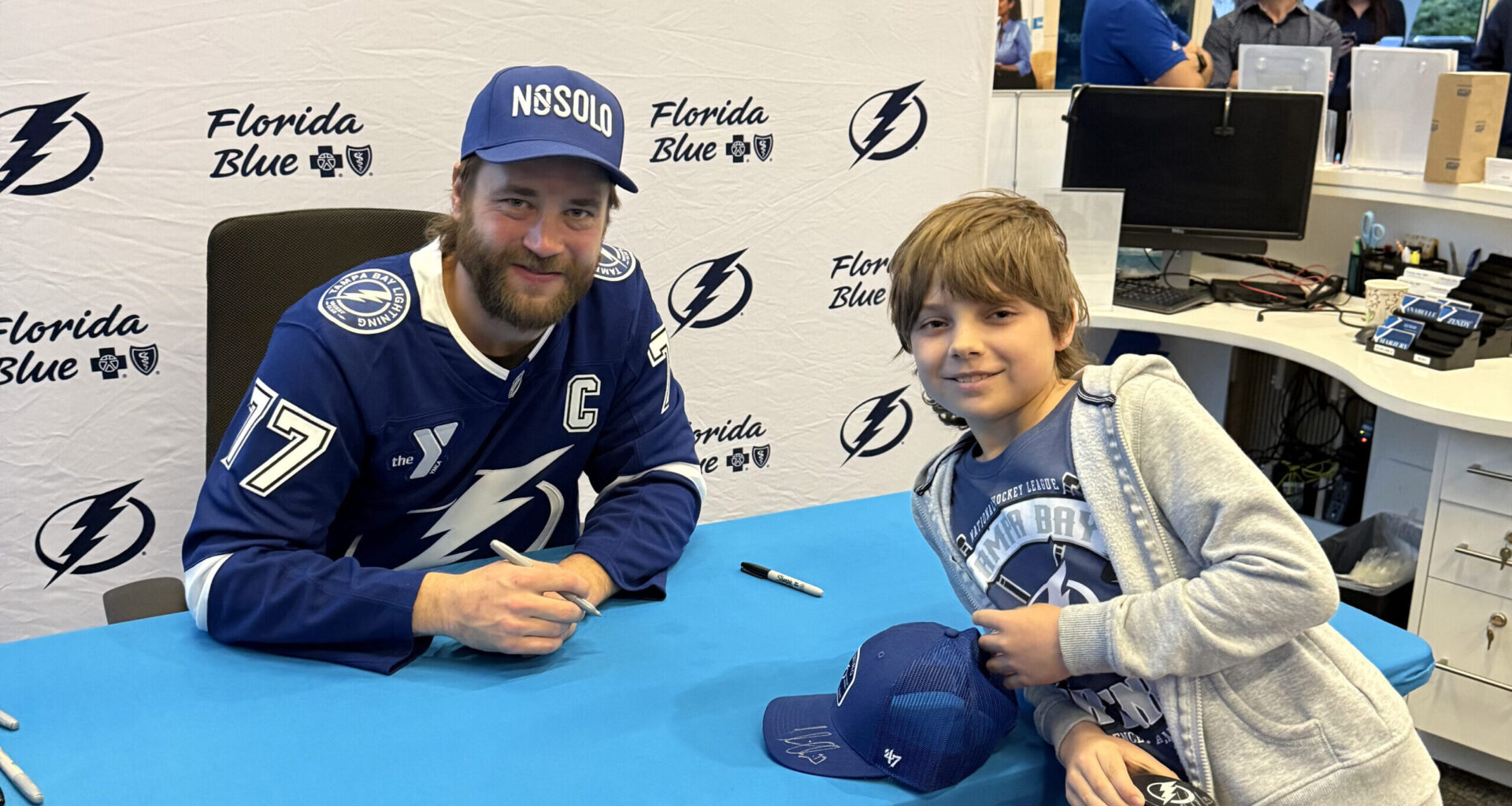
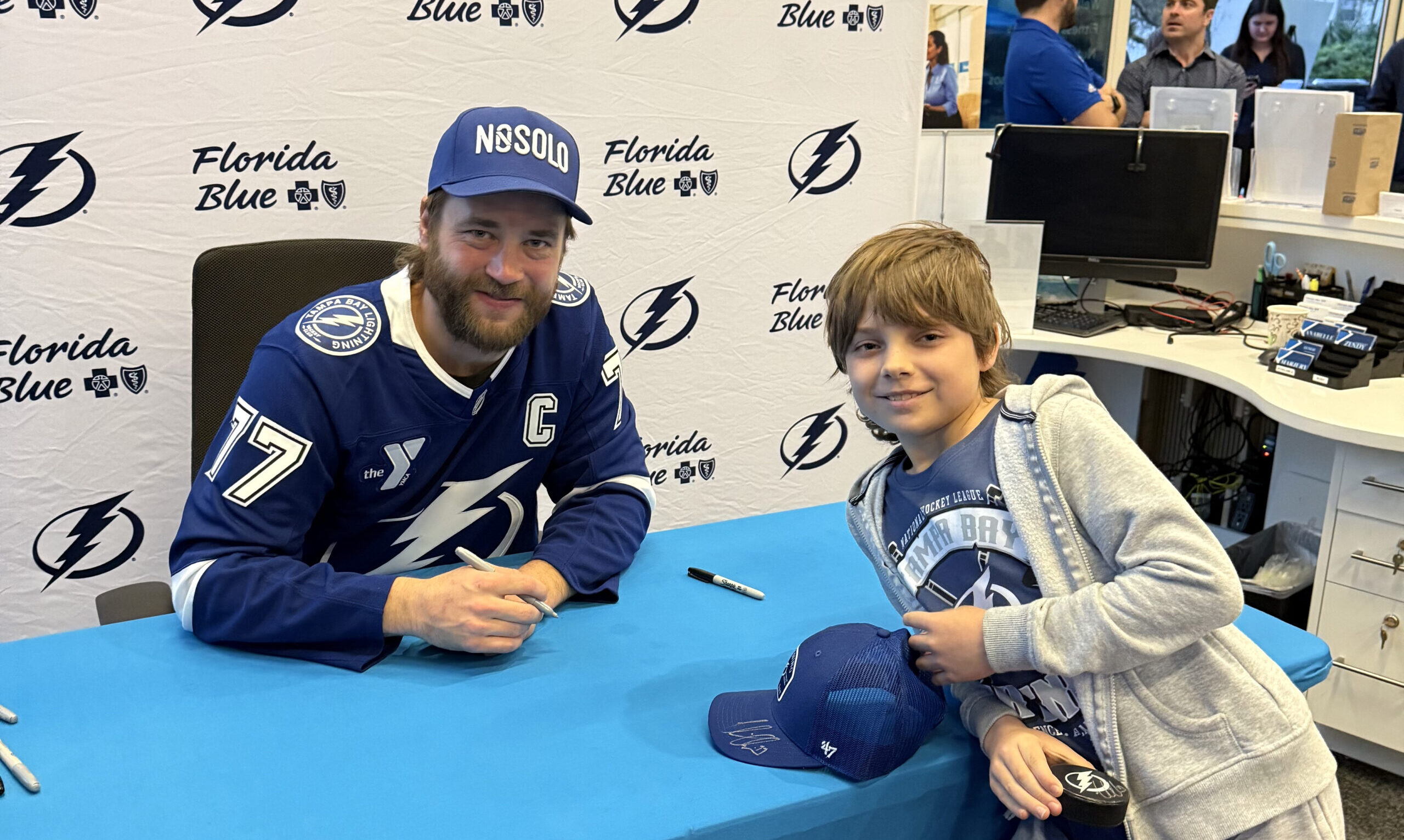
Victor Hedman with a fan at the Tampa Bay Lightning community event. Photo by Daria Mironova/WMNF.
June is Men’s Mental Health Awareness Month.
Even today, with more resources available to athletes than ever, professional organizations often manage mental health concerns privately and rarely discuss them openly.
Hockey players are raised in a culture of competition, toughness, and resistance. The sport requires physical and mental endurance. Players learn to fight, compete, and remain resilient on the ice regardless of circumstances.
Away from the rink, many personal challenges go unnoticed. Mental health struggles are often less apparent than physical injuries. That is why public openness from well-recognized and accomplished athletes is crucial. It reduces stigma and encourages others to seek support when necessary.
Victor Hedman opens up about mental health
Following the Tampa Bay Lightning’s playoff elimination in early May, captain Victor Hedman spoke to reporters during the team’s exit interviews. With honest vulnerability, he revealed the reason for his absence late in the season. He stepped away from hockey to focus on his mental health after ongoing struggles. Moreover, the Lightning released a public statement on their website and social media channels that featured Hedman’s personal experience. The gesture highlighted the importance of his message.
It was a difficult but deeply personal decision for one of the NHL’s most respected veterans. Hedman expressed that he needed to prioritize his well-being, not only for himself but to become the best teammate, husband, and father he could be.
The longtime Lightning defenseman missed the final 15 games of the regular season and the first-round playoff series against the Montreal Canadiens. Hedman admitted his struggles had weighed on him for a long time, ultimately overwhelming him during a March 19 matchup against the Vancouver Canucks. The Swedish blueliner left the game during the first period. The Tampa Bay Lightning won 6-2. But many Bolts fans wondered if an undisclosed injury had sidelined the captain.
However, on March 25, the Lightning announced that Hedman had taken a leave of absence for personal reasons. By that time, the 35-year-old defenseman had 17 points (one goal, 16 assists) in 33 games.
Asking for help
Injuries disrupted much of Hedman’s season. However, he admitted the biggest battle was mental, not physical. During his media session, he encouraged people to ask for help rather than isolate themselves.
Dr. Geoffrey Peal, a licensed clinical psychologist who works with athletes of all ages and levels, says elite performers are often viewed as invincible, especially by young players. When a respected leader, such as the Tampa Bay Lightning captain Victor Hedman, openly talks about feeling overwhelmed or struggling with mental health, it can have a powerful impact. Peal says those conversations encourage athletes at every level – from youth sports to the professional ranks – to seek help rather than suffer in silence.
“When we work with youth athletics now, there’s become a big push for mental health,” Peal said. “Because performance, in general, in athletics requires a higher level of anxiety.”
He noted that social media can make those challenges even more difficult. Constant comparison and exposure to criticism can take a toll on athletes’ well-being.
“So, when you have access to everybody in the world, that comparison goes into overdrive,” Peal said. “And it’s easy to downplay your own achievements and your own accomplishments.”
According to Peal, when high-profile athletes share their own struggles, their openness reminds fans and young players that even elite competitors face emotional challenges and that asking for help is a sign of strength, not weakness.
NHL mental health program
The NHL veteran Hedman, with over 1,160 games on his resume, also openly expressed that therapy, family support, teammates, the organization, and former teammate Steven Stamkos were all crucial to his recovery.
Hedman’s comments reflect a larger shift happening across professional hockey. While the sport has long celebrated toughness and playing through pain, more NHL players speak publicly about mental health struggles.
The NHL and NHL Players’ Association have operated the NHL/NHLPA Player Assistance Program for roughly 30 years. The confidential program helps players and their families manage mental health challenges, substance abuse, and other personal issues. Players can voluntarily enter the initiative and take paid leaves of absence while receiving treatment.
The NHL hosts annual team presentations explaining how the program works. Players receive contact information for administrators and confidential hotlines. Some athletes voluntarily enter the program. Others undergo mandatory evaluations after legal or behavioral incidents. Even with these support programs, asking for help remains difficult in a highly competitive sport.
Nick Paul’s advocacy in Tampa Bay
Inside Tampa Bay’s locker room, forward Nick Paul has also become a strong mental health advocate.
When the Lightning winger Nick Paul joined the organization in March 2022, he brought more than his hockey skills. He launched the Points by Paul initiative, which donates money to the Crisis Center of Tampa Bay for every point he scores.
For Clara Reynolds, president and CEO of the Crisis Center, the value of the initiative extends far beyond the dollars raised. She says professional athletes have a unique ability to reach audiences that mental health organizations often cannot.
“The money is impactful for an organization like ours,” Reynolds said. “A big deal has been the fact that he (Nick Paul) has made such huge strides in de-stigmatizing mental health because of his willingness to talk about it so openly.”
Among the thousands of fans attending a local hockey game, there may be someone silently struggling with a mental health challenge. That’s why Reynolds says Nick Paul’s willingness to share the message has become one of the most valuable parts of the Points by Paul initiative.
“One of the other benefits is that we never know who is attending a game and hearing that valuable message from Nick – that it’s okay to not be okay.”
Paul began speaking about mental health after losing a close friend to suicide years ago. He also discussed his own struggles earlier in his career, as he moved between the NHL and the minor leagues. Paul later became certified through the NHLPA as a peer support resource for teammates.
This past season, the Points by Paul program partnered with the Lightning Foundation and other donors to raise more than $28,000 for the Crisis Center of Tampa Bay, to encourage conversations about mental health among hockey fans and the broader community.
Crisis Center leaders say they hope to continue partnering with Nick Paul and the Points by Paul initiative in future seasons. More information about the organization’s programs and services is available at crisiscenter.com.
The hidden side of a brutal game
By sharing his experience publicly, Victor Hedman added an important and heartfelt voice to a growing movement inside sports. As more players speak openly about mental health, many hope these honest conversations encourage others to seek help sooner rather than later.
During Men’s Mental Health Month, advocates remind that anyone struggling with emotional and behavioral challenges to reach out for support and remember that help is available.
The Crisis Center of Tampa Bay operates a 24-hour crisis line and can be reached by dialing 988.