
Entering free agency with the fourth-fewest dollars to spend against the salary cap, the Minnesota Wild needed to play Moneyball. The core of “Moneyball” was that GM Brad Pitt* had to find bargains, mostly through unearthing players with obvious warts and hidden upside. Guys who were old, played bad defense, or had ugly partners could find a home if they got on base enough.
The Minnesota Wild took a stab at some Moneyball on July 2. After pulling off a trade for aging Blake Coleman and Olli Määttä, they signed UFA Max Shabanov to a one-year, $1.6 million contract. Shabanov made his NHL debut last year at age 25, coming off two straight 20-goal seasons in the KHL. In his final campaign for Traktor Chelyabinsk, Shabanov finished third in the league with 67 points.
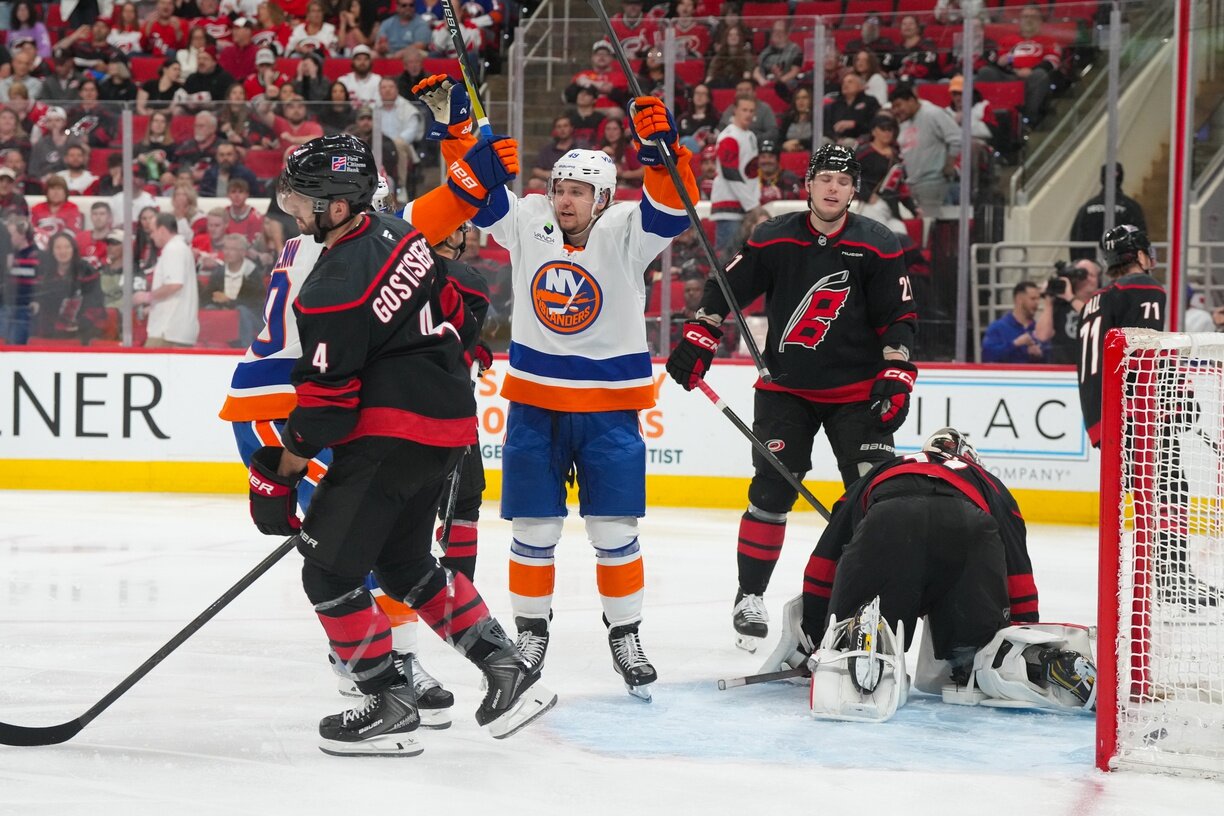
So what’s his problem? He’s 5-foot-9. Little guy! The late bloomer went undrafted and didn’t sign with an NHL club until last year, and the New York Islanders were fine with letting him walk after one season, even though he had 18 points in 44 games. And it’s not like the Isles are in a position to be giving up offensive potential.
Bill Guerin mentioned at Thursday’s press conference that the Wild pursued him as a free agent last year, so getting him without being on the hook for his rookie growing pains feels like a win. Make no mistake, Shabanov had his struggles adjusting to the NHL last season. He was out-scored 24-to-26 at 5-on-5 last season and struggled defensively despite a relatively sheltered role.
But the skill is there, and now it’s on the Wild to unlock it.
Dylan Griffing of Elite Prospects scouted Shabanov in his third NHL game and had the following to say: “With his skating speed and inside-minded style, he was able to get a couple of rapid, opportunistic moments of dangerous offence.” Griffing noted that he struggled with contact and consistency — neither being unusual for a rookie — but also that Shabanov has a motor, which is a quality the Wild seek in smaller players.
When looking for the common thread between Coleman, Shabanov, and Bobby Brink — the three forwards who seem to be replacing the departing trio of Mats Zuccarello, Vladimir Tarasenko, and Marcus Johansson — it seems to be speed and pace of play. Shabanov doesn’t have the raw footspeed that Coleman and Brink possess, but he’s able to play fast, getting the bulk of his shot attempts on the rush.

Shabanov didn’t get many opportunities to carry the puck into the zone, but he was very successful on his chances. According to All Three Zones‘ tracking data, 66.0% of Shabanov’s zone entries were controlled, which was a higher rate than anyone in Minnesota last year save for Ryan Hartman (69.0%) and Kirill Kaprizov (68.8%). Adding him should help the Wild in their quest to up their pace of play at 5-on-5, a process they started last year with the Quinn Hughes trade.
The hope for Shabanov is that he’ll get more of a starring role than he got on Long Island. Shabanov bounced from linemate to linemate, most often with fellow rookie Calum Ritchie. And even that was for just 155 minutes of 5-on-5 time. He also spent limited time with Jean-Gabriel Pageau, Emil Heineman, Simon Holmström, Bo Horvat, and Anthony Duclair. With respect to Holmström, Horvat is probably the only true top-six quality forward of that group, at least currently.
Unless the Wild find a way to bring in another top-six winger, Shabanov has a wide-open path to meaningful minutes with Kaprizov or Matt Boldy on his opposite wing. Coleman is the one player who feels like a lock to hold down one of those spots, as the roster currently sits. That leaves the other one up for grabs, with Shabanov, Brink, or Danila Yurov being the most obvious candidates to grab the enviable role.
On paper, Shabanov might even have the most inside track to a top-six role. For starters, we know that Brink and Yurov have a role on this team if they’re not on one of Minnesota’s top two lines. Brink’s ideal role in a contending lineup is that of a scoring third-liner, and he’s probably stretched moving up the lineup. Yurov shined as the Wild’s third-line center last year, and could even work his way into centering Kaprizov with a big offseason, bumping Hartman to his ideal spot as a third-liner.
It’s not clear whether Shabanov has a role if he’s relegated to the Wild’s bottom six. Minnesota went heavy with their checking lines in the playoffs, and are set to return the Foligno brothers, Michael McCarron, and Yakov Trenin. If Shabanov is playing with two forecheckers, is that a waste of his skills? And is it putting him in a position to fail if he’s in a defense-first assignment?
It’s important to pump the brakes on the potential of Shabanov teaming up with Kaprizov or Boldy. Maybe he’ll eventually slot into a situational bottom-six forward, drawing in when the Wild need a change-of-pace option for some offense. And of course, Shabanov could top out as a KHL All-Star, never finding his way into a regular NHL role.
But for $1.6 million, that’s an easy bet to take. If the Wild can get someone in their top-six for under $2 million — in this UFA environment — we’re talking about a steal, even as a placeholder. That’s doubly true if he can take a step in his sophomore season and find a long-term spot in the Wild’s top-nine.
*This is a joke, I know the guy’s real name was Billy Beans**.
**This is also a joke. I know his full name was William Beanson.
Think you could write a story like this? Hockey Wilderness wants you to develop your voice, find an audience, and we’ll pay you to do it. Just fill out this form.