
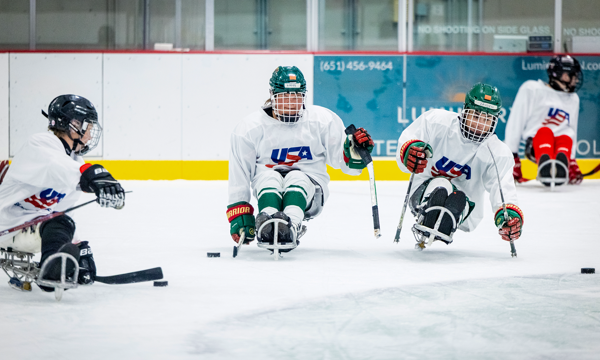
Evan Nichols admits it’s kind of cool to be viewed as a Paralympic hero by youngsters just learning the sport, but he never planned on being in that position.
That’s what happens when you play on the gold-medal-winning U.S. Paralympic Sled Hockey Team — kids as young as grammar school-age look up to you while they participate in a regional sled camp.
The camps, five of them in 2026 at various locations across the country, are part of USA Hockey’s sled hockey player development pyramid that is swiftly creating a pipeline of talent for the national team. The neat thing for the campers is that they get to skate with national team players like Nichols.
“I never thought I’d be in that kind of position,” said Nichols, a 21-year-old from Haymarket, Virginia. “I never thought people would be looking to me for advice. I’ve got to teach them all I can. That part has been fun.”
But while the camps, now in their third year, may create that pipeline to more Paralympic glory, Chuck Gridley, USA Hockey’s New York District Coach-in-Chief, insists they are primarily about building skills that players can bring back to their home ice and help grow the grassroots aspect of the sport.
“Most players that play the game are at the rec level, they are playing in their hometown,” said Gridley, one of the coaches working at these camps. “We’ve got players out there who are 8, 9, 10 years old; we’ve got a group of teenagers and the players that have the highest chance to make the national team level are 15 to 20 [years old].”
Keep in mind, though, that anyone with an interest in building their sled hockey skills can participate. That means campers can be as old as 40 or beyond.
USA Hockey hosted regional sled camps June 5-7 in Denver and June 12-14 in Eagan, Minnesota. Upcoming camps include July 17-19 in Fishers, Indiana, Aug. 7-9 in Amherst, New York and Aug. 28-30 in Reno, Nevada.
“We’ve tried to spread these camps out, make it geographically possible for as many players to get these camps as they can, and make it financially easier,” Gridley said, adding the cost is $125 for a three-day camp.
Gridley and U.S. National Sled Hockey Team head coach David Hoff coordinate the on-ice work, and Hoff said he loves it.
“There are kids there that are rec players who are having fun and looking forward to getting better,” Hoff said. “We have people coming in who want to bring back skills to their association. That’s the wide-eyed part of it. You have the chance to see someone they want to be like. There is a path or opportunity to do that. The skill level improvement has been awesome.”
In pyramid construction, local sled play is the base, Hoff said. The regional camps are the next level, which is succeeded by the invitation-only USA Hockey National Sled Player Development Camp, being held July 19-25 in Columbus, Ohio.
From there are the tryouts for the U.S. National Sled Team and the U.S. Women’s National Sled Team. The national teams, consisting of Paralympic gold medal winners like Nichols, are at the top of the pyramid.
Virtually all national team players help at one camp if not more, Gridley said. That means a youngster, or even an older player, may arrive at a regional camp and see people like Declan Farmer or women’s sled star Erica McKee on the ice.
“A lot of national team players work the camps and give back,” added Dan Brennan, director of sled national teams. “So a young kid is going to look up to Declan Farmer rather than Dan Brennan for hockey tips. We’ve had a lot of young kids that have traveled all across the United States. That’s the stuff that makes our sport really cool.”
Gridley added: “They understand the value of giving back. They understand the effect it has on the players and the effect it has on them as well.”
Of course, winning five Paralympic gold medals in a row will only help build the pyramid simply by virtue of increased exposure.
“One hundred percent,” Brennan said. “It’s our new way of doing things. We want to accelerate our developmental players.”
Nichols said he sees a ton of potential of the kids on the ice at the camps and gets a lot of questions about what it’s like being on the national team. When he explains the amount of skating and training required to maintain a spot on the squad, “that is normally met with shock and surprise.”
He also gets the offbeat questions, like what foods he hates. (He doesn’t drink coffee.)
While the camps are fun, they’re also fun with a purpose, Nichols said.
“You can kind of see the determination of somebody who wants to get there, and that is the majority of the battle,” he said. “Moving forward, it’s about how much work they put in. Seeing the motivation they have to make that team is the biggest deciding factor, and we’re seeing a lot more of that.
“A bunch of eyes are on hockey in general and we’re trying to build the momentum.”
Story from Red Line Editorial, Inc.