
One word separates a good penalty kill from a bad one: pressure.
For that reason, escaping pressure is a definitive requirement for any good power play.
Despite the nickname “man-advantage unit,” NHL power plays don’t dominate with numbers; instead, they dominate with time. If numbers were the secret to a dominant power play, all five players would bum-rush the net and use their numerical advantage in the most dangerous area of the ice.
You can see that happen in some sports. Scrums in rugby, goal line stands in the NFL, and even the low block in soccer. On an NHL power play, players space the ice. They want to entice the penalty kill to leave their structure.
So why would a penalty kill ever do it? Why chase the puck-carrier and leave space open behind you? It comes back to pressure. By definition, a shorthanded unit needs their opponent to make a mistake to escape their zone. There are no perfect power play units in the NHL. If there were, they would convert 100% of their power plays. The 2025-26 Edmonton Oilers led the league with a 30% conversion rate — truly elite, but far from perfect.
Therefore, penalty killers apply pressure. They take away their opponent’s time and force them to stickhandle or pass away from the pressure under a short amount of time. For that reason, the most valuable power play specialists are elite problem solvers with quick hands.
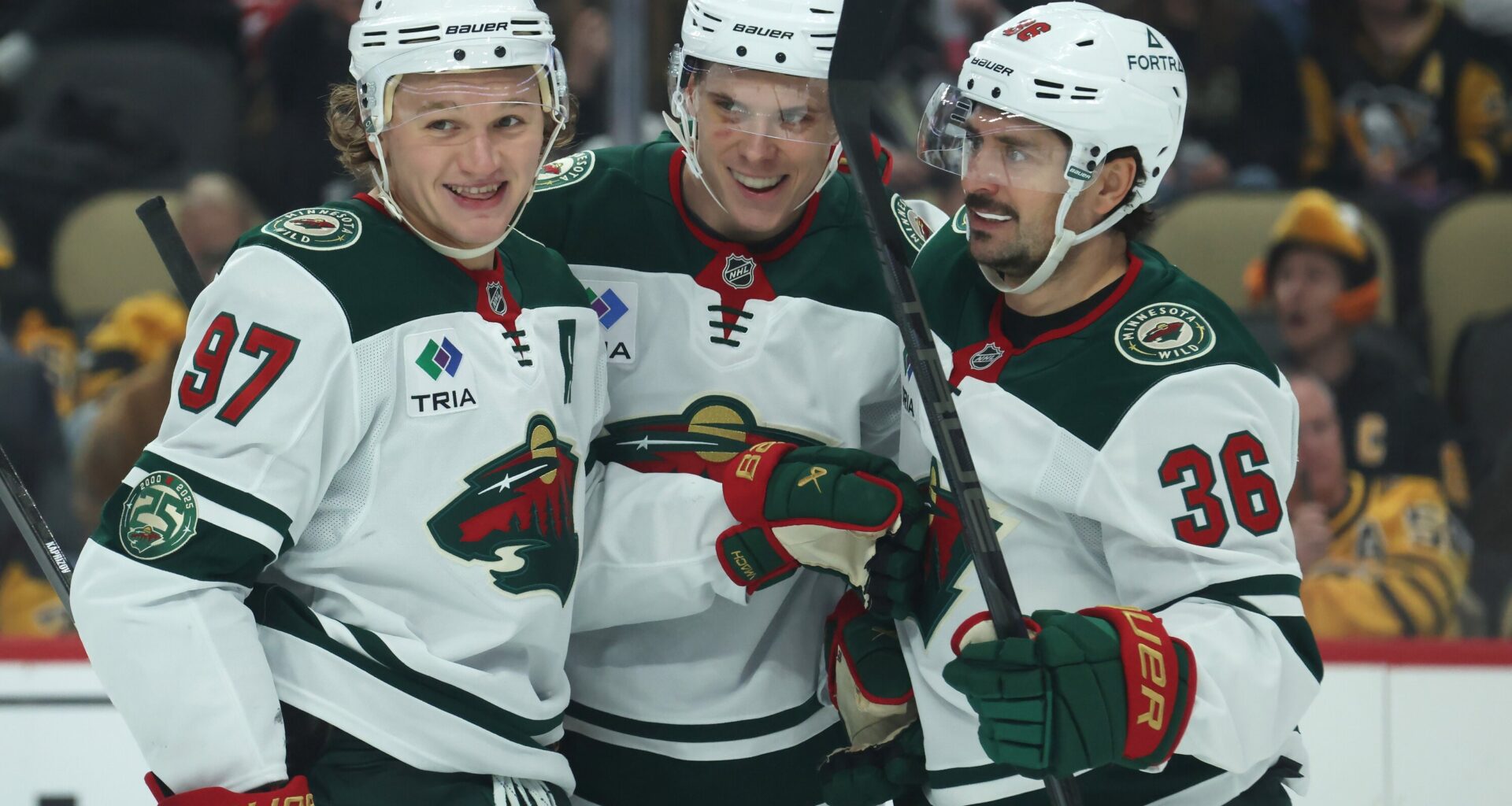
Those two skills are Mats Zuccarello’s superpowers.
So, what will the Wild power play do without them?
Michael Russo and Joe Smith made this one of their five “big Wild questions” on The Athletic ahead of training camp. They suggested Brock Faber, Bobby Brink, Michael McCarron, and Maxim Shabanov.
After reviewing each of these options, as well as new top-six winger Blake Coleman, I believe that Brink or Coleman will take the job. Here’s why:
Maxim Shabanov
Shabanov seems an unlikely option to me. He’s skilled, but he may struggle with the North American game. The Russian import played his rookie season with the New York Islanders last year. The Islanders weren’t a particularly deep team, but they only dressed him for 44 games. Shabanov also doesn’t possess an elite shot. He failed to score in his five-on-four minutes with the Islanders and converted five goals on 6.3 expected goals (xG).
Perhaps the most concerning proxy for Shabanov’s ability: He’s billed as a playmaker, but I can’t find an NHL highlight reel for him anywhere. Maybe the state of New York is suddenly experiencing a shortage of video editors. (Perhaps they were all watching the Knicks last year.)
He’ll be an option to monitor through training camp, but I’d bet he’ll land on the second unit to start the season.
Michael McCarron
McCarron seems even less likely. While his right-handed shot will open favorable passing lanes for him to connect with his teammates, the question is whether he’s talented enough to share power play minutes with Kirill Kaprizov, Matt Boldy, and Quinn Hughes.
McCarron’s career shooting talent is 23% below the NHL average according to MoneyPuck’s xG model — last season, his shooting % against expectation was 356th out of 412 qualifying forwards.
He’s extremely inexperienced on the power play, logging ten five-on-four minutes over the past three seasons. Not ten minutes per year — ten minutes total. On top of that, he’s redundant with
Joel Eriksson Ek as a pure-netfront player. His 2025-26 shot map is below.

That likely outweighs the value of having a right-handed faceoff specialist to pair with Eriksson Ek, as well as the value of icing a right-handed passer. I’m not some stat nerd hating on Michael McCarron, either. I like the way his contract fits the team’s window to win, and he fills a valuable role as a depth center. But he doesn’t make sense on the power play.
Brock Faber
Now is the moment I break your heart: Brock Faber probably isn’t taking Zuccarello’s spot on the power play.
Faber is not Alex Ovechkin. Ovechkin’s shooting talent is 20% above NHL average; Faber’s is 6%. For context, Jared Spurgeon’s career mark is around 10% — and that’s likely below his peak now that he’s played well into his 30s. Spurgeon and Faber’s hardest shots in ‘25-26 were 92.28 and 92.67 miles per hour (61st and 63rd percentile). Ovechkin’s was 97.30 (99th percentile) — that might seem close, but it’s 5% faster. That’s 5% less time for a goaltender to react, which is significant when they’re reacting in microseconds.
If we aren’t clamoring for Spurgeon to replace Zuccarello, we should at least pump the brakes on Faber taking that job.
Here’s the theory behind putting Faber into Zuccarello’s role on the left flank. As a right-handed shot, Faber would enjoy opportunities to rush one-timers, and also have a favorable passing lane to Kaprizov in the bumper or Boldy on the right flank.
In theory, a right-handed shooting threat forces one defender to cover the shooting lane, leaving only three penalty-killers to defend passing lanes. However, this requires elite offensive instincts and deft small-area passing abilities.
In a split second, as the puck moves towards Faber, he has to read the location of all eight other players on the ice and identify whether to pass or shoot. If he passes, he must determine which teammate is open.
Faber is a right-handed shot, but he doesn’t have the skill set to maximize the advantages of his handedness. That makes his handedness a much weaker point in his favor.
The value that Zuccarello brought to the left flank was never about ripping one-timers. His value was in managing time and pressure. He and Quinn Hughes spent long shifts in the offensive zone keeping the puck and evading pressure, and manipulating defenders into pressuring them before passing to Boldy or Kaprizov open in more dangerous areas.
Faber doesn’t have the small-area passing ability to fill that role, or the blistering shot required to convert his own opportunities.
Blake Coleman
As of this moment, Blake Coleman should be penciled into the top unit. He’ll need to fend off the other four players on this list through training camp to do it, but he’s clearly the fourth-best forward on the team right now.
Coleman isn’t a prototypical power play specialist; however, he has played on power plays in his previous stops, including about 1.3 minutes per game over his past two seasons with the Calgary Flames. It’s not a massive workload. Compare that to Kaprizov’s 3.7 minutes per night, and it’s clear that Coleman was a secondary option. Still, it’s enough to make him a favorite for the fifth spot on Minnesota’s top unit.
Coleman’s skillset probably won’t fit well on the left flank. He’s more of a nose-for-the-net type player. His five-on-four shot map (left) compared to Zuccarello’s (right) makes that evident:

This tracks with what I notice when reviewing Coleman’s playstyle. He wants to be close to the net, and he shoots whenever he has a clear lane. When he has a teammate near the net, he wants to get them the puck — even if they aren’t skating on a dangerous angle.
Coleman played a netfront role in Calgary, but he won’t be supplanting Eriksson Ek. Even if he did, it doesn’t make sense to do that and move Eriksson Ek to the left flank. However, if Coleman can play in the bumper role, that would free up Kaprizov to play the left flank.

That would create a dynamic peripheral scoring threat between Boldy on the right flank, Kaprizov on the left, and Hughes on the point. With Coleman and Eriksson Ek threatening the high-danger areas, opposing penalty kills would be offered two choices:
Present a shooting gallery to the Wild’s three most dangerous sticks.
Open up space for Coleman and Eriksson Ek two-on-one at the net.
Option one is the most likely choice. NHL teams hate to be outnumbered, and they hate giving up high-danger ice. While the Wild may struggle to attack the center of the ice, opportunities for Hughes and Kaprizov to feed Boldy or skate into their own space would be appealing.
Would this still be an elite power play? Let’s run the numbers.
At five-on-four, Kaprizov ranked 16th in the NHL in goals-per-minute. Coleman won’t replace that, and Kaprizov’s goal-scoring numbers will likely take a hit if he moves to his off wing. On the other hand, Mats Zuccarello ranked 55th in assists per minute last season. They have to replace that production as well.
The theory here would be that Kaprizov can feed Hughes and Boldy better than Zuccarello did, replacing the downturn in his own goal scoring. While I question whether most players on the roster could replace Zuccarello on the left flank, it goes without saying that Kaprizov can do pretty much anything the team asks of him in the offensive zone. If Coleman can be serviceable in the bumper role, the Wild could have an elite power play for the second year in a row.
Bobby Brink
Brink will be Coleman’s primary competition for this role. Over the past three seasons, he’s played about 2 minutes per game at five-on-four, though, so clearly he’s an option.
Brink could take over the left flank. He’s worked from that position for Philadelphia in the past.
Brink isn’t a particularly dangerous shooter. While most would assume that an undersized forward must bring skill in spades, he shoots about 9% below NHL average. Despite his below-average shooting talent, Brink has been able to convert from around the left faceoff circle.
A much more interesting option could be moving Brink into the bumper role. While this would force one of Kaprizov or Boldy onto the left flank, a less dangerous shooting location, it could pay dividends to have a right-handed bumper in Brink.
If Brink takes over the bumper, the right flank role (currently occupied by Matt Boldy) would take on a new playmaking dynamic. With Brink’s stick available in the high slot and Eriksson Ek available near the goal line, Matt Boldy has multiple options to move the puck if his shooting lane is blocked. He and Hughes would enjoy a free passing lane to manipulate angles and pull defenders out of position, unless teams leave Kaprizov open on the back door.
When this becomes too stale or peripheral, it also provides opportunities for Kaprizov and Brink to switch positions, forcing the penalty kill to communicate and monitor the weak side and slot players. Watching all of that while keeping eyes on Hughes and Boldy with the puck is extremely challenging.
It’s possible that Brink’s power play experience as a flanker won’t translate to the bumper role. But, if he can take that role on, this personnel grouping has a chance to unlock the same elite ceiling that last year’s unit found with Zuccarello.
So, Who Will it Be?
With the departures of Zuccarello, Marcus Johansson, and Vladimir Tarasenko, finding the fifth member of the power play will be a focal point of training camp. It should be an open competition, with Blake Coleman as the early favorite.
For the Wild power play to regain last season’s elite status, Coleman probably isn’t the answer. But keep an eye on the performances of Shabanov and Bobby Brink. One of them could unlock a new level to their game and pick up right where Zuccarello left off.
If that doesn’t happen, add a power-play specialist to Bill Guerin’s shopping list.