

The Toronto Maple Leafs are going into the 2026-27 season with a roster that looks quite a bit different from the one that finished last season. There are new faces, new roles and, perhaps most importantly, a different idea about how all those pieces should fit together.
Two things stand out. Toronto may not be as concerned about whether every player ranks among the NHL’s best individually, and it may finally have enough depth for its lines to have different identities. That could make this a much more balanced team than the Maple Leafs have had in recent years.
The Maple Leafs May Not Need Top-20 Defensemen: Just the Right Ones
There’s something interesting about the NHL Network leaving Darren Raddysh off its list of the top 20 defensemen in the NHL. Raddysh is coming off a 70-point season with Tampa Bay, including 22 goals and 48 assists, and finished sixth among NHL defensemen in scoring. So when someone argues that Toronto’s new No. 1 defenseman should have been on that list, it’s not exactly an unreasonable argument.
 Darren Raddysh, Tampa Bay Lightning (Amy Irvin / The Hockey Writers)
But maybe that’s not really how the Maple Leafs are looking at their defence anymore. A top-20 list is about individual talent. Who is the best player? Who produces the most? Who can carry the biggest role? The Maple Leafs seem to be trying to build something a little different. The question isn’t whether every defenseman is one of the 20 best in the league. It’s whether the pieces fit together. Raddysh can move the puck, create offence and play a bigger role, and those qualities could be more important to Toronto than where he ranks on somebody else’s list.
And that’s the interesting part of Raddysh. The Maple Leafs didn’t need to win a debate about whether he belongs among the NHL’s 20 best defensemen. They needed a defenseman who could fill a specific role on their blue line. NHL Edge noted that Raddysh was the only defenseman last season with at least 20 goals, 200 shots and 60 hits. If those qualities complement the other pieces Toronto has assembled, his ranking on a Top-20 list may not matter very much. The team isn’t trying to build a list of great defensemen. They’re trying to build a great defence.
The Maple Leafs May Finally Have a Lineup Where Every Line Has a Job
One of the more interesting things about the Maple Leafs heading into 2026-27 is how much more balanced the lineup looks. Last season, it often felt like Toronto needed its biggest stars to drive everything. This projected lineup looks different. Matthews gets Gavin McKenna and William Nylander, giving him a young playmaker, a proven scorer and plenty of speed. Then you look down the lineup, and there isn’t the same sense of one line carrying all the offensive responsibility. John Tavares has Matthew Knies and Easton Cowan beside him, and suddenly that second line has its own identity.
2026-27 Toronto Maple Leafs Projected Lineup:
McKenna – Matthews – Nylander
Cowan – Tavares – Knies
Sissons – Paul – Roslovic
Joshua – Blueger – Duhaime
The Maple Leafs aren’t simply putting three talented players together and hoping they figure it out. They’re putting together combinations that can complement one another. Matthews can benefit from McKenna’s playmaking while Nylander’s speed creates another problem for defenders. Tavares can still be the experienced playmaker and finisher, while Cowan brings energy and creativity and Knies adds size, scoring ability and physicality. That line doesn’t have to imitate the Matthews line. It can play a different kind of game and still be dangerous. That gives Toronto something it hasn’t always had: the ability to attack opponents in more than one way.
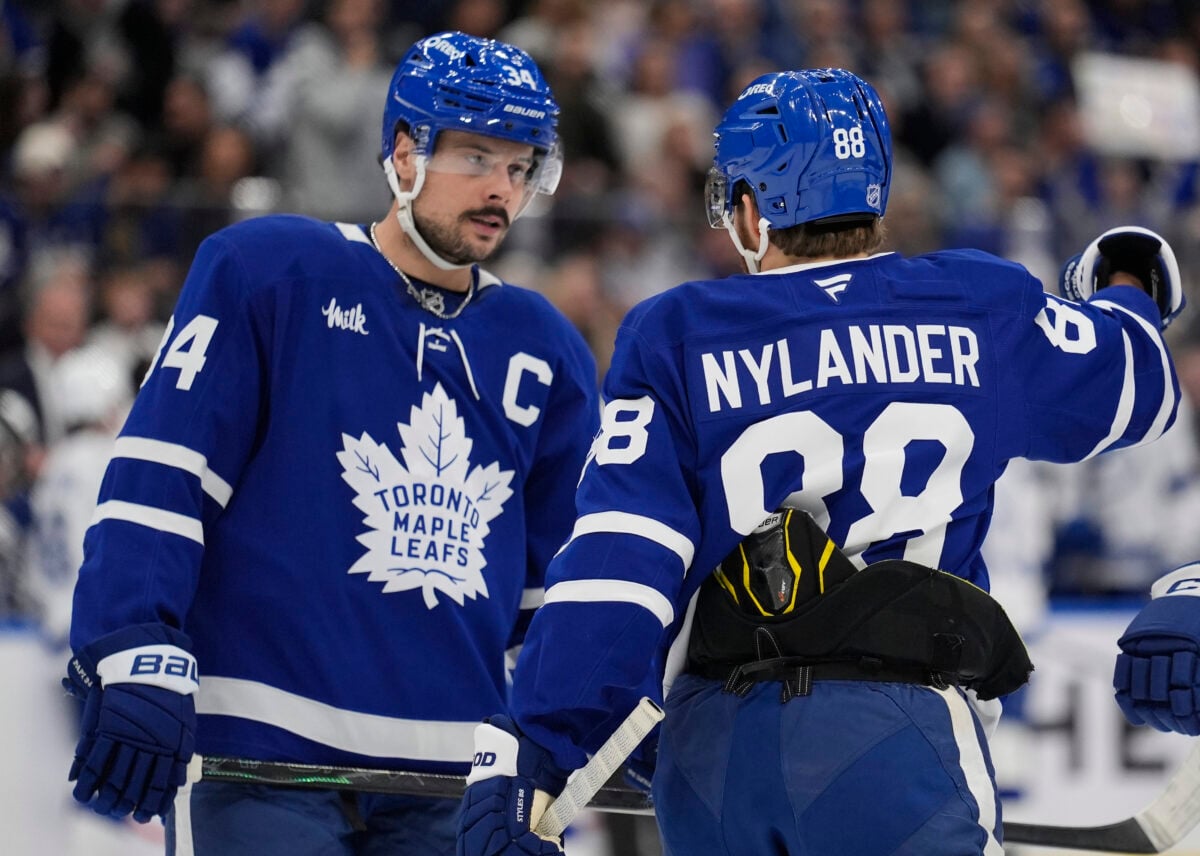 Toronto Maple Leafs forward William Nylander and forward Auston Matthews.
(John E. Sokolowski-Imagn Images)
And it continues down the lineup. Sissons, Paul and Roslovic give Toronto a third line with size, experience and two-way responsibility, while Joshua, Blueger and Duhaime give the fourth line a clear identity. The same idea shows up on defence, where the Maple Leafs can mix puck movement, experience, physical play and younger legs rather than asking one or two players to do everything. Maybe every player on this roster isn’t a star, and maybe every line won’t produce at the same rate. But that isn’t necessarily the point. The more interesting question is whether Toronto finally has four lines and three defensive pairs that each know what they’re supposed to do.
What’s Next for the Maple Leafs?
The Maple Leafs may be moving away from the idea that success comes from having the most individually talented lineup possible. Instead, they’re building a group in which different players can do different things well. That’s a subtle change, but it could be an important one. If the pieces actually fit, Toronto may have something it has been missing: a team that doesn’t need everything to go through its stars every night.
And that might be the biggest thing to watch when the season begins. The individual talent will still matter, of course. Matthews, Nylander and the rest of the core will have to produce. But if Toronto’s new additions can give the team more balance, more options and clearer roles, the team could finally be built to win games in several different ways.
Free Newsletter
Get Toronto Maple Leafs coverage delivered to your inbox
In-depth analysis, breaking news, and insider takes – free.