

After a disastrous conference final against Vegas and an underwhelming offseason, the majority of Avalanche fans that this writer has heard from over the summer are pretty down on the team.
That’s understandable considering the franchise went all-in to win the Stanley Cup, didn’t get the job done and had to sell off some important players in the summer to become cap compliant. It’s not all sunshine and rainbows and next week we’ll take a look at why some reasons for concern are very valid, but for now, we’ll keep the glass half-full approach.
Because for as “blah” as the last few months have been, this is still a good team just weeks away from the start of another training camp.
No. 8 and 29 are still in Denver
Yes, the Avalanche have lost some key players, but as long as Nathan MacKinnon and Cale Makar are still wearing burgundy and blue, this team will be competitive. And, at least for now, there’s still a good supporting cast around them for that to continue next season.
Winning is all that really matters, especially to these two, but you can’t take for granted being able to watch two of the best players in the world on a nightly basis. They each have the ability to win games by themselves, and as long as they’re in an Avalanche uniform, this group has a fighting chance.
Continuity on defense
Bringing back both Brett Kulak and Brent Burns isn’t the splash on defense that some were hoping for, but the Avalanche are very much following the “if it’s not broken, don’t fix it” approach to their blueline. For all but those final four games last year, it was not broken.
The Avalanche allowed 10 fewer goals at 5-on-5 than the next closest NHL team and finished in the top five in expected goals against. Only three teams allowed fewer scoring chances against than Colorado. For as deadly as they were offensively, and they were deadly, they didn’t give the other team an inch. The loss of a few important penalty killers in Jack Drury and Valeri Nichushkin will force them to make some adjustments and test the overall team defense, but that could also be a reason why they decided to keep some continuity on their blueline.
Defense is usually the area where teams struggle the most at the start of a new season as teams implement new systems and build chemistry. By bringing back the same six defensemen they ended last season with, the Avalanche should (theoretically) be ahead of the curve, which could allow them to get off to another strong start.
 Colorado Avalanche goaltender MacKenzie Blackwood (39) stops a shot during the second period in Game 4 of the Western Conference finals series against the Vegas Golden Knights in Las Vegas. (AP Photo/John Locher)
Woodshed remains
Since arriving in Colorado, Scott Wedgewood has been a revelation. His goals saved above expected across his 64 games with the Avalanche have been elite. Last season was a much larger sample size, but he did the same thing the year before in a lesser role. Goaltending can be fickle, but given what he’s provided since being acquired, you have to at least expect solid play when Wedgewood is in.
While not impossible, Wedgewood starting 43 games feels unlikely if Mackenzie Blackwood is healthy to start camp, which he’s expected to be. Even in a “down” year, Blackwood’s numbers were still strong. He just lacked consistency and couldn’t seem to get into a rhythm after missing the first month of training camp. Expectations are high within the organization for a healthy Blackwood to repeat his performance from the year prior.
With an 84-game regular season, the Avalanche will need both and are in good shape in net. It just might be wise to commit to one as “the guy” heading into the postseason.
Other Central contenders were quiet
It’s hard to deny that the Avalanche had an underwhelming offseason, but the two teams they fought all season long with for the Central Division title didn’t exactly do much either.
Dallas finished second in the Central before falling to the Minnesota Wild in round one. It looked iffy for a while, but they were able to get star forward Jason Robertson back under contract for this upcoming season. Beyond that, the biggest move they made was dealing away young 20-goal scorer Mavrik Bourque for nothing so they could re-sign Robertson. They’re still a good team, but didn’t do much to improve.
And then you have the Wild, who the Avalanche eliminated with relative ease in the second round. While their fans are concerned whether or not Quinn Hughes will re-sign with them, there also has to be some mild concern around key departures this summer. Marcus Johansson, Vladimir Tarasenko and Mats Zuccarello all left via free agency, with the latter being a large loss to their deadly power play. That’s 53 goals and 150 points exiting their lineup. They did bring in Blake Coleman, a dependable middle-six winger who will help, but that’s a lot of offense out the door.
Utah will be the team to watch in the Central, as they added dependable veterans in Vincent Trocheck and Anders Lee to their forward core. They’ve improved, but closing that massive 29-point gap in the standings between themselves and the Avalanche won’t be easy.
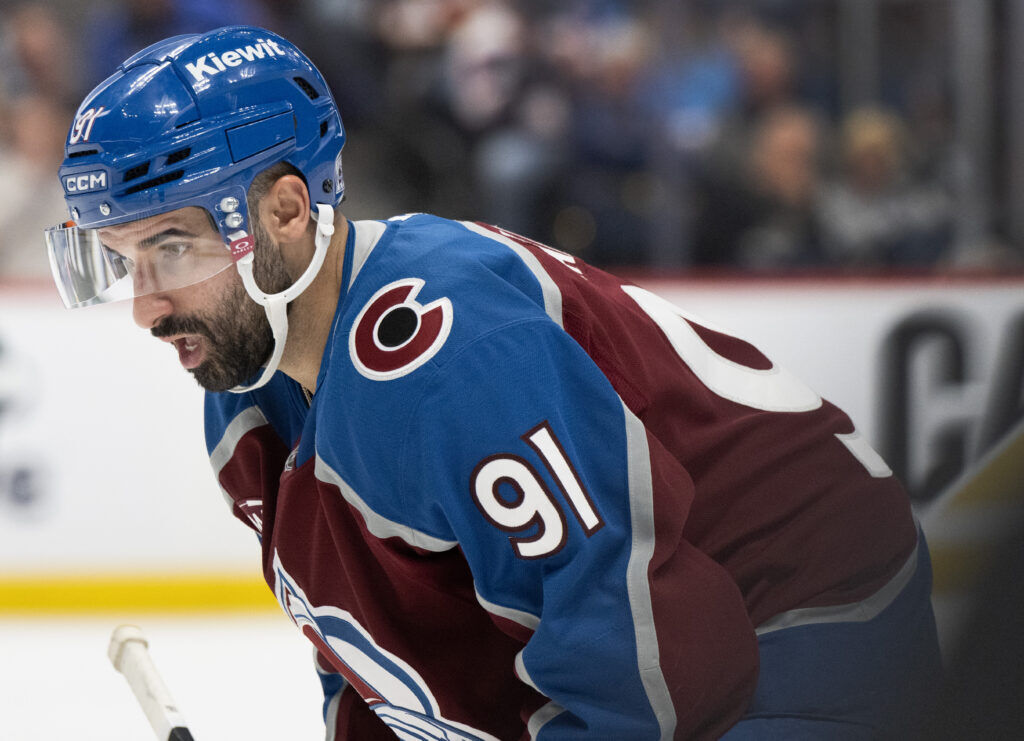 Colorado Avalanche center Nazem Kadri (91) prepares for a faceoff against the Minnesota Wild during the third period in Game 5 of the second round of the NHL playoffs Wednesday, May 13, 2026, at Ball Arena in Denver. (The Gazette, Christian Murdock)
Comparing rosters
The current Avalanche roster is a downgrade from the one Colorado finished the postseason with, but is it worse than the one that started last year and was the best in the NHL? That’s probably the right way to look at things, and the two groups are comparable.
Colorado’s deadline acquisitions, over the course of an entire season, are expected to replace some of the full-time departures. While Nazem Kadri won’t provide the same defensive impact Nichushkin did, the center should be able to put up similar numbers to the Russian offensively. Nicolas Roy has historically been a more productive offensive player than Jack Drury and should see time on the penalty kill with a full training camp under his belt. Brett Kulak seemed like a better fit for what the defense needs over Sam Girard.
And then you have the wild cards. Both Ross Colton and Joel Kiviranta took big steps back offensively last season. A healthy Jaden Schwartz alone could replace production from both of those players. Combined with the influx of youth, particularly the arrivals of Fedor Svechkov and Zachary L’Heureux from Nashville, and the Avalanche should be able to replace the two departing veterans with ease.
How Joe Sakic tweaks the lineup in season could make or break things, but the current roster is comparable to the one the Avalanche got off to a red-hot start with last season.
What I’m hearing
Some changes to Altitude’s broadcast team next season. Rachel Tos announced that she’ll be stepping away from her role as team reporter, a role that recently had a job listing appear. Tos is fantastic and will stay in the Altitude family, but welcomed a son earlier this year and said she wants to make family her priority at the moment. Lauren Gardner returns to Altitude and will be a part of all their broadcast teams, although her exact role with the Avalanche remains to be seen.
The Avalanche, like every other team, will be getting a “Hometown Remix” jersey at some point this coming season from Fanatics. Forgive me for not having a ton of faith in Fanatics properly pulling this off, but hopefully I’m wrong.
What I’m seeing
Sunday’s Avalanche alumni game at Magness Arena should be a great time. Joe Sakic was injured last year and couldn’t play, but it sounds like he’s expected to play this year.
Looked at prices for a seat at the Winter Classic in Utah and just about had a stroke. One ticket outlet says seats start at $282. That’s a lot of dough to watch a game where visibility is typically not great.
What I’m thinking
A handful of Avalanche regulars and prospects are already skating at Family Sports if fans are hankering to see some hockey in August.
August is usually the quietest month of the year in the NHL, but this one feels particularly quiet. General managers got all the chaos out of their systems back in late June.