
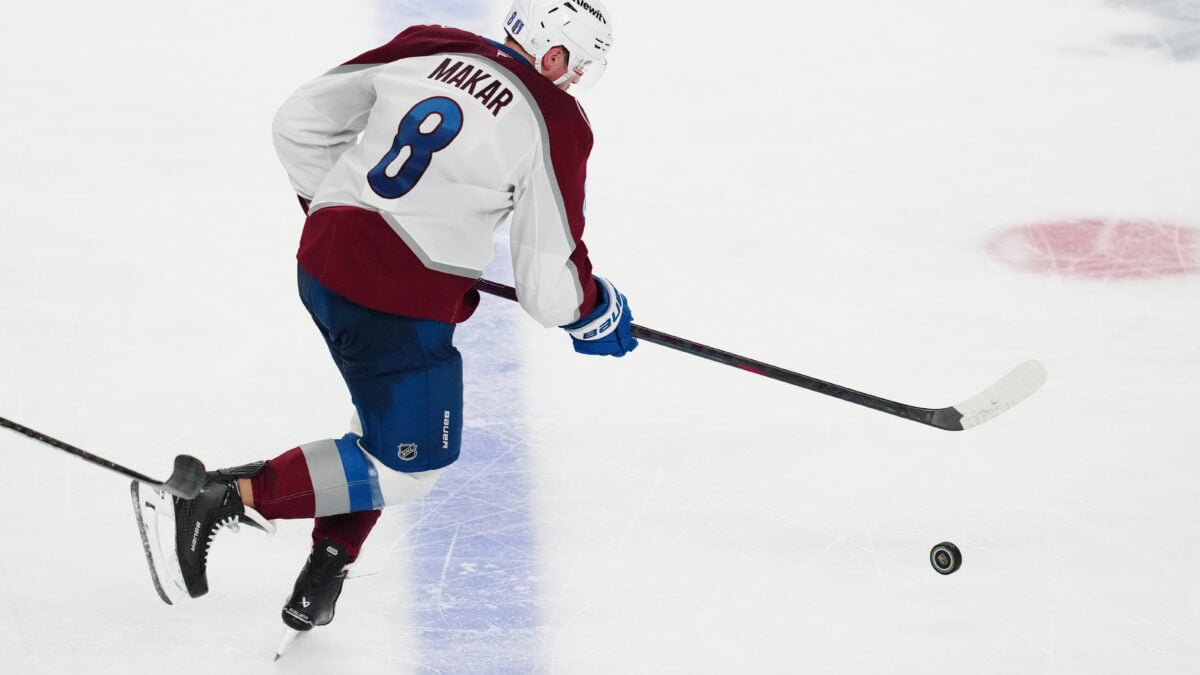
Ahead of Sunday’s Alumni Game between the Colorado Avalanche and DU Pioneers, general manager Joe Sakic fielded questions from local reporters about Cale Makar’s contract negotiations.
“We continue talking, and I’m pretty confident that he’ll be signed before the season starts,” Sakic told reporters before taking the ice.
Makar, 27, is entering the final season of his current six-year contract and can become an unrestricted free agent next July if he doesn’t sign an extension. That, obviously, remains an unlikely scenario for a player who has established himself as arguably the NHL’s best defenseman and a cornerstone of the Avalanche.
For now, it’s simply a matter of getting a deal done that works for both sides.
The biggest complication may be the rapidly rising salary cap and the new standard being established by some of the league’s biggest contracts.
Because of that, Makar could see his current $9 million AAV more than double on his next deal.
Last September, Kirill Kaprizov signed an eight-year, $136 million contract with the Minnesota Wild carrying a $17 million AAV. That deal begins with the upcoming 2026-27 season.
Before Kaprizov’s new contract even kicked in, his record AAV was surpassed twice this summer. Leo Carlsson signed a five-year, $90 million contract with the Anaheim Ducks after Philadelphia extended him an offer sheet worth $18 million annually. The Ducks ultimately matched the offer and will be on the hook for that deal starting in September.
Then came young star Macklin Celebrini, who signed a five-year, $94 million extension with the San Jose Sharks carrying an NHL-record $18.8 million AAV. That contract begins in 2027-28.
Makar, along with Minnesota Wild defenseman Quinn Hughes, could surpass Celebrini’s mark when their next contracts are negotiated as early as this summer.
For the Avalanche, planning for Makar’s next contract has been a priority for years, dating back to the Mikko Rantanen contract saga in 2024. They always kept things open for that.
But it’s hard to ignore how much the rising salary cap and new contracts around the league have changed the market since then.
“Really? I haven’t noticed that,” Sakic joked when asked if he’d noticed some of the new high-value contracts signed this summer.
“Like I said, I’m not worried about it. Cale’s not worried about it. Dialogue’s been great, and when there’s an agreement, we’ll gladly announce it. Hopefully something will be done before the start of training camp.”
Sakic also pointed to the league’s projected salary-cap growth as a major factor in the rising price tag for star players.
“I think everybody’s projecting where the cap’s going, and that’s why you’re seeing these contracts go to a certain level,” he said. “Everybody wants to lock up their young stars, and that’s what’s happening. That’s where the projections are right now. This year and next year it jumps, what, maybe $12 million or something like that? And then it’s another big jump after that.”
The NHL’s salary cap is set at $104 million for the 2026-27 season and is projected to rise to $113.5 million in 2027-28.
There’s also another soft deadline to keep in mind, as the NHL’s new collective bargaining agreement takes effect on Sept. 16. Under the new CBA, the maximum term for a contract signed by a team with its own free agent drops from eight years to seven.
There has been speculation that Makar could be motivated to sign an eight-year extension before that deadline, but that may not necessarily be the case. With the salary cap rising rapidly, more star players could have reasons to prefer shorter terms and another opportunity to cash in later.
Sakic was asked whether the CBA’s upcoming change is influencing the negotiations.
“Not really worried about it,” he said. “I think when there’s a deal announced or a signing agreed to, both sides will be comfortable with whatever term it is.”
The Avalanche already have 11 forwards, five defensemen and a goaltender under contract for the 2027-28 season, when Makar’s next deal would begin.