
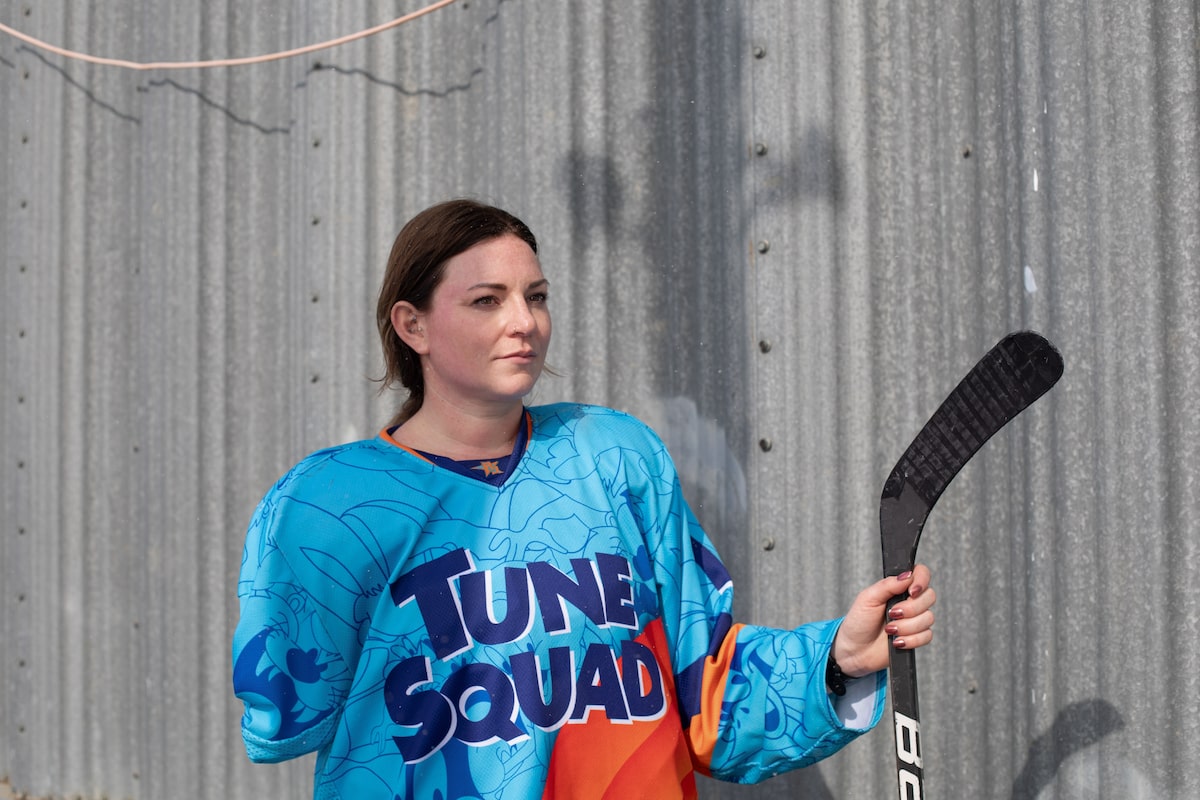
Sherry Sharko lay in the dirt of an Australian stockyard. Next to her, the motor of a tractor rumbled.
Her right arm lay several feet away.
It was February, 2008, and Ms. Sharko, just 19 years old, knew she was lucky to be alive. But she also knew a dream she had nurtured from childhood had come to a sudden and brutal end.
“Honestly, it was literally the first thing when I lost the arm, I was like, ‘There goes hockey,’” Ms. Sharko said. “Hockey was always the passionate thing. I really wanted to make something of myself in it.”
At the time, the game seemed lost to her. But years later, she has improbably found her way back to the ice.
Ms. Sharko does almost everything on her own, but tying her hair back presents a problem when it is ‘too silky,’ she says – hence this assist from her friend Lindsay Heckman. Soon, they are each lacing up for their game in the Barn Burner Tournament in Bon Accord, north of Edmonton.
Ms. Sharko grew up on a farm near Devon, Alta., about a half-hour from Edmonton, and like many hockey-mad Canadian kids, she spent her early years dreaming of stardom.
In her teens, she followed her hockey ambitions through school programs, club teams and tournaments.
The zenith was 2004-05, playing with the Edmonton Chimos in the fledgling Western Women’s Hockey League, where she shared the ice with some of the legends of the women’s game.
A scoresheet from March, 2005, from a game between the Chimos and the Calgary Oval X-Treme, gives a sense of the calibre of play.
The Calgary roster that night included Team Canada member Correne Taves (née Bredin), along with future Team Canada Hockey Hall of Fame inductees Hayley Wickenheiser and Danielle Goyette. Even though the game ended 0-0, Ms. Sharko managed a mention on the scoresheet with a penalty for bodychecking.
But despite moving in those rarified circles, Ms. Sharko sensed a trend. “You start to realize, ‘I’m not getting picked for the teams,’” she said. She was told several times she was too aggressive. “I played boys hockey until midget, and it didn’t always come through well in my tryouts.”
Then, ahead of the 2005-06 season, she was cut from the Chimos, a blow she said “kind of crumpled me.”
Stung, Ms. Sharko spent the next year alternately travelling and working. At the end of 2007, her wanderings took her to Australia, where she has citizenship from her mother’s side.
Even though Australia isn’t much of a hockey powerhouse, the game still beckoned.
“They informed me that if I stuck around there for two years, I would be able to try out for their national team,” she said. “I was hoping to do some travelling and play hockey there.”
She found a job at a cattle feedlot near remote Munglinup in Western Australia, population 140, about 600 kilometres southeast of Perth. There she met and began dating co-worker Mitch Wever, a New Zealander who shared Ms. Sharko’s love of travel.
Mr. Wever joined Ms. Sharko in an interview with The Globe and Mail to talk about the day that changed her life.
The morning of Feb. 8, 2008, was comparatively chilly, at least in Ms. Sharko’s estimation. She had been in Australia for about six months and seeing Mr. Wever for about a month. She was up early to grind feed for the cattle. “Because it was a colder morning, I had asked Mitch to borrow his jacket, and so I was wearing his jacket, which was way too big for me,” Ms. Sharko said. “It was a crisp morning, I remember that.”
“It wasn’t,” Mr. Wever interjected with mock disgust. “I’m like, ‘You don’t need a jacket, don’t be such a baby.’”
She was using a grinder mill driven by a power takeoff shaft, rotating at high speed. Power takeoff shafts are notorious for their role in devastating, often fatal, farm accidents.
As Ms. Sharko began grinding the feed, she leaned over to make an adjustment. The spinning shaft caught the sleeve of the too-big jacket. “I got wrapped into the machine, and at that point I was like, ‘God, I’m going to die,’” Ms. Sharko said. “And when it spat me out, it was, ‘Oh, I didn’t die.’”
She didn’t die, but her right arm had been sheared off above the elbow, her right femur was broken, and, as she would discover later, she had torn ligaments in her left knee.
Her memory of the immediate aftermath of the accident is fuzzy, but she guesses she lay on the ground somewhere between 10 and 30 minutes. Eventually, Ms. Sharko’s boss found her, still conscious. Amazingly, she hadn’t bled out.
“Really incredible,” Ms. Sharko said. “Apparently, the body is just an amazing device. So, when it’s stressed like that, a lot of times it will kind of stretch the blood vessels and snap them almost closed. So, I didn’t really lose that much blood. I lost a bunch, but not enough to be kind of concerned for it. It just kind of lopped off an arm, and on I went.”
One thing Ms. Sharko and Mr. Wever have in common is a gift of understatement.
“The first I became aware of it was when our boss came running across the yard holding an arm, which was a little bit jarring,” Mr. Wever said.
It took about 45 minutes before an ambulance arrived. As she waited, Ms. Sharko leaned into a stereotype encompassing Canadians, Australians and hockey players in general.
“I remember asking my boss for a beer and he told me, ‘No.’”
The ambulance took her to Esperance, a town of about 10,000 people, a little more than an hour from Munglinup, with Mr. Wever holding gauze and wadding over the stump of her missing arm.
Initially, there was hope the arm could be reattached, but an air ambulance sent to transfer Ms. Sharko to a major hospital in Perth was rerouted to a traffic accident. The delay made reattachment impossible.
If there was one bright spot, it was that she didn’t also lose her badly broken right leg. After doctors attended to the injuries around her severed right arm, she has a foggy memory of going in for surgery on her leg, unsure if it would still be there when she woke up.
Just three weeks after the accident, her right leg had healed enough for her to attempt standing. It was at that moment that Ms. Sharko discovered she had torn ligaments in her left knee and required yet more surgery.
Despite the setbacks, Mr. Wever said she remained matter of fact.
“She was almost scarily calm about it,” he said. “It was always like she just wanted to be out of hospital and get on with things.”
Roughly eight weeks after the accident, she returned to Canada in a wheelchair, bored with recovery.
“I wanted to be a little more independent,” she said. “And eventually … I kind of ignored what [the doctors] said and started walking.”
As Ms. Sharko healed, Mr. Wever embarked on a previously booked trip to Canada, visiting her in Alberta.
“I think when we were in Australia, neither of us expected any more, to be honest,” he said earlier this year. “I came here, and we still got along really well.”
“And the poor guy has just regretted life ever since,” Ms. Sharko cut in.
“Yeah, she trapped me with the beautiful weather,” the displaced New Zealander said, heavy snow blanketing the ground outside at the time of the interview.
For a long time after her accident, Ms. Sharko was convinced she would never skate again, let alone play hockey. The delayed surgery on her left knee caused her to drag her foot, which lasted more than a year. In the meantime, she was also learning to live without her dominant arm.
Her return to the ice began with Mr. Wever, who turned a pond on their property into a winter rink.
She began skating again but resisted the call of hockey until a friend invited her to play a pickup game, 11 years after her accident. Reluctant at first, Ms. Sharko was eventually cajoled. She was a bag of nerves stepping back onto the ice in her old gear.
“It was almost like I was going skydiving or something,” she said. “I get nervous every time I play hockey, but that, I remember being almost nauseous. And then the next day, I just felt like I’d been run over by a truck.”
Since that first game back, Ms. Sharko, now 37, has become an eye-catching presence on the rink, both in beer league play and informal shinny.
Holding her stick in front of her with her left hand, Ms. Sharko has a narrow-looking posture that contrasts with the wide, two-handed stances of the other players.
She has tried a variety of prosthetic arms, but they have never worked well for her. Instead, the right sleeve of her jersey remains empty, tied or pinned up for organized hockey, in accordance with league rules. But during pickup shinny, she races up the ice, the sleeve flapping behind her like a flag caught in a breeze.
She carries the puck with remarkable confidence as she attacks opponents, relying on her elite skating ability to shield the puck with her body. She turns and pirouettes, sometimes straight upright, other times crouched low, cutting in and out between the other players. It’s almost reminiscent of figure skating – if figure skating featured a lot of accidentally-on-purpose body contact and the liberal use of creative profanity.
Former Team Canada member Ms. Taves now plays with (and sometimes against) Ms. Sharko. She said what impresses her most about Ms. Sharko’s play is how hard she works.
“She’s always skating, never coasting,” Ms. Taves said. “When she’s playing against you, you’re like, ‘Oh, here she comes. Hustle back.’ If you just float back, she’s on you.”
Breaking into open ice, Ms. Sharko leans forward into her stride, legs pumping and stick outstretched. In those moments, she seems to be in some sort of hockey purgatory, caught between controlling the puck and chasing it.
With one hand, she can lever her stick off her shin pads to shoot the puck, but not with the accuracy or velocity she wants. Instead, she often glides into the offensive zone, wheels around defenders and drops or sweeps a pass to an open teammate.
There is still ferocity in her play, an echo of younger days when ambition drove her always to be better. But now, there’s also an obvious joy: an athlete revelling in competition, camaraderie and love of the game.
These days, Ms. Sharko and Mr. Wever live and work on the grain farm where she grew up. It’s a bucolic setting with a few goats and sheep, and a large, exuberant dog named Moose.
Although Ms. Sharko no longer plays hockey at the level she once did, her passion for the game burns even brighter. She plays five or six times a week on a number of different teams and enjoys it more than she did before her accident.
“I was so stupidly competitive, I think back then I probably lacked a bit of the enjoyment,” Ms. Sharko said. “There comes a kind of graceful period where you’re like, ‘I’m doing this for fun.’ I’ve turned that page now.”
Last season, Ms. Taves invited Ms. Sharko to tell her story to a minor hockey team she coaches.
“I thought, what a great story to show the courage it takes to overcome something in your past, or your mind, or something physical,” Ms. Taves said.
“It’s about your mental strength and how you choose to face the challenges in your life. She felt that when that accident happened, there was no other choice but to close that chapter. And then she opened it back up, and now she’s just living it.”
The relationships, not the statistics, represent what is most meaningful to her, Ms. Sharko said.
“The best bit of coming back is the friends I’ve made. … I’ve met some of the best people in my life through the sport.”
Accessibility in motion: More from The Globe’s podcast archives
Canadian Blind Hockey games sound like clanging, from the oversized pucks; tapping, as players use sticks to navigate pylons; and cheering, as teams celebrate their victories. In 2023, The Decibel and sports reporter Rachel Brady went to a game to hear from parents, players and coaches. Subscribe for more episodes.