
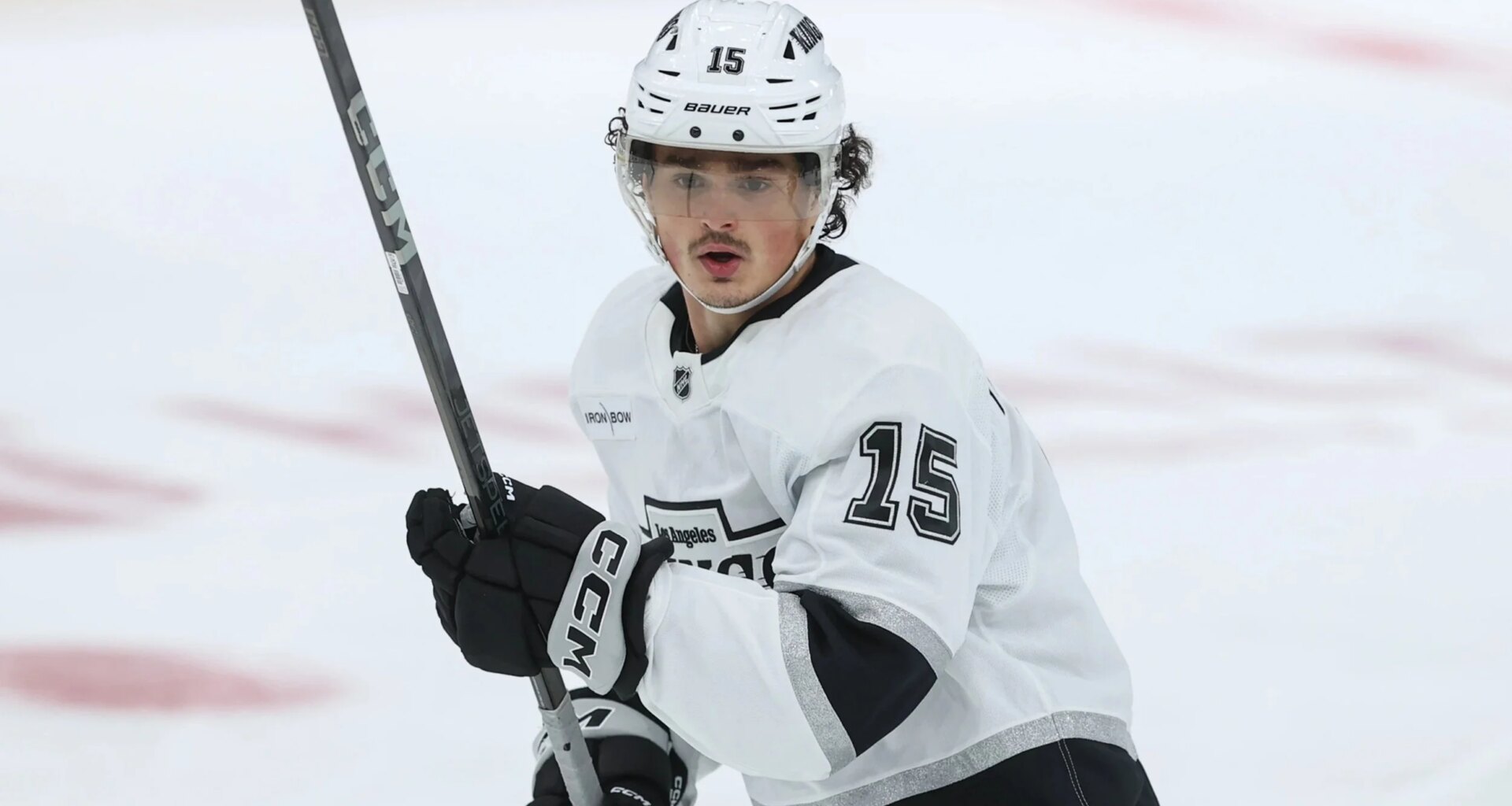
Maybe he could handle all the responsibility of the pivot, but why take one of the few offensive roles on this roster that already works and change it unless you absolutely have to, especially with Kevin Fiala unavailable to begin the season? Moving Kempe to center potentially solves one position while creating another problem on the wing. Turcotte doesn’t present the same trade-off.
TURCOTTE DOESN’T HAVE TO REPLACE KOPITAR
This is where expectations need to remain reasonable.
Turcotte doesn’t need to become Kopitar, an 80-point center or even the player Los Angeles imagined when it selected him fifth-overall in 2019. That conversation isn’t particularly useful anymore. Turcotte is 25, and the question isn’t whether he ultimately justifies a draft selection made seven years ago, it’s whether he can help the 2026-27 Kings win.
It’s also impossible to fairly evaluate Turcotte’s development without acknowledging how frequently injuries interrupted it.
His early professional seasons were repeatedly disrupted by significant injuries, including multiple concussions and other ailments that cost him substantial playing and development time. For a young center trying to adjust to professional hockey, those weren’t merely games missed on a stat sheet; they were lost practices, lost repetitions and lost opportunities to establish confidence and continuity at precisely the stage when those things mattered most. Turcotte still has to be evaluated on what he is today rather than what might have happened under different circumstances, but his path from fifth-overall pick to 25-year-old still trying to establish a permanent NHL role hasn’t been a conventional development curve. Injuries repeatedly stopped that curve just as it appeared ready to move forward.
That’s part of what makes this opportunity so intriguing. For perhaps the first time in his professional career, the discussion isn’t primarily about where Turcotte was drafted, what happened to his development or whether he can stay in the NHL. It’s about whether he can handle an important NHL job. If Turcotte can handle second line center responsibilities, even imperfectly, the lineup suddenly becomes much easier to construct – Artemi Panarin, Byfield and Kempe can remain together, Turcotte can potentially center Mats Zuccarello and Alex Laferriere (and eventually Fiana), Haula can strengthen the third line and Laughton can be deployed lower in the lineup in situations better suited to his strengths.
That’s not simply Turcotte winning the 2C job. That’s one player potentially making three lines better.
AND THAT’S REALLY THE POINT
The Kings don’t need Turcotte to drive the second line by himself; they need him to make it work, and there is reason to believe his style can complement skilled wingers.
Turcotte plays fast, not simply with his feet but with his decisions. He pressures pucks, pursues possession, gets underneath opponents and plays through the middle of the ice. Alongside Zuccarello and Laferriere, he wouldn’t necessarily have to be the primary creator because Zuccarello can create and Laferriere can attack space and finish. Turcotte can connect the pieces by winning possession, advancing the puck, supporting it, recovering it and getting to the middle. That’s a much more reasonable standard than expecting him to suddenly become a high-end offensive center. There is still a production threshold, however, because the Kings were one of the NHL’s weakest offensive teams last season and cannot afford a second line whose primary accomplishment is not getting scored on.
Turcotte doesn’t need to put up huge numbers, but his line must create enough offense that opponents respect it. Can it enter the zone with possession, sustain offensive-zone time and consistently put Laferriere in scoring positions? Can Turcotte get the puck to Zuccarello in areas where his creativity becomes dangerous? If the answer is yes, the Kings suddenly have something they badly need: a second scoring line capable of preventing opponents from loading everything against Panarin-Byfield-Kempe.
That’s the actual test, not whether Turcotte scores 60 points but whether the lineup becomes harder to defend because he’s in the middle of it.
BYFIELD GETS HIS OPPORTUNITY, TOO
There’s another reason I like the idea: it allows the Kings to finally make this Byfield’s team down the middle.
For years, Byfield developed with Kopitar occupying the most important center role on the roster. That safety net is gone, and the Kings shouldn’t try to manufacture another one. Put Byfield between Panarin and Kempe and find out how high his ceiling actually is. Panarin gives him an elite creator, Kempe provides speed and finishing, while Byfield brings size, puck transportation, retrieval ability and an offensive game that has continued to mature. Then leave them together long enough to find out what they can become.
If Turcotte can handle the next center position, Laviolette doesn’t have to compromise Byfield’s opportunity by moving Kempe. That’s why this isn’t simply a Turcotte story; it’s also a Byfield story, a Kempe story, a Haula story and ultimately a roster-construction story.
GIVE TURCOTTE THE JOB – THEN MAKE HIM KEEP IT
One excellent pre-season game proves almost nothing, and that’s a caveat.
The NHL gets much harder when the standings begin counting, when opponents stop experimenting, matchups become intentional and time and space disappear.
Saturday shouldn’t be treated as an answer so much as permission to ask the question: Can Alex Turcotte actually be the Kings’ second-line center?
I’d give him the opportunity and then make him keep it, not because he was a fifth-overall pick and certainly not because he scored twice against Anaheim in September, but because his camp has earned him a legitimate test in a role that could improve the structure of the entire lineup. Give the alignment enough runway to produce meaningful information. If it doesn’t work, Laviolette has alternatives: Haula can move up, Kempe remains an emergency option and Ken Holland can eventually look outside the organization if the internal solutions aren’t sufficient.
But don’t abandon the idea before you’ve actually tested it, because the potential payoff is larger than Turcotte himself.
THIS IS WHERE HAULA’S VALUE MAY ACTUALLY INCREASE
Haula doesn’t become a failed off-season addition because Turcotte plays above him. Quite the opposite – it may allow the Kings to use him in a role better suited to maximizing his value.
Haula can handle defensive assignments, take faceoffs, kill penalties, move around the lineup and provide secondary offense. Those attributes become more valuable when Los Angeles isn’t simultaneously asking him to drive a scoring line. The Kings accumulated center options during the off-season, and maybe the payoff isn’t one acquisition becoming the answer. Maybe it’s having enough depth that nobody has to be asked to do too much.
That’s an important distinction.
THE KINGS NEED FUNCTIONS, NOT ANOTHER KOPITAR
Kopitar can’t be replaced by Turcotte, Byfield, Haula or by moving Kempe.
For nearly two decades, Kopitar provided elite two-way center play, offense, matchup responsibility, special teams, leadership and durability in one package. Searching for one player to reproduce all of that is the wrong exercise.
But instead, you can replace the functions. Byfield can absorb more offensive responsibility, Kempe can remain a primary scorer, Haula and Laughton can handle more of the defensive work, Panarin can drive creation and Turcotte can potentially provide another legitimate center. Collectively, that’s how the Kings move forward.
Which brings us back to Saturday.
Turcotte scored twice; a nice afternoon, but forget the goals for a moment because what matters is that Laviolette now appears willing to ask a considerably more consequential question: Can Turcotte center the second line? If the answer becomes yes, the Kings won’t merely have discovered another useful player. They may have discovered the lineup structure they spent the entire off-season trying to find without making a trade, moving their best goal scorer out of position or creating another hole somewhere else.
Sometimes the best roster move isn’t the one a General Manager makes. It’s the one a player forces the organization to discover.