
It was one of the bigger announcements in the hockey world over the past calendar year — the fact that players who’ve played in any of the Canadian Hockey League’s (CHL) three leagues would now be eligible to commit to NCAA schools.
While it wasn’t directly said by those announcing this groundbreaking news for player development, what it did for the hockey world was change the landscape of prospect development in both organizations. The NCAA became a more competitive league, while the CHL would be able to explore more development options for some younger players.
That said, it was a discussion point for some players at this season’s NHL Combine in Buffalo this past weekend. Even more so for players like Malcolm Spence and Jack Ivankovic who recently committed to NCAA schools and made the jump from major junior to the collegiate circuit.
Both NCAA committed players and those remaining in major junior had similar things to say about the news — like it or not, it provides more options and, in some cases, better options for players to continue their development and extend their respective careers.
Goaltenders Given a Second Life With NCAA Option
One of the questions that was asked of goaltending prospect Joshua Ravensbergen was in regards to Canadian goaltending and why the nation hasn’t been as strong at the position in recent years. It was his response that got me thinking of the development path of goaltenders — especially those who come through the CHL.
 NCAA, CHL (The Hockey Writers)
“At the end of the day it’s not really about where you go and I learned that not being draft to the [WHL],” said Ravensbergen about being drafted in the first round of the 2025 NHL Draft. “It’s about what team you go to and then you have to work your way up. It doesn’t really matter where you go, it’s what you do after.”
Related: NHL Draft Prospect Joshua Ravensbergen Going Undrafted to First-Round Potential
Ravensbergen reminded reporters on Saturday that goalies are one of the most important positions in the game and often take longer to develop, something he noted the NCAA could help with.
“Goalies don’t get as much time to develop,” he noted about the age limitation in the CHL. “It’s either be a pro at 20 or it’s really hard to make it as an overager in the CHL. A lot of goalies don’t hit their prime until later and they aren’t really given that opportunity in the CHL. Although now, hopefully, that will change because we’re able to go to the NCAA as opposed to playing until you’re 19 and then you either go pro or get cut from your junior club.”
Jack Ivankovic Taking the NCAA Route
One goaltender has already decided to make the jump. Ivankovic will be leaving the OHL’s Brampton Steelheads after two seasons to join the University of Michigan Wolverines in the fall. The 18-year-old went 25-12-5 in 2024-25 with a .903 save percentage (SV%) and 3.05 goals against average (GAA) and is projected as one of the top two goaltenders off the board at the draft.
Still, the move to the NCAA gives Ivankovic an opportunity to further his development, a longer window to do so and the chance to earn an education at the collegiate level while playing hockey.
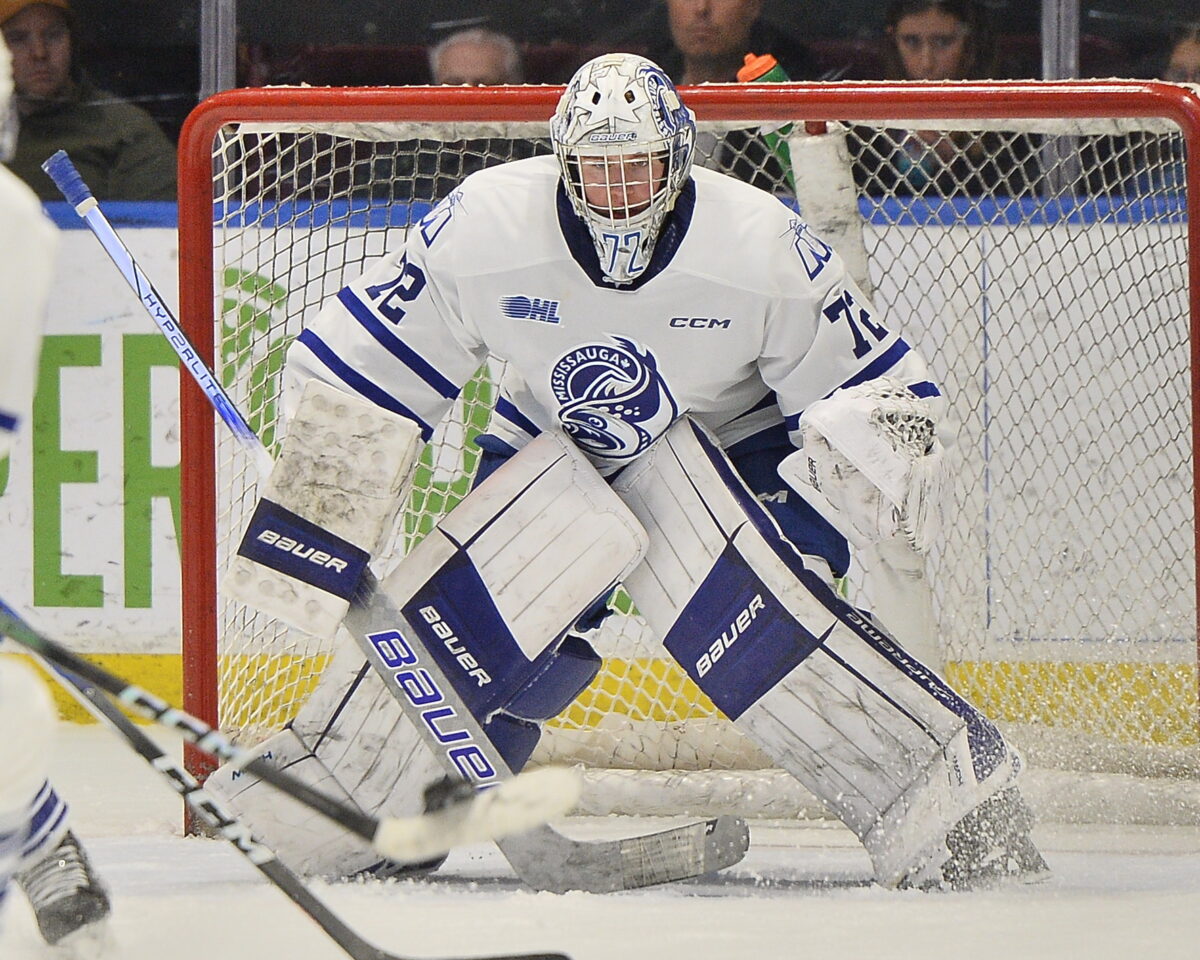 Jack Ivankovic, Mississauga Steelheads (Terry Wilson / OHL Images)
“Being a starter at such a young age, and the Big 10’s pretty unreal,” Ivankovic said as reasons for his move to Michigan. “Playing against older guys, you know, is something I thought was going to be best for my development.”
He also that is has been a conversation amongst players — the benefits of the NCAA route of development — a decision he surely didn’t make lightly.
NCAA Option Offer Further Growth for All Players
It’s not just goaltenders that are considering the move either. Spence, a forward with the Erie Otters in 2024-25, will also make the collegiate jump for the 2025-26 season to the University of Michigan.
Spence, a projected 2025 first-round pick, finished the 2024-25 seasons with 32 goals and 73 points in 65 games for the Otters.
But other players, who’ve yet to determine their future, have considered how the NCAA eligibility will change the landscape of their hockey careers in North America.
Related: THW’s 2025 NHL Draft Guide
“It’s definitely interesting,” said fellow prospect Blake Fiddler on the NCAA. “A lot of guys have a lot more opportunity with the NCAA. I’m not opposed to it, but I’m just kind of taking it day-by-day and year-by-year. Planning to go back to Edmonton next year and finish what we started there.”
Porter Martone had a similar sentiment: “It definitely changes [the landscape] and gives people more options. My number one goal is to play in the NHL next year, so I’m going to try and go to training camp and earn my spot.”
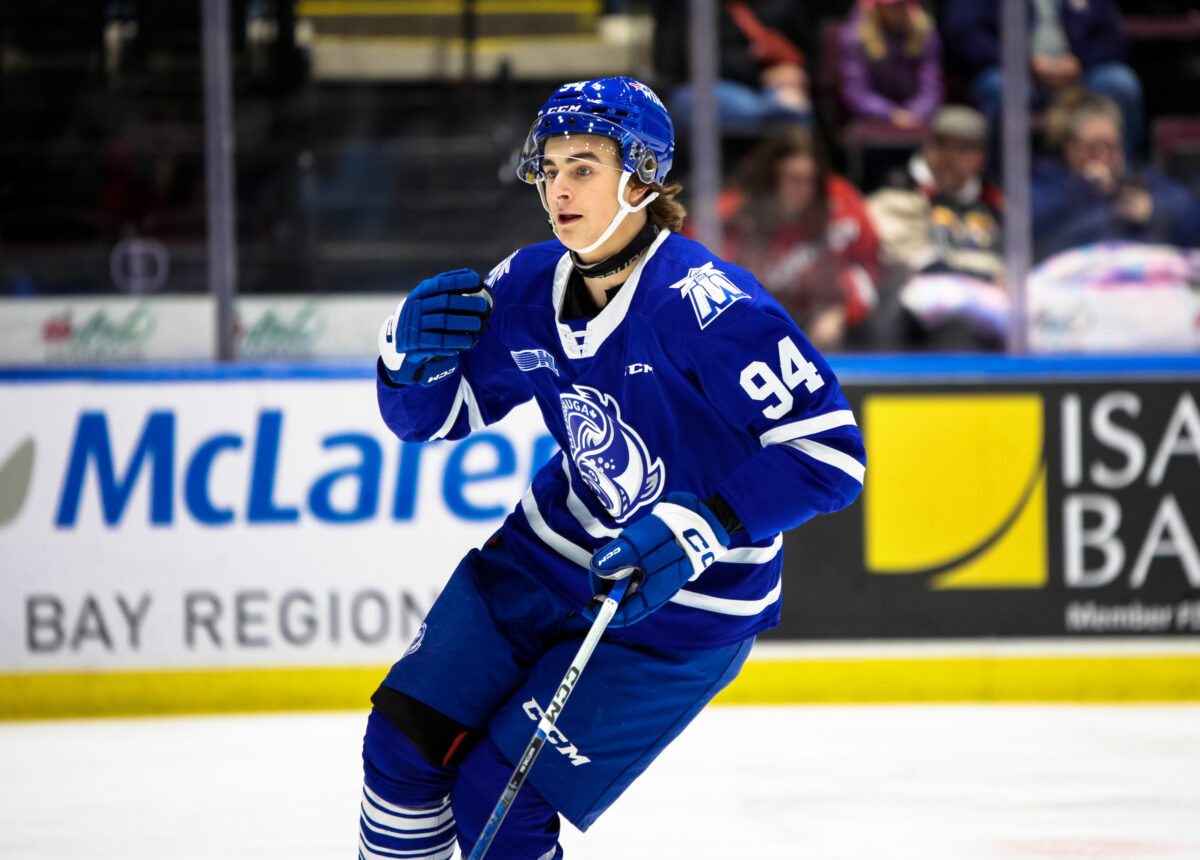 Porter Martone, Mississauga Steelheads (Natalie Shaver/OHL Images)
“Obviously it opens up some doors for some guys,” said Kitchener Rangers’ Luca Romano. “I think it’s a good rule change for development and also make our league better. Young guys that want to go to school can come to our league first, play a couple years and then head onto school. I think it’ll make the NCAA really competitive.”
Like the others, Romano is happy where he is in Kitchener.
While there’s still a loyalty amongst some of the players looking to return to their CHL clubs, the decision to head to the NCAA for others wasn’t made with ease. In fact, players along with their families and agents made the decisions based on what they felt was best for their development and in some cases that may be the route they’re meant to take.
For goalies like Ivankovic and Ravensbergen, a little more time might be the different between an adequate and an elite career for these Canadian goaltenders.
Sign up for our NHL Prospects & Draft Substack newsletter
