
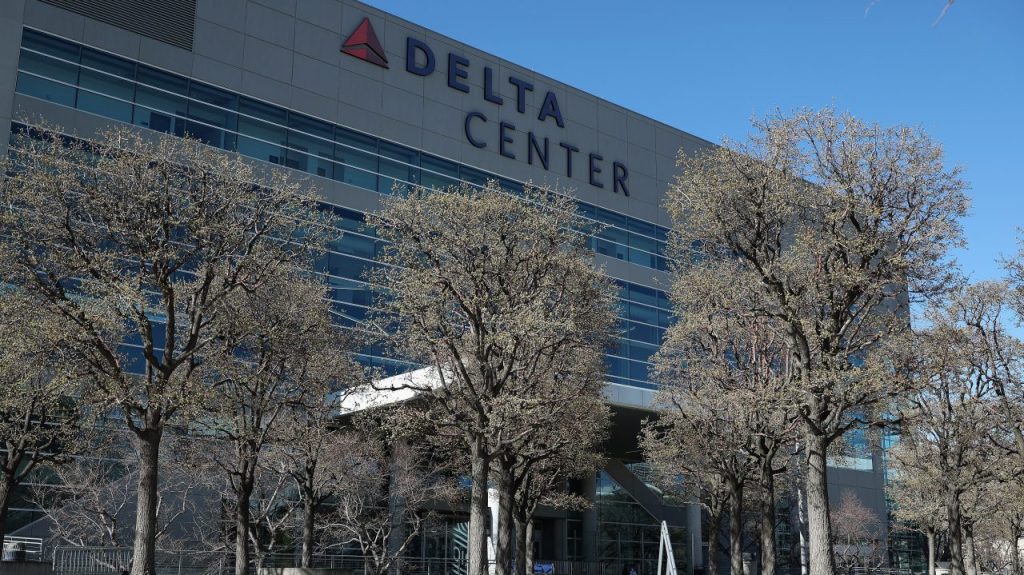
Smith Entertainment Group, which owns the NBA’s Utah Jazz and the NHL’s Utah Hockey Club, is planning a multiyear renovation of the Delta Center. The changes will go even further than those made when Ryan and Ashley Smith brought the former Arizona Coyotes to Salt Lake City last year.
The renovations, as part of the creation of a new mixed-use sports and entertainment district, will be paid for through a significant infusion of taxpayer dollars. In October, Salt Lake City Council approved an increased sales tax in its downtown (0.5%) that will fund its $900 million contribution to the district over the next 30 years, with $525 million allocated for the renovations.
Last May, Ryan Smith pledged “a minimum” of $3 billion toward the creation of the district.
The first round of renovations will focus on what’s billed as “the first-and-only” retractable seating arrangement to fully accommodate the needs of both the NBA and NHL franchises. SEG has hired StageRight, a Michigan-based designer that specializes in building stages, risers and other performance venue products, to develop the arena’s new seating.
The arena bowl will be lengthened by 12 feet at each end and the floor will move up by two feet to accommodate the new riser system. When activated, the system will be able to retract 29 rows of seats for UHC games or add them for Jazz games. Additionally, dehumidifiers will be added to keep the hockey ice cold.
For fans, premium spaces will be added to the arena’s first level and restroom capacity will grow “by 12%.” SEG will also begin the groundwork this summer for a parking structure adjacent to the Delta Center.
Capacity for UHC games will go from just over 11,000 as of last season to nearly 17,000 fans. The capacity for Jazz games will grow by a few hundred seats—from 18,206 to nearly 19,000.
Down the line, the renovations will include a redesigned main entrance, redesigned arena concourses and a revamped upper bowl.
With the arrival of the Hockey Club last spring, the Delta Center became the 11th arena to house both an NBA and NHL team. Although the arena once held minor league hockey games, the premium demands of an NHL franchise forced SEG to make quick renovations to accommodate the new team. The changes included new NHL locker rooms, tunnel pathways from those locker rooms to lead to the team benches, and additional spaces for hockey coaches and officials.
While there were rumors that SEG would pursue a multipurpose arena in Salt Lake City for both of its teams, Ryan Smith, the founder of Qualtrics, instead publicly committed to developing the Delta Center.
Before Utah, the last time an NHL team moved into an arena primarily used for an NBA team was in 2015 when the New York Islanders temporarily moved from Long Island to the Barclays Center, home of the Brooklyn Nets, for parts of five seasons. The Islanders’ residency there was roundly criticized due to the poor sightlines for hockey, obstructed seating and the dark ambiance (based on the Nets’ black, gray and white colors) surrounding the arena bowl. The Isles eventually found their way back to Long Island to the $1 billion UBS Arena in Belmont Park.
The Delta Center opened in 1991, replacing the Salt Palace as home to the Jazz. It was built at the cost of $93 million (around $214.7 million today, when adjusted for inflation), and underwent a $125 million renovation in the summer of 2017, with upgrades to the concourses and premium suites.
In December 2020, the Miller family sold the Jazz and Vivint Smart Home Arena (one of the arena’s past names) to the Smiths for $1.66 billion. Nearly two decades after declining to renew its naming rights agreement due to its 2006 bankruptcy filing, Delta Air Lines returned as the arena sponsor in 2023. Valued at $3.6 billion, the Jazz rank 22nd in Sportico’s NBA franchise valuations list.
Last spring, in a complicated deal, the Smiths acquired the hockey operations of the Coyotes from the NHL for $1.2 billion after Alex Meruelo sold the franchise to the league. Meruelo’s inability to secure a permanent home for the hockey team led to its departure from Arizona. Currently valued at the purchase price, the Hockey Club ranks 28th in Sportico’s NHL franchise valuations list.