
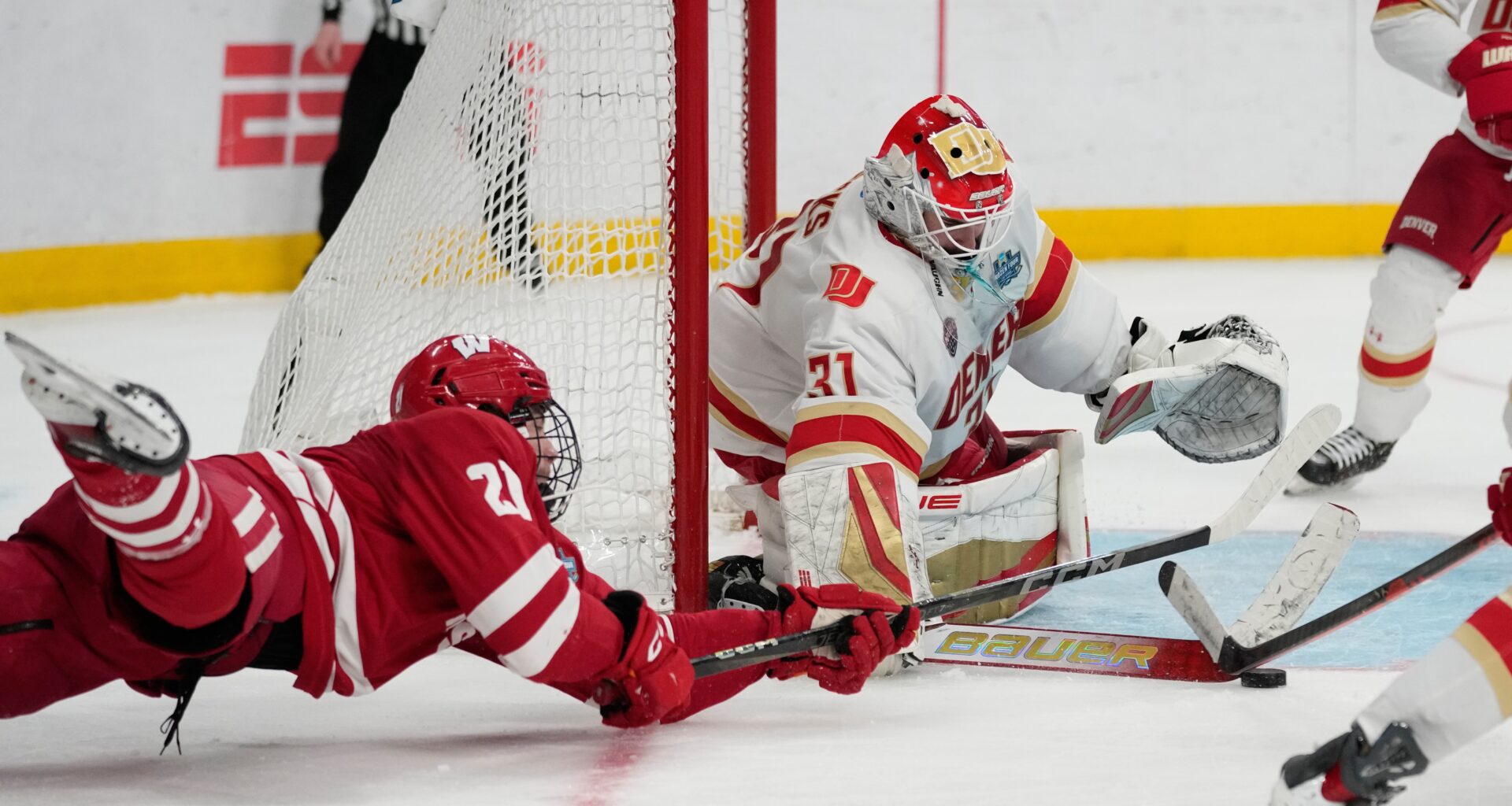
David Carle and Tavis MacMillan have deep ties to Alaska, so it’s no surprise they both wanted a particular player from the Fairbanks Ice Dogs to come to the University of Denver.
They devised a plan to make it happen. MacMillan would fly to Fairbanks, where he had played and coached at the University of Alaska at Fairbanks, to try and lock down a commitment. There was just one slight issue.
They didn’t tell the boss, former DU head coach Jim Montgomery.
“He didn’t know about it,” Carle said. “Tavis and I talked about it and we were like, ‘Don’t even tell him. He’s going to tell you not to go, but we feel we need to go, so let’s just do it. He trusts us to do the job. Let’s do the job and get the player.’”
MacMillan went to Fairbanks. The player, Kyle Mayhew, committed to the Pioneers in March 2018. Mayhew played more than 150 games for the Pios and was part of the 2022 national championship team, Carle’s first as the program’s head coach.
“That’s the level of trust you’re looking for,” Carle said. “That maybe sounds deceitful, but it was the opposite. With Tavis, there’s full trust in him going out and doing what he needs to do to find players and build relationships.”
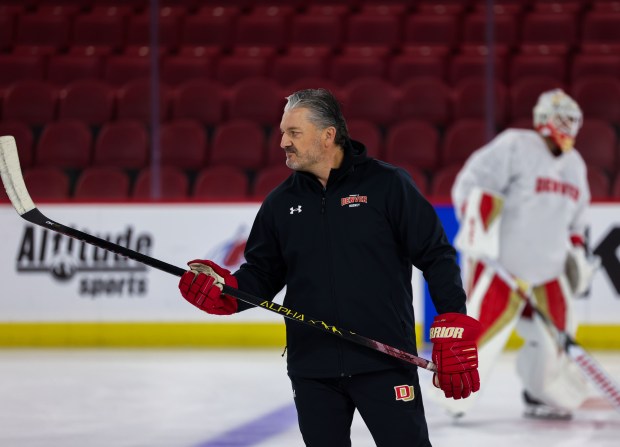 Tavis MacMillan has won four national championships as an assistant coach with the Pioneers and was promoted to general manager and assistant coach before the season. (Courtesy DU Athletics)
Carle and MacMillan have won four national titles together, first as assistants to Montgomery in 2017 and then three in the past five seasons as they’ve built DU into the premier college hockey program of the past decade.
They’ve done so at a place far removed from the traditional American hockey hotbeds that produce NCAA players. Carle is one of the most accomplished NCAA coaches and he’s only 36 years old.
There’s a strong argument that Carle has the best coaching staff in the country, led by MacMillan, who arrived in 2015, and Dallas Ferguson, who joined in 2018 when Montgomery left for the Dallas Stars and Carle became the head coach.
MacMillan has been the recruiting coordinator, but before this season he was promoted to general manager and assistant coach. His connections in the hockey world, particularly in Western Canada, are vast and diverse.
“When I first came in, I remember sitting in my very first coaches meeting with (Montgomery) and (Carle),” MacMillan told The Denver Post. “I just came off eight years of doing NHL scouting, and I learned very quickly that wow, these two are at a whole other level. I need to just go find these guys players, because if we can find players, these guys can do the rest.
“It took me a little bit, but once I figured it out, it actually got easy because I knew what they wanted. They had no problem passing on players if they weren’t a good fit, no matter how good they were. And it allowed me to have the confidence and the flexibility to be able to find them the right players.”
 Members of the Denver Pioneers celebrate with their fans after the victory against the Wisconsin Badgers in the NCAA Division I men’s ice hockey championship game at T-Mobile Arena on April 11, 2026 in Las Vegas, Nevada. (Photo by Ethan Miller/Getty Images)
It has helped the Pios build an NCAA superpower. There have been massive changes to how college hockey teams recruit players, who they recruit and how rosters are constructed in the past five years. MacMillan and DU have adapted, and the most successful program in NCAA history has found a new level.
No. 1-ranked Denver welcomes No. 2 Michigan to Magness Arena this weekend for the season’s marquee non-conference game. The Pios are the defending national champs, and just welcomed the most decorated recruiting class in program history.
“It’s not that it was bad before by any stretch, but I think it’s a really well-oiled machine now,” Carle said. “There’s not many recruiting battles we get into now where we feel like we’re on our back foot.”
‘This whole business is networking’
For MacMillan, everything comes down to relationships.
He grew up in a small town in Alberta, played and coached in Fairbanks and then spent eight years scouting for the Atlanta Thrashers/Winnipeg Jets franchise. MacMillan first met Carle when the latter was a player at Shattuck-St. Mary’s, a prep hockey factory in Minnesota with an alumni list that includes Nathan MacKinnon, Sidney Crosby and Macklin Celebrini.
MacMillan has family connections in the sport all over Western Canada. His brother, Darren MacMillan, is the GM at South Alberta Hockey Academy, which is part of the Canadian Sport School Hockey League, a primary feeder system for Western Canada’s top junior leagues.
His brother-in-law, Sean Clouston, is the GM of the Kamloops Blazers in the WHL. His nephew, Torrin White, is an assistant coach with the Lethbridge Hurricanes in the WHL.
“This whole business is networking,” MacMillan said. “You have to use resources wherever you can find them, and having the connections out West has certainly helped us.”
One such connection directly helped the Pios claim their 11th national title in April. MacMillan heard about this small goaltender playing for the Merritt Centennials in the British Columbia Hockey League.
The Pios didn’t have a spot open for a goaltender of that age at the time. But MacMillan was intrigued and kept an eye on the kid as he moved on to the Brooks Bandits, a club that has produced Cale Makar and several future Pios, and then the Victoria Royals in the WHL.
Then, a spot opened up for the 2025-26 team. Carle asked MacMillan if he had any goalies in mind.
 Johnny Hicks #31 and Brady Milburn #10 of the Denver Pioneers celebrate the team’s 2-1 victory over the Wisconsin Badgers to win the NCAA Division I men’s ice hockey championship game at T-Mobile Arena on April 11, 2026 in Las Vegas, Nevada. (Photo by Ethan Miller/Getty Images)
That diminutive goalie from Merritt was Johnny Hicks.
“I said, ‘Yeah, I know a kid.’ He goes, ‘Well, throw him up on the screen.’ And I said, ‘Uh, he’s not real big. Just a heads up,’ ” MacMillan said. “The rest of the staff watched Johnny and we had (goalie coach Ryan Massa) watch him, and everybody liked the player. Even after having (Devin) Cooley and (Magnus) Crona, all these great big kids, everybody saw what Johnny was on video, and he was a kid who could help us.”
‘The right kids, not the right players’
So much has changed for MacMillan and the Pios on the recruiting trail in the past few seasons.
College athletes got an extra year of eligibility if they were in school during the COVID-19 pandemic, so players like Mayhew could return for a fifth year. Then the transfer portal led far more players to change schools than ever before.
Name, Image and Likeness deals added an external financial component, which has gone to another level internally with revenue sharing. But the biggest change for college hockey was a ruling that made players from the three Canadian major junior leagues (the CHL) eligible to join NCAA teams.
“You went from facing fastballs and just hitting fastballs to hitting curveballs and breaking pitches and off-speed pitches,” MacMillan said.
For years, NCAA programs recruited players when they were 14 and 15 years old. College teams competed with the WHL, OHL, and QMJHL for players, who had to choose one path or the other. Canadian kids who wanted to go to college had to play in Canada’s second-tier junior leagues or come south to play in the USHL.
MacMillan and the Pios have always focused on recruiting players from Western Canada and the western United States, but now they recruit 16- and 17-year-olds from the WHL.
“When the CHL market opened up, one of the first things David challenged me with was make sure you get the right kids, not the right players,” MacMillan said. “We certainly could have went and grabbed this great player or that great player, but if they didn’t meet our standards of the person we want to bring in, we weren’t recruiting them. That hasn’t changed. That’s been the one constant through everything.
“I always make the joke that I’ll get fired for bringing in a bad kid before I’ll ever get fired for bringing in a bad player.”
The Pioneers had five CHL players in the freshman class a year ago, their first year eligible. Kyle Chyzowski, previously the captain of the Portland Winterhawks, scored the title-winning goal against Wisconsin. Hicks was the Most Outstanding Player at the Frozen Four.
It was unclear how the CHL kids would adjust to the academic rigors of college hockey. The Pios had the second-best cumulative GPA in the National Collegiate Hockey Conference last season.
“I had an old coach that once told me that hard work and all that stuff — it’s not a light switch, it’s a lifestyle,” MacMillan said. “You can’t just switch it on. If you’re a great hockey player and work hard at it, you probably do that in school too. We were able to find a lot of kids that live that lifestyle. They’re driven. They’re motivated. They’re hungry, and we don’t hide away or shy away from when we recruit kids of what our goal is and it is to win a national championship every year.
“David has said it before – we need just as many kids to say no as we do yes. Because if they say no, they probably weren’t a good fit for us.”
‘We’ve got some work to do here’
All eight members of this freshman class are NHL draft picks, including a pair of first-round selections. It also symbolizes how recruiting has changed so quickly in college hockey.
Before CHL eligibility, MacMillan could map out his travel plans months in advance to see players. When he sat in a conference room down the hall from his office at Magness Arena last Monday, he still hadn’t booked travel for the past weekend.
How the roster will be constructed, and how far out to project, has changed as well.
“We’re talking about it maybe not weekly, but biweekly. We’re talking about potentially who we could lose, who we got to replace,” MacMillan said. “So much is going to change one year ahead that it’s going to influence two years ahead. Now, everything that you had planned for two years is out the window, and you got to adjust again for that.
“We just try and target one year ahead now and even that is a moving target.”
DU’s freshman class has eight players. Before all the changes, most of them would have been committed at least two years before arriving on campus.
When the calendar flipped to January 2026, the Pios only had three of the current freshmen committed. The team also struggled that month, losing the first five games and also its starting goaltender, Quentin Miller, to an injury.
One of MacMillan’s principles with recruiting is that every prospect has his own timeline. The player, his family and his advisor drive the bus on the process, while MacMillan and the Pios adjust and recruit based on said timeline.
“The shoe will fall,” Carle said. “It might not be to a level or a timeline that we’re hoping it does, but it will fall at some point. I think it got a little bit more nerve-racking because of the losing back in January.
“You’re looking at the board and it’s like, ‘OK, we’ve got some work to do here.’ ”
Ben MacBeath committed in September 2024. He had played at Edge School, a CSSHL program in Calgary that has produced several future Pioneers, including current Minnesota Wild forward Rieger Lorenz and sophomore defenseman Eric Jamieson.
He was also teammates at Edge with Landon Dupont, the favorite to be the No. 1 pick in the 2027 NHL draft. The Pios recruited Dupont, but he ultimately chose Michigan and will be at Magness this weekend with the Wolverines.
MacBeath’s commitment did help the Pios land their top recruit in this class. He and Daxon Rudolph, the No. 4 selection in the 2026 draft, are longtime friends.
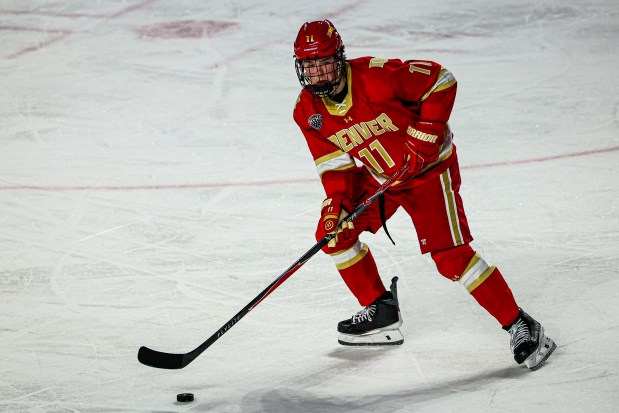 Daxon Rudolph was the No. 4 pick in the 2026 NHL draft, making him the highest selection in DU program history. (Courtesy Stephanie Burgoon/Alaska Anchorage via DU Athletics)
“They’ve been on my radar since I was a kid with the success they’ve had,” Rudolph said. “They were a team that I wanted to be part of. I knew I was going to be interested in coming here and I’m happy it worked out. I talked to three teams, but the people and the winning pedigree they have really excites me.”
Mikey Berchild also committed in September 2024. A Minnesota native, Berchild was at Shattuck-St. Mary’s and chose the Pios over several other top programs before spending the past two seasons with the USA NTDP.
“He was probably the last guy from what I’d call the traditional recruiting model,” MacMillan said. “We spent a lot of time watching him at Shattuck, whether it was the U15, U16 or prep team. Mikey was fast-tracked. He was always playing above his age group and was always successful. He was being recruited by everyone. He’s a really good player and he had options. But we felt he would be a really good fit here at Denver.”
Ryan Miller was next up, in February 2025. It’s not hard to see why Miller made his way to Denver.
Miller’s father is from Milk River, Alberta. That’s also MacMillan’s hometown. He also played for MacMillan’s brother at South Alberta Hockey Academy.
“I’m actually related to Ryan,” MacMillan said. “I believe my grandmother and his great-grandmother are sisters. One of Ryan’s uncles was one of the my younger brother’s best friends. It’s a town of 800 people. You knew all the Millers.
“He played at SAHA, where my brother and nephews worked, so I had to listen to them all the time telling me about how great Ryan Miller is.”
 Ryan Lin is one of two-first round picks in this recruiting class for the Pioneers, a first in program history. (Courtesy Stephanie Burgoon/Alaska Anchorage via DU Athletics)
Ryan Lin was one of the most sought-after defensemen in this class, and the San Jose Sharks selected him with the No. 21 pick in the 2026 draft. He officially committed to the Pios on April 2, but Carle said they knew he was coming well before that.
“Right around Christmas time, I started thinking about it a little more,” Lin said. “I actually sought out Denver and they showed interest. I wanted to come here. I wanted their winning pedigree, their coaching staff. Since I’ve got here, all the players have been exceptional on the ice, off the ice, everything. The facility’s great. I could go on forever, but it seemed like the perfect spot for me.”
The Pios were confident they’d lose all three right-handed defensemen on the 2025-26 team to NHL teams, something the big board in Carle’s office reminded them of often during that tenuous stretch in January.
“It was a big deal, Ryan Lin committing when he did,” Carle said. “Lin told us in late January, early February that he wanted to come. We were then able to speak very openly and honestly to a lot of the D that were out there and available. It gave us more confidence of like, ‘Hey, we’re doing this the right way. Let’s stick with the process.’ ”
Blake Fiddler, a second-round pick in the 2025 draft, became the second right-handed defenseman to commit on April 29. Fiddler’s father, Vern, was a longtime NHL player and Blake grew up playing in the Dallas Stars’ youth program. The Pios saw him play a lot with the junior Stars, and his father being from Alberta helped as well.
The final three members of the class didn’t commit until June. Max Heise was committed to Michigan State for three years, but he had visited DU’s campus when he was playing for Penticton in the BCHL before the CHL eligibility rules changed. He picked the Pios on June 3.
Jack Pridham had been committed to Boston University, but went to play for Kitchener in the OHL. He won the Memorial Cup with current Colorado Eagles coach Jussi Ahokas, and then committed to the Pioneers on June 6. Pridham had previously played for West Kelowna in the BCHL, and MacMillan had a connection to the billets he stayed with.
Rudolph committed June 4. He’s the highest-drafted player in program history. He completed the set of three right-handed defensemen the Pioneers needed to revamp their depth chart.
“Recruiting those guys was a lot of fun,” MacMillan said. “It was stressful because you’re competing against other big programs to get those guys. It’s always been about competing. If you look back at Logan O’Connor, he was still being recruited by Michigan. His dad played at Michigan. So the timelines have shifted and other things have changed, but you’re still competing to get players.”
Want more sports news? Sign up for the Sports Omelette to get all our analysis on Denver’s teams.