
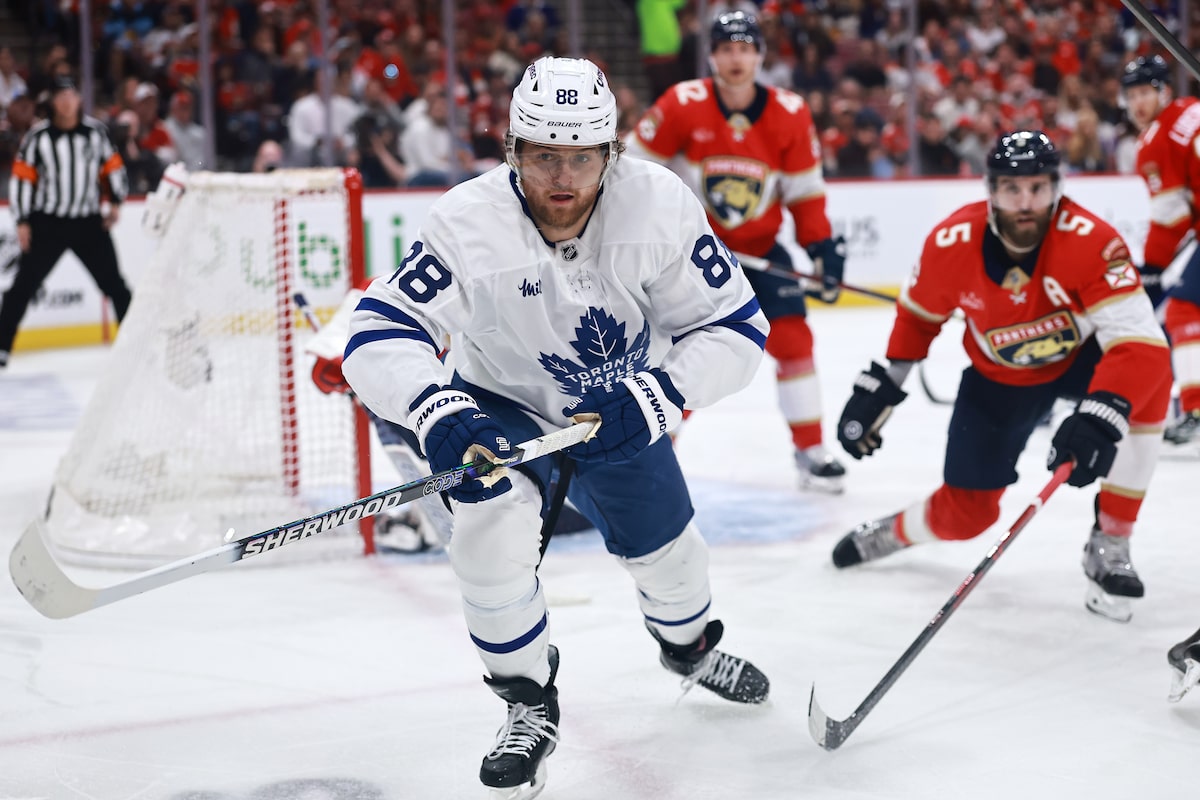
William Nylander of the Toronto Maple Leafs chases the puck against the Florida Panthers in Game Six of the Second Round of the 2025 Stanley Cup Playoffs at Amerant Bank Arena on May 16, in Sunrise, Fla.Carmen Mandato/Getty Images
During the Stanley Cup finals, commissioner Gary Bettman feels compelled to come out and be seen connecting with the average punter.
Like a lot of very successful men, Bettman has two conversational approaches – wary agreement and ultraviolence. He chose the latter when speaking to hockey’s Donald Trump minus the guiding hand of a Roy Cohn, Paul Bissonnette, on TNT’s Monday broadcast.
One of Bissonette’s bugbears is taxes and their effect on NHL roster construction. You can sign in Ottawa and pay 13 per cent provincial tax, or go to Las Vegas and pay no state tax. The difference is a cottage, every year. How nice a cottage depends on how good you are.
There are ways to mitigate this loss – signing bonuses, mainly – but that loophole may be in the process of closing. If it does, woe betides all Canadian sports clubs.
It is a sign of the times that hockey fans are very concerned about Mikko Rantanen’s theoretical signing bonus, but unbothered that they will never get their own, nor any other, similar tax advantage. Where’s our Lenin?
If it’s not a problem for the NHL, then it’s definitely an issue.
Cornered, Bettman’s reaction was to attack.
“Will you stop? It’s a ridiculous issue,” Bettman said. “For those of you who played, OK, were you sitting there with a tax table?”
Of course not. That’s why you pay an agent.
When he wants to, Bettman can puff himself up to real majesty. He used that ability to cow the know-nothings on the TNT panel and reduce the segment to comedy. Watch it if you can. It’s a lesson in social domination, but it doesn’t magically make the tax issue disappear.
NHL commissioner Gary Bettman speaks to the media prior to Game One of the 2025 Stanley Cup Final between the Florida Panthers and the Edmonton Oilers at Rogers Place in Edmonton on June 4.Bruce Bennett/Getty Images
Bissonette has it half right. Taxes tilt the field. There is a second problem though – branding.
In a rational employment market, smaller teams in cities that don’t rate hockey would have to pay more to attract top talent. This is how it works in any other business.
If you’re a top bond trader, you want to work in New York. If you’re a great systems engineer, you want to work in San Francisco. You may agree to work in Oklahoma City, but it’s going to take incentives – some combination of a great gig, more salary and lower cost of living.
There is also the question of status. All of us would prefer to work for a business that evokes an emotion in strangers. That emotion is envy.
It’s why people throng newspapers, and why they work for peanuts at a book publisher. You don’t get the same reaction at parties when you say you own a part of a car dealership, which is also why you get rich owning a car dealership.
In a sensible hockey environment, playing for an Original Six and/or a Canadian team would be a selling point to prospective employees. Instead, it’s a problem to overcome.
Nobody wants to play for the Leafs or the Canadiens any more because the media is mean and the fans pay attention. Whether or not it’s true is beside the point. That’s the story everyone tells each other, so the teams have to do business as if it’s true.
It’s why William Nylander makes Connor McDavid-level money to be somewhere well south of a Connor McDavid-level year-round performer. He’s charging the Toronto tax.
That tax holds in Montreal, Winnipeg and New York – actual high-tax environments. It does not apply in Florida or Nevada. Nobody is able to leverage fan angst to get over the market rate in Dallas.
If you play football, you want to be on the Cowboys. That’s the dream. In baseball, it’s the Yankees. Basketball, the Lakers.
Sam Bennett of the Florida Panthers scores against the Edmonton Oilers.Steph Chambers/Getty Images
Hockey? Your dream is to live in Fort Lauderdale and drive to the office in your shorts year-round. You get the benefit of being recognized at Louis Bossi’s, but no one bothers you at Publix.
You’re taking home more than your counterpart in Calgary, but with 90 per cent less hassle. No more hiding in the house all weekend because you lost to the Oilers.
This Stanley Cup final is a lab environment to test this idea. The Oilers have a lot of big contracts coming up in the next year or so. Connor McDavid is the headliner. He must become the highest paid player in the game.
Downstream, that still leaves Evan Bouchard, Matthias Ekholm and Stuart Skinner, amongst others.
Will they be sitting there with the tax table in their hand, or will they – per Bettman – be laser-focused on which Montessori their toddler could eventually attend?
If Edmonton wants to keep this championship-calibre lineup together, it will mean that a few guys have to give them a break. We’ll see.
Over on the other side, Florida is set to lose control of Sam Bennett, the current likely winner of the Conn Smythe trophy.
Unlike the golden chokers who make up the top end of the Jets or Leafs rosters, Bennett is at his best when it matters. Currently, he makes less money than Mitch Marner earns in autumn.
If he were a soccer player, Bennett would be headed to the biggest, brightest market available – a Barcelona, or a Manchester City. Since this is hockey, Bennett is expected to re-sign with Florida for less than the Leafs currently pay any of their top guys. It’s nonsensical, but that is the marketplace the NHL has created. Their professional entertainers offer a discount for anonymity.
You get why Bettman bridles when the topic comes up – it’s an institutional failing that stunts growth, and can’t be solved by fiat.
No executive can force the top talent to play in the biggest markets. That’s on teams to manage, and they’re terrible at it.
However, it’s ridiculous to suggest it’s an issue, says the guy in charge while he sits at the sport’s showcase event, being held in an imaginary city where it’s cresting 40C and there are alligator warnings on the fences surrounding the property. Everything is as it should be in the home of winter sport.