
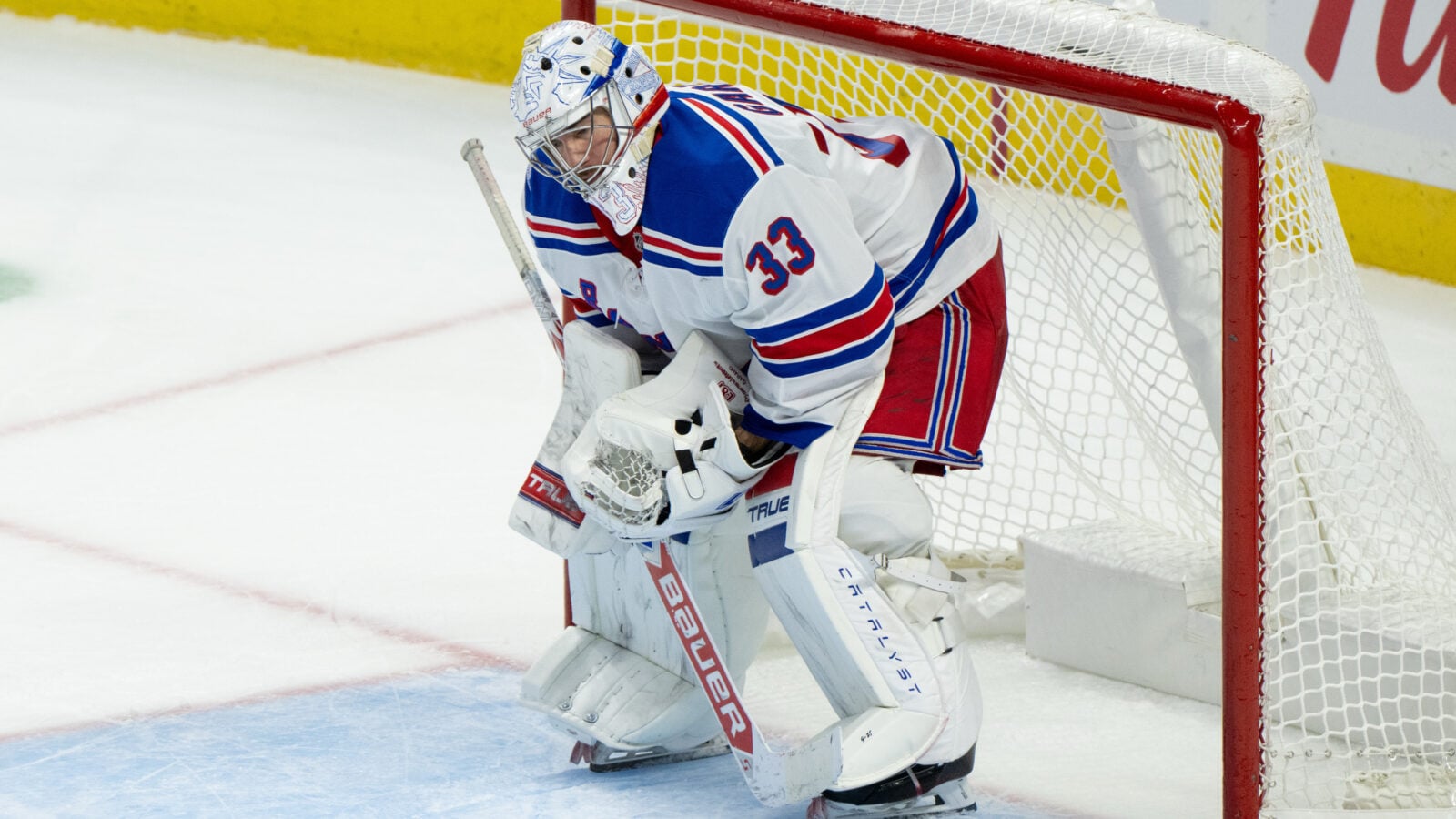

Dylan Garand’s short time with the New York Rangers has featured some major ups and downs.
The 24-year-old rookie goaltender entered this week’s five-day gap in the schedule after taking the loss in each of New York’s past three games. He allowed five goals in road losses at Toronto (5-4) and Ottawa (7-4, with two empty-net goals) last week, then took got the “L” on Monday night by allowing two goals on 17 shots in relief of James Reimer, when the Rangers lost 6-3 to the Los Angeles Kings at Madison Square Garden.
But through his first 13 NHL decisions – three during a late-season callup in 2025-26 and 10 so far this season – Garand is 6-5-2 with a 2.41 goals-against average, .914 save percentage and one shutout. Few goaltenders would be disappointed with those numbers. Two of the losses came in relief; in addition to Monday’s defeat, he was the losing goaltender in a 3-1 loss to the Washington Capitals despite allowing just one goal after taking over in the second period when Igor Shesterkin sustained a season-ending knee injury.
Rangers tools
But how does Garand compare to the Rangers’ three most recent long-term starters — Shesterkin, Hall of Famer Henrik Lundqvist and 300-game winner Mike Richter? One member of that trio has held down the No. 1 goaltending job for the vast majority of the past 35 seasons of Rangers hockey. Shesterkin and Lundqvist each won the Vezina Trophy as top NHL goalie; Richter is the only one of the three who owns a Stanley Cup ring, and he also led Team USA to the championship at the World Cup of Hockey in 1996.
Here’s how Garand’s start to his NHL career compares with those of his three predecessors:
Dylan Garand
Through 13 decisions (11 starts): 6-5-2, 2.41 GAA, .914 save percentage, 1 shutout
This season: 4-5-1, 2.69 GAA, .899 save percentage, 1 shutout
 Marc DesRosiers-ImagnCredit: IMAGN IMAGES via Reuters Connect
The Rangers took Garand in the fourth round (No. 103 overall) in the 2020 NHL Draft. He turned pro in the fall of 2022 but wound up spending the next four seasons with AHL Hartford — mostly because Shesterkin had established himself as one of the League’s elite goaltenders, winning the Vezina in 2021-22, and had a veteran backup behind him in New York.
Garand was a good goalie on a bad team for most of his time in Hartford, though did excel in the Calder Cup playoffs in 2023 and 2024. He finally got a call to the NHL in March 2026 and impressed with a 2-0-1 record, 1.62 GAA and .948 save percentage in three starts.
Jonathan Quick’s retirement appeared to open the door for Garand to become a full-time NHL goaltender. Instead, the Rangers opted to acquire longtime NHL backup Joonas Korpisalo from the Boston Bruins — and put Garand on waivers before the start of this season. Luckily, he cleared — because not only is Shesterkin gone for the season, but Korpisalo has yet to play because of a foot infection.
Garand looks like he’ll own at least part of the starter’s net for the rest of this season, with Korpisalo set to return and share the load in the next couple of weeks. But assuming Shesterkin (armed with his record-setting goalie contract) is healthy in the fall, it’s hard to see anyone unseating him.
Igor Shesterkin
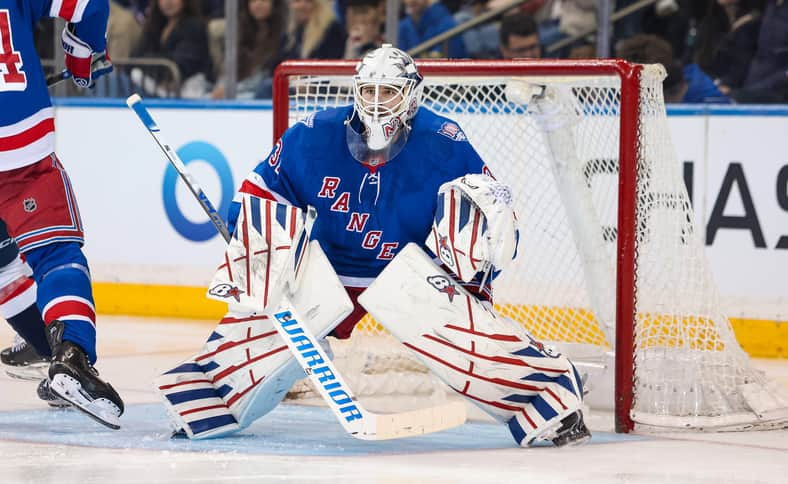 Danny Wild-Imagn ImagesCredit: IMAGN IMAGES via Reuters Connect
Through 13 decisions: 10-3-0, 2.85 GAA, .928 save percentage, 0 shutouts
Career: 190-108-28, 2.51 GAA, .917 save percentage, 22 shutouts
Shesterkin and Garand have one thing in common: Each was a fourth-round draft pick. The Rangers selected Shesterkin with the 118th choice in 2014 after his first taste of action in the KHL. He remained there through 2018-19, when he came to North America — and became the first Russia-born goaltender to play for the Rangers.
Shesterkin, Lundqvist and Alexandar Georgiev divided the goaltending chores in 2019-20, with Shesterkin winning 10 of his 12 starts. Lundqvist retired before the COVID-delayed 2020-21 season; Shesterkin won the starting job and owned it ever since.
He won the Vezina in 2021-22, the first of two seasons Shesterkin led the Rangers into the Eastern Conference Final. He put up 37 wins in 2022-23 and 36 more in 2023-24, powering the Blueshirts to the Presidents’ Trophy as the NHL regular-season champion, and into the conference final for the second time in three seasons.
The Rangers signed Shesterkin to a record-setting contract extension in December 2024. He’s remained among the top NHL netminders (the best in the world, according to The Athletic). Injuries have been his biggest problem; the Rangers lost 11 of the 13 games he missed last season due to a lower-body injury, then was off to a 3-1-0 start before getting hurt on the second Friday of this season.
Henrik Lundqvist
First 13 decisions: 8-3-2, 2.13 GAA, .923 save percentage, 1 shutout
Career: 451-310-96, 2.43 GAA, .918 save percentage, 64 shutouts
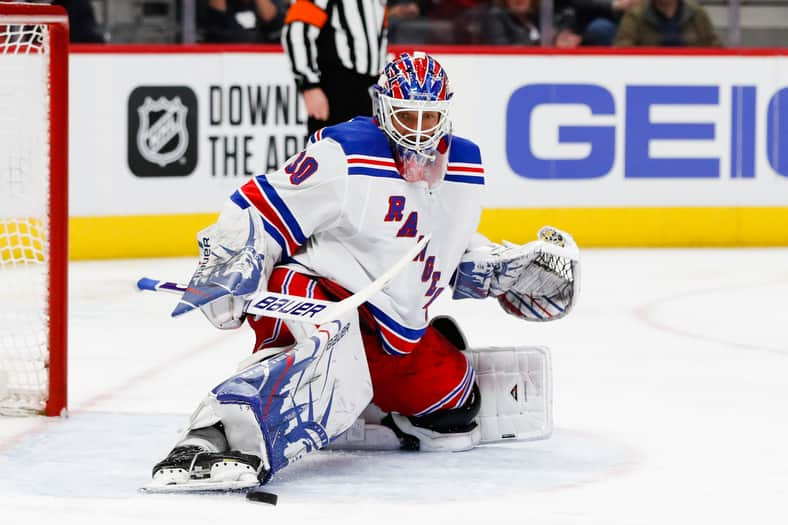 Rick Osentoski-USA TODAY Sports
The Rangers’ most recent Hall of Famer didn’t exactly walk in off the street. But being a seventh-round pick (No. 205 overall in the 2000 draft) is pretty close.
As was the case with Garand and Shersterkin, Lundqvist needed several years before arriving on Broadway. It wasn’t until after the 2004-05 lockout that he left Sweden, where he won SHL top goaltender honors three times, playing for Frolunda.
No one knew what to expect when Lundqvist arrived on Broadway. But he quickly took the starter’s job from veteran Kevin Weekes and held it for more than a decade. He finished his first season with 30 victories, setting a Rangers record for wins by a rookie and was named a Vezina finalist for the first of three straight seasons.
“The King” finally won the Vezina in 2012 and led the Rangers to their most recent trip to the Stanley Cup Final two years later. Lundqvist owns almost every record for goalies in Rangers history, including victories, shutouts, playoff wins and games played. He also set an NHL record by winning six consecutive Game 7s in the Stanley Cup Playoffs.
With Shesterkin and Georgiev on hand, the Rangers bought out the final season of Lundqvist’s contract in 2020. He signed with the Washington Capitals — but never played for them because of a heart issue. The Rangers retired his No. 30 on Jan. 28, 2021, and he was inducted into the Hall of Fame in November 2023.
Mike Richter
First 13 decisions (14 appearances): 7-3-3, 2.96 GAA, .899 save percentage, 0 shutouts
Career: 301-258, 73 ties, 2.89 GAA, .904 save percentage, 24 shutouts
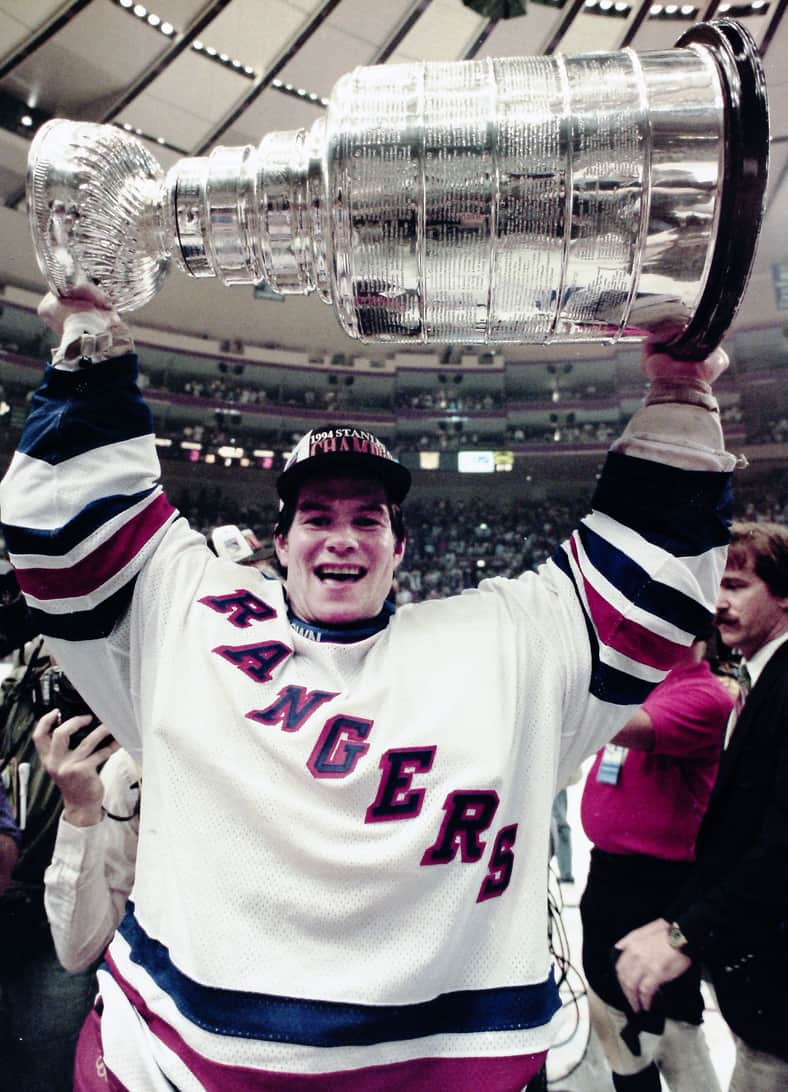 Rangers Mike Richter celebrates with with the Stanley Cup after defeating Vancouver 3-2 in Game 7 of the Stanley Cup Final at Madison Square Garden June 14, 1994.Credit: USA TODAY Network via Reuters Connect
The Rangers liked the Philadelphia-area native enough coming out of prep school to take him in the second round (No. 28) of the 1985 draft. But like his successors in the No. 1 goaltending role, his path to the Garden had some twists and turns.
First, there were two seasons at the University of Wisconsin — the NCAA Division I award for top goaltender was named in his honor in 2014. He spent 1987-88 on the U.S. Olympic Team with future Rangers teammate Brian Leetch, splitting four decisions at the 1988 Games in Calgary. After that, it was one-plus seasons with the Colorado/Denver Rangers in the International Hockey League (then the Blueshirts’ top farm team).
Richter didn’t become a full-time NHL goalie until 1989-90, when he backed up John Vanbiesbrouck and helped the Rangers to a first-place finish for the first time since 1941-42. He gradually earned equal time with ‘Beezer’ — the two alternated for the first 76 games of the 1991-92 season, helping New York win the Presidents’ Trophy before being upset in the Patrick Division Final.
Expansion in the summer of 1993 broke the up “VanRichterBrouck” tandem; the Rangers traded Vanbiesbrouck rather than lose him for nothing. Richter became the unquestioned No. 1 goalie on Broadway — and he carried them to their first Stanley Cup championship since 1940.
Two years later, Richter starred for Team USA in its upset win over Canada at the World Cup of Hockey. He got the Rangers as far as the Eastern Conference Final in 1997 before the team hit a downturn, missing the playoffs for seven straight seasons.
Richter became the first Rangers goalie to reach the 300-win mark on Oct. 28, 2002, when they defeated the Phoenix Coyotes 3-2 in overtime at the Garden. But it was his next-to-last career win; injuries ended his career soon after. The Rangers retired his No. 35 on Feb. 4, 2004, and he was inducted into the U.S. Hockey Hall of Fame four years later.

John Kreiser covered his first Rangers game (against the California Golden Seals) in November 1975 and is still going … More about John Kreiser
