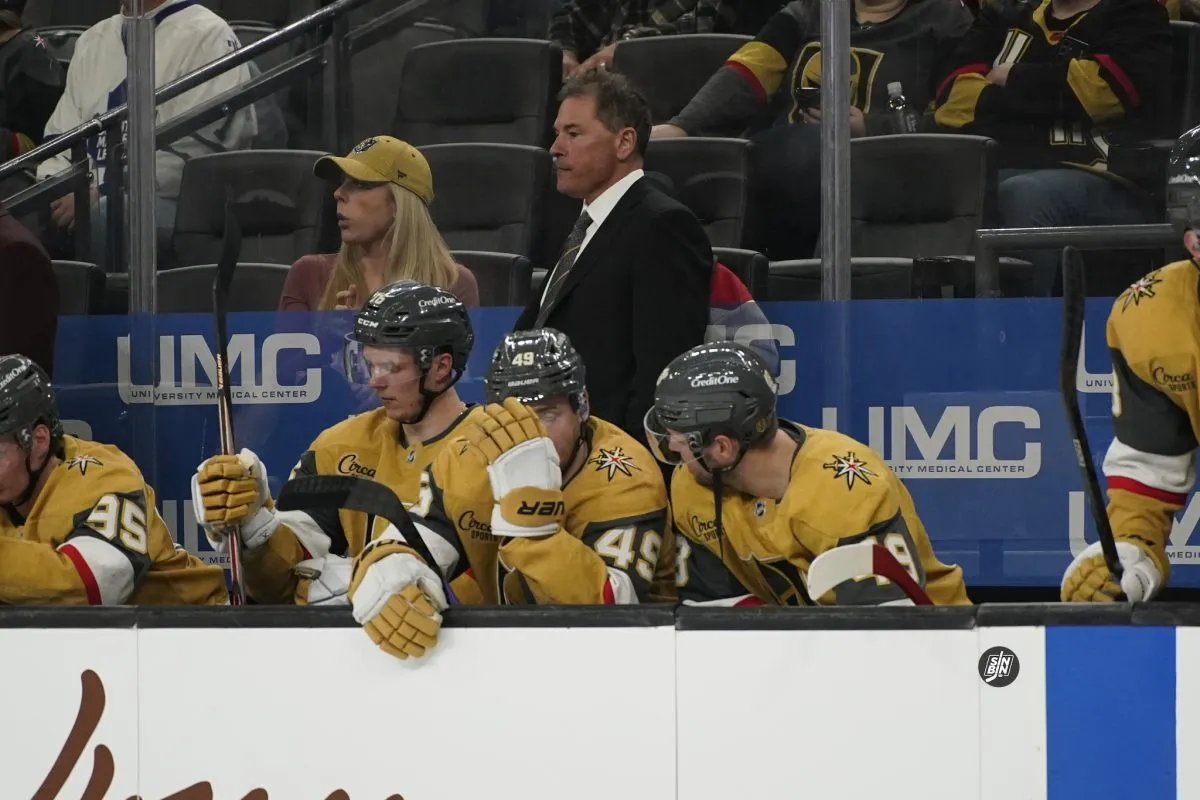

(Photo Credit: SinBin.vegas Photographer Brandon Andreasen)
Before the series started, there were plenty of places to look to find where the Golden Knights had an edge over the Minnesota Wild. Special teams, center depth, experience, and defense corps were a few that came to the front of mind. But, no matter how big the advantage was in each of those categories, they all paled in comparison to the superiority the Golden Knights held behind the benches.
Bruce Cassidy vs John Hynes is a mismatch of epic proportions, and it manifested itself in as big a way as possible in Game 5.
Let’s start with what Cassidy got right. First, he made the unconventional decision to pair up his top two defensive centers to make a super line that took the brunt of the responsibility against Minnesota’s dominant trio. Jack Eichel and William Karlsson shared the ice with Joel Eriksson Ek, Kirill Kaprizov, and Matt Boldy for more than half of their ice time, and it limited the damage they were able to do.
In addition, Cassidy made the move to play Tanner Pearson as opposed to Victor Olofsson to allow for more flexibility in his bottom-six. Pearson played just seven minutes, but he assisted on the game-winning goal in OT. Cassidy’s line blender not only got Eichel going, it sparked Mark Stone’s first goal of the series, and it spit out lines of Brett Howden, Keegan Kolesar, and Pearson, as well as Ivan Barbashev, Reilly Smith, and Nic Roy, each of which were responsible for the overtime goals that have given the Golden Knights the lead in the series.
Cassidy calmly nailed his offside challenge late in Game 5 amidst the chaos. He correctly chose to forego a goalie interference challenge in Game 4 that could have resulted in a repeat of what happened in LAK/EDM series. And he has come up with solutions to issues the Golden Knights were having getting through the neutral zone, creating traffic in front of the goal, and turning the puck over deep in the zone.
This is why Bruce Cassidy has a Jack Adams award to his name. It’s why his playoff record with the Golden Knights is now 22-12 and his overall mark is 60-53. It’s why he’s won four of his last five playoff series and is one win away from a 5th. And it’s why his name is engraved on the Stanley Cup.
Now, to the other side.
John Hynes put on a masterclass of making life as easy on his opponent as he possibly could have.
It started just eight minutes into Game 5 when the Wild earned a power play. Hynes made the call to remove rookie defenseman Zeev Buium from the lineup after the four-minute high-sticking penalty in Game 4. In doing so, he had sidelined the power play quarterback from the top unit of the Minnesota power play. Down the stretch of the regular season, Hynes had deployed a five-forward unit that had a bit of success. So, he turned back to it on the road with Jack Eichel and William Karlsson on the ice as penalty killers. Moments later, Eichel had the puck flying up the ice in a 2-on-1 situation with 24-year-old left winger Matt Boldy as the lone man back trying to stop two of the best penalty killers in the world. This is the coaching equivalent of splitting 10’s at the blackjack table, and it was so obvious that I even predicted the goal moments before it happened. https://x.com/SinBinVegas/status/1917399490891506161
But that was just the beginning of Hynes’ issues. On the Golden Knights’ second goal, Karlsson set a good screen in front of goaltender Filip Gustavsson as Stone ripped a shot from the high slot. The contact on the goalie is minimal, and Karlsson was being pushed towards the goalie even if the contact was severe enough for goalie interference. Hynes was undeterred. He challenged the play, and in less than a minute of deliberation from the Situation Room, the call was upheld and the Wild had to kill a penalty.
Next, with Marcus Johansson available to return from the injury that kept him out of the previous game (which Hynes chose to replace him with Vinnie Hinostroza who took a 1st period penalty the Golden Knights scored on), Hynes opted to break up one of the most successful lines from Game 4. Rather than leaving Marcus Foligno, Ryan Hartman, and Mats Zuccarello together after scoring the go-ahead goal in the 2nd period of Game 4, he put Johansson into Foligno’s place and the line struggled at even-strength. The bottom-six that helped the Wild win a pair of games earlier in the series went silent.
Finally, the biggest decision of the game, a line change on what ultimately became the last shift of the game. After the puck ended up in the crowd, a neutral zone faceoff ensued. Likely overcorrecting from Game 4 in which he used just four defensemen in the 16-minute overtime period, Hynes not only decided to give his 4th line their first shift of the overtime period, but he also matched them up with his 3rd pair defensemen. This gave Cassidy the perfect opportunity to counter with his 4th line and 3rd pair, and the rest is history. (If you really want to, keep your eyes on Jon Merrill on the game-winning goal, and ask yourself if the Hobey Baker finalist sitting in the press box could have done better.)
This is why John Hynes has a career 6-18 record in the postseason. It’s why he’s never finished above 4th place in his division in any of his 11 seasons behind the bench. It’s why he’s never won a playoff series. And it’s why he probably never will.