
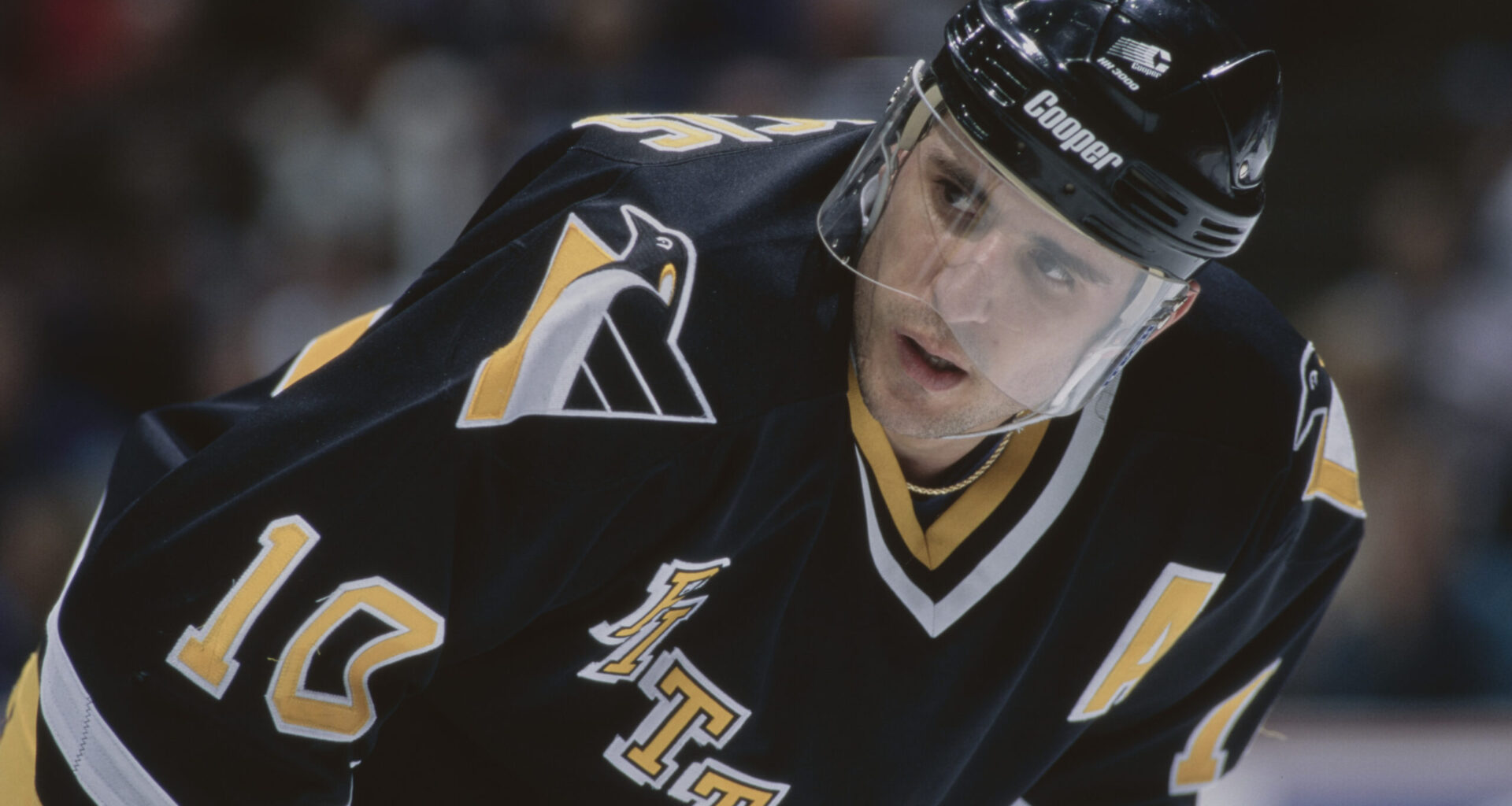
Some of the best NHL trade trees show when history is made. The Wayne Gretzky trade tree shows the growth of hockey in the United States as the best player moved south of the border. However, there are darker moments with trade trees. When it comes to teams that don’t exist anymore, you can usually find the trade that caused it if you look hard enough. For the Hartford Whalers, it’s more evident than most. It’s the day they traded Ron Francis out of Hartford.
The Birth of the Legend
Francis was born in Sault Ste. Marie in Ontario, and took to hockey like a duck to water. He started with the AAA Sault Ste. Marie North stars, where he was the captain, and he flashed that incredible talent. In just 45 games, he tallied 57 goals and 92 assists for 149 points, which caught the attention of the local Soo Greyhounds. Francis joined them in the Ontario Hockey League (OHL) for the 1980-81 season.
Following his strong youth start, Francis recorded 26 goals and 43 assists for 69 points in 64 games with the Greyhounds. That was a good rookie season in the OHL, which he followed up with 25 games the following season, but 18 goals and 30 assists for 48 points marked a successful campaign. He was dubbed one of the top prospects entering the 1981 NHL Draft.
His Stint in Hartford
Francis was selected fourth overall by a team the NHL recently took in from the WHA. Looking to make a name for themselves, the Whalers took the chance on a young kid. Hartford was looking to try and cement itself as a successful NHL franchise, and they were hoping the driving factor would be their new first-line center. Francis started on the right foot, with 25 goals and 43 assists for 68 points in 59 games.
In his sophomore season, Francis hit star status with 31 goals and 59 assists for 90 points in 79 games. He became the face of the Whalers franchise before turning 20 and continued it across nine seasons in Hartford, scoring 243 goals and 502 assists for 745 points in just 647 games. However, entering the 1990-91 season, the Whalers were struggling. The old Hartford Civic Center wasn’t drawing crowds like it used to, and the finances were tight. Rumors started circling Ronny Franchise.
 Ron Francis, Hartford Whalers (Photo by Steve Babineau/NHLI via Getty Images)
Francis played through the noise, scoring 21 goals and 55 assists for 76 points in 67 games, but on March 4, 1991, his time in Hartford came to an end. A trade that doomed one organization helped cement the legacy of another. Francis was traded to the Pittsburgh Penguins.
The Trade
Francis was traded alongside Grant Jennings and Ulf Samuelsson to the Penguins for John Cullen, Jeff Parker, and Zarley Zalapski. To this day, it remains one of the most lopsided trades in NHL history. Pittsburgh got a second-line center to offer a secondary threat behind the great Mario Lemieux. Francis became one of the driving factors of a new era in Pittsburgh.
In his first two seasons in Pittsburgh, Francis won the Stanley Cup twice. Quickly becoming one of the premier players in the league, his success would see him win the Selke Trophy as the best two-way forward in the league and the Lady Byng twice for his sportsmanship as a Penguin. In 553 games with the Penguins, Francis recorded 164 goals and 449 assists for 613 points across his eight years in the Steel City. However, time is a circle, and the conclusion of his time in Pittsburgh made him a free agent, so he rejoined his former organization.
They were no longer the Whalers, and we’ll get to that, but he joined the Carolina Hurricanes in 1998. In Carolina, Francis won the Lady Byng Award again and the King Clancy Trophy for his leadership as he led the Hurricanes to the Stanley Cup Final in 2002. Eventually, he got traded out of Carolina to Toronto, but that’s a different trade tree.
Francis ended his career with 549 goals and 1,249 assists for 1,798 points in 1,731 games across 23 seasons in the NHL. To this day, he remains fifth all-time in points and second in assists. He became one of the all-time greats and was inducted into the Hockey Hall of Fame in 2007. His number 10 was retired by Carolina for his service to both the Hurricanes and Whalers.
Pittsburgh’s Side
Francis, Samuelsson, and Jennings were the three Pittsburgh acquired. We’ve followed Francis, and he wasn’t traded. Samuelsson played in 277 games with the Penguins and scored just 11 goals and 83 assists for 94 points, but the left-shooting defenseman was not employed to put up points. He racked up 804 penalty minutes during his time with the Penguins, enforcing the “tough guy” mantra. He was traded with Luc Robitaille to the New York Rangers for Sergei Zubov and Petr Nedved.
If you just said out loud, “Zubov was a Penguin?” you’re not crazy. He only played 64 games in the Steel City before he was traded. He scored 11 goals and 55 assists for 66 points, which is impressive for a defenseman, but he was later traded to the Dallas Stars for Kevin Hatcher. Hatcher played 220 games across three seasons with the Pens, scoring 45 goals and 95 assists. Again, it was great production from a defenseman, but he wasn’t Zubov. He traveled the opposite path to Zubov when the Penguins traded him to the Rangers for Peter Popovic. Popovic played just 54 games with a goal and five assists. He wasn’t traded, ending Zubov’s branch.
Petr Nedved’s Branch
If you’re a frequent reader of trade trees, you’ll realize where Nedved takes us. He played just two seasons in Pittsburgh, scoring 78 goals and 92 assists for 170 points in 154 games. Nedved was sensational, and the Rangers decided they had made a mistake and brought him back. Nedved was traded back to Manhattan alongside Sean Pronger and Chris Tamer for Harry York and Alexei Kovalev. The Kovalev trade tree is its own story, so let’s do this quickly.
York played in two games with the Penguins but had no production and wasn’t traded. Kovalev played 365 games for the Penguins across two spells, scoring 151 goals and 203 assists for 354 points. He was traded back to the Rangers along with Dan LaCouture, Janne Laukkanen, and Michael Wilson for Joel Bouchard, Mikael Samuelsson, Richard Lintner, and Rico Fata.
Bouchard played just seven games as a Penguin, helping himself to an assist before he left the organization, and that wasn’t via trade. Lintner played in 19 games as a Penguin, scoring three goals and adding two assists, but he also departed the organization, and it wasn’t via trade. Rico Fata played in 120 games as a Penguin across three seasons, scoring 21 goals and 26 assists for 47 points. He was claimed off waivers by the Atlanta Thrashers, though, so that branch also ends.
Finally, we get to Samuelsson. He played in just 22 games as a Penguin, scoring twice, but he was traded. He was dealt in the buildup to the 2003 NHL Draft with the third overall pick and a 2003 second-round pick to the Florida Panthers for a 2003 third-round pick and the first overall pick. The third-rounder was used on Daniel Carcillo, who was traded to the Arizona Coyotes along with a 2008 third-round pick for Georges Laraque before ever playing a game with the Penguins. Laraque played 88 games as a Penguin, scoring four goals and 11 assists for 15 points.
That first overall pick was used on Marc-Andre Fleury. The Flower backstopped the Penguins to three Stanley Cups. He played in 691 games as a Penguin, starting 536, where he had a 375-216-68 record with a .912 save percentage and a 2.58 goals-against average. He even had 14 assists during his 13 years in black and yellow. Fleury was selected in the expansion draft by the Vegas Golden Knights all those years later, but it ends the Kovalev branch of the trade tree.
Whalers Side
Cullen, Parker, and Zalapski were the three the Whalers got back. Let’s start with Zalapski. Parker never played for the Whalers and wasn’t traded, so that is easy enough. One of the best names in hockey, Zalapski played in 229 games for the Whalers across five seasons, scoring 44 goals and 121 assists for 165 points. While the Francis trade is seen as a fleecing, Zalapski was still a very productive player for the Whalers. That was until he got traded. He was packaged with James Patrick and Michael Nylander and sent to the Calgary Flames for Ted Drury, Paul Ranheim, and Gary Suter.
For the eagle-eyed among you, yes, that is former Hurricane Jack Drury’s father, Ted. That’s also William and Alex Nylander’s father, Michael. Let’s start with Drury. He played in 50 games with the Whalers, scoring four goals and 11 assists for 15 points. He left Hartford through the now long-forgotten waiver draft. That’s a relic for another day, but it ends that branch.
Ranheim played seven seasons for the Whalers organization, joining them in their relocation to Raleigh. In 432 games, he scored 49 goals and 80 assists for 129 points. A good servant to the Hurricanes, he was traded to the Philadelphia Flyers in 2000 for a 2002 eighth-round pick. Yes, children, the draft used to be way longer than it is today. That pick was traded with a sixth-round pick and a ninth-round pick to the Tampa Bay Lightning for a fourth-round pick in 2003. That was used on Matej Trojovsky. He never made it to the NHL, but he did have a decent career bouncing around Europe and the junior North American leagues.
Suter’s Branch
If you’re a Flames or Blackhawks fan, you’re probably thinking, “Suter was never a Whaler,” and you’re right. He never played for Hartford. The very next day, he was sent to the Chicago Blackhawks with Randy Cunneyworth and a 1995 third-round pick for Jocelyn Lemieux and Fratisek Kucera. Lemieux played in 86 games as a Whaler, scoring 13 goals and eight assists for 21 points. He was traded with a 1998 second-round pick for Jim Dowd and a 1997 second-round pick. We’ll come back to Dowd and Kucera, but the 1997 pick was traded to Calgary with Hnat Domenichelli, Glen Featherstone, and a 1998 third-round pick for Steve Chiasson and a 1997 third-round pick.
Chiasson wasn’t what he was a few years earlier, and the defenseman only played 112 games for the Whalers organization across three seasons. He scored 11 goals and 46 assists for 57 points, but he wasn’t traded. Francis Lessard was picked with that 1997 pick. He never played for the organization, but he was traded to Philadelphia for a 1999 eighth-round pick. That was used on Antti Jokela. He never left Europe, ending that branch.
Dowd never played for the Whalers; he was traded the same day he was acquired. However, he was packaged with Kucera, who I mentioned earlier. Kucera played parts of three seasons in Hartford, playing 94 games and scoring six goals and 26 assists. The defenseman wasn’t there to put up points. Anyway, these two were sent to the Vancouver Canucks for Jeff Brown and a 1998 third-round pick. This pick was the one sent to Calgary in the Chaisson deal. Brown played in 81 games for the Whalers organization, helping himself to 10 goals and 41 assists for 51 points. However, the defenseman was sent to Toronto for a 1999 fourth-round pick.
That was used on Evgeny Pavlov, so please make your own Pavlov jokes here, but the Whalers organization didn’t draft him. In fact, by that point, they were the Hurricanes, and Carolina traded that pick to the Nashville Predators for Eric Fichaud. The goaltender played in just nine games with the Canes, with a 3-5-1 record. He wasn’t traded, ending the Zalapski branch.
Cullen’s Branch
Cullen played for three seasons in Hartford, scoring 34 goals and 55 assists for 89 points in 109 games. Like Zalapski, he wasn’t a bad player by any means; he just wasn’t Francis. He played so well that he attracted interest from the Maple Leafs. Hartford sent him to Canada for a 1993 second-round pick. That pick wasn’t used by Hartford, instead opting to trade it with Sergei Makarov, the 1993 sixth overall pick, and a 1993 third-round pick for the second overall pick in 1993. That was used on Chris Pronger.
 Zarley Zalapski, Hartford Whalers, November 17, 1991 (Photo by Graig Abel/Getty Images)
Now, like Kovalev, the Pronger trade tree has already been done for you to read, so let’s get through this quickly. Pronger played in 124 games, scoring 10 goals and 34 assists for Hartford before he was traded to the St. Louis Blues for Brendan Shanahan. The Shanaplan only played two years in Hartford, scoring 45 goals and 34 assists for 79 points in 76 games before he was sent to the Detroit Red Wings alongside Brian Glynn for Paul Coffey, Keith Primeau, and a 1997 first-round pick.
Carolina used the pick on Nikos Tselios, who only played two NHL games. Coffey played 20 games, scoring three goals and five assists, before he was traded to the Flyers with a 1997 third-round pick for Kevin Haller, a 1997 first-round pick, and a 1997 seventh-round pick. The seventh-round pick was used on Andrew Merrick, who never made the NHL. Haller played 100 games for the Hurricanes organization, scoring five goals and 11 assists for 16 points. He was traded to the Mighty Ducks of Anaheim for a 2000 fourth-round pick and Dave Karpa. Karpa played three years in Carolina, scoring five goals and 12 assists for 17 points in 120 games. He wasn’t traded.
That 2000 fourth-round pick was used to trade up to acquire a pick that became Niclas Wallin, who played in 517 games for the Hurricanes, scoring 18 goals and 51 assists for 69 points. He was traded to the San Jose Sharks with a 2010 second-round pick for a 2010 second-round pick. That was used on Mark Alt. He never played for the Hurricanes but was traded, along with Brian Boucher, to the Flyers for Luke Pither. He never made the NHL.
Related: Mark Messier Trade Tree: Edmonton Oilers to New York Rangers
Carolina used the 1997 first-round pick from the Coffey deal to trade down to a second-round pick in 1997 and a third-round pick in 1998. The second-round pick was used on Brad DeFauw, who played nine games with Carolina, scoring three goals. The 1998 third-round pick was used on Erik Cole. Cole played in 418 games for Carolina during this stint, scoring 129 goals and 151 assists for 280 points and winning the Stanley Cup in 2006. Cole was traded for Joni Pitkanen in a one-for-one trade. Pitkanen played in 266 games for Carolina, scoring 24 goals and 116 assists for 140 points, which is great for a defenseman, but a broken heel on an icing ended his career.
Primeau played in 234 games for Carolina across three seasons, scoring 82 goals and 94 assists for 176 points before he was traded to Philadelphia with a 2000 fifth-round pick for Rod Brind’Amour, Jean-Marc Pelletier, and a 2000 second-round pick. Brind’Amour played in 694 games for Carolina, scoring 174 goals and 299 assists for 473 points. He won the Selke Trophy twice and captained the team to the Stanley Cup before retiring as a Hurricane. Pelletier never played for Carolina, but he was traded with a conditional 2003 pick to Arizona for Patrick Desrochers. Desrochers had a 1-1 record in two games with the Canes.
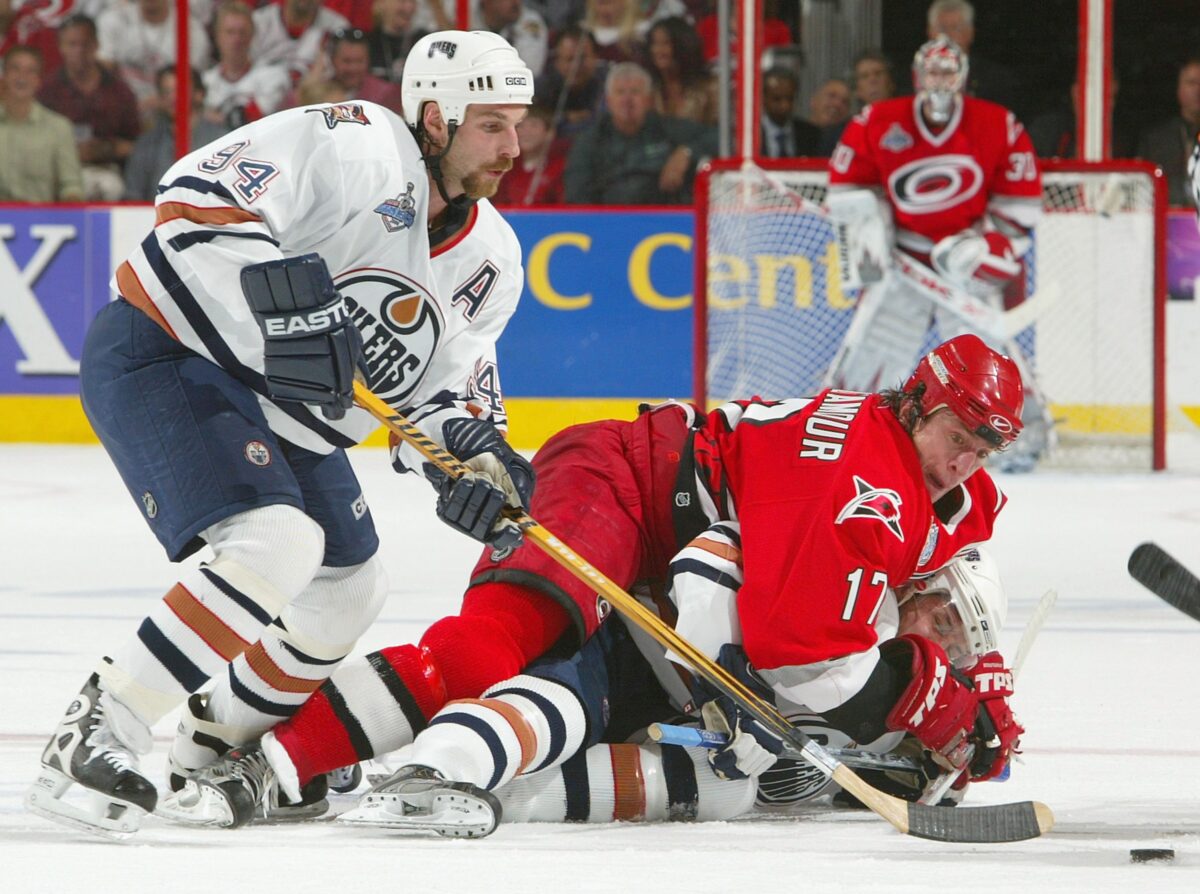 Ryan Smyth of the Edmonton Oilers skates after the puck as Rod Brind’Amour of the Carolina Hurricanes falls onto an Oilers player during Game 2 of the 2006 NHL Stanley Cup Final (Photo by Jim McIsaac/Getty Images)
That 2000 second-round pick was traded with a 2000 first-round pick, a 2000 second-round pick, and Nolan Pratt for a 2000 second-round pick and Sandis Ozolinsh. The second-round pick became Tomas Kurka, who played in 17 NHL games, scoring three goals and two assists, but wasn’t traded. Ozolinsh played in 118 games as a Hurricane, scoring 16 goals and 51 assists for 67 points. He was then flipped to the Florida Panthers for Kevyn Adams, Bret Hedican, Tomas Malec, and a 2003 conditional second-round pick. The conditions for the pick were never met.
Hedican and Adams both won the Cup in Carolina. Adams spent five years in Raleigh, playing in 300 games and scoring 38 goals and 34 assists for 72 points before he was traded to the Coyotes for Dennis Seidenberg. Seidenberg played three seasons with Carolina, scoring six goals and 45 assists for 51 points in 137 games. He wasn’t traded. Hedican spent six years in Raleigh, playing 369 games and scoring 19 goals and 82 assists for 101 points. He was not traded. Malec played in 43 games with Carolina, grabbing two assists before he was traded to the Ducks with a 2004 third-round pick for Martin Gerber. Gerber played one season in Carolina, won the Cup, and left in free agency.
How This Trade Tree Changed Hockey
This monster of a trade tree changed everything. The Francis trade was the moment the Whalers franchise started to sink. They had given up on their most marketable player, and it resulted in them moving. However, the pieces they got back also resulted in Carolina building a Stanley Cup champion for the 2005-06 season, which cemented their place in the hockey world. It cursed one city, but the franchise moved and blessed another.
On the Pittsburgh side of things, they won their first Stanley Cup with Francis. He played a second-fiddle role, of course, but he was a key part of getting over the hump. With a lot of the absences Lemieux suffered, Francis did fill in occasionally. He did that well, which is part of why they got him. It cemented the legacy of the Penguins and brought championships to Pittsburgh. It laid the groundwork for the next generation of Penguins to come in and continue their success.
History isn’t typically this extreme, but this is a trade that led to one franchise relocating for greener pastures while the other hoisted the most prized trophy in all of sports. It’s the trade that doomed the NHL in Hartford, but it brought the foundation of success to Pittsburgh. It shook the hockey landscape because of a young Czech rookie the Penguins had, but his trade tree is a different story for a different time.
