


The Boston Bruins logo. (Image by GrAl on Shutterstock)
In a nutshell
Boston’s politicians united to fight the Bruins’ 1981 move to New Hampshire by threatening to build a competing arena, ultimately forcing team owners to abandon the relocation and build a new venue in Boston with their own money.
The battle reflected deeper tensions between working-class urban communities and wealthy suburbs, showing how sports team relocations often involve complex issues of race, class, and community identity beyond just economics.
Cities can successfully challenge powerful sports franchises when they work together strategically, but only if they understand that keeping a team requires political unity and economic leverage, not just better facilities.
In 1981, Boston’s beloved Bruins hockey team almost became the Salem, New Hampshire Bruins. The team’s owners had grand plans to ditch their crumbling downtown arena for a shiny new sports complex complete with dog racing and tax breaks. But when politicians and fans fought back, they proved that billion-dollar sports franchises don’t always get their way.
Aaron Bonsu, a researcher at Penn State University, examined this forgotten sports saga for a new study published in The International Journal of the History of Sport. His research reveals that team relocations aren’t just about money — they’re battles over community identity, political power, and what cities are willing to sacrifice to keep their teams.
“Questions of where sports venues go and who pays for them have been consistently relevant for decades in America’s big four sports,” Bonsu explains in an interview with Penn State. The Boston story “illustrates how communities can influence sports-venue projects.”
Why the Bruins Wanted Out
By 1981, Boston Garden was falling apart. Reporters called it “decrepit, decaying, disheveled.” The arena lacked air conditioning, making it unusable during summer months. Delaware North, the company that owned the Bruins, had watched Boston ignore the arena’s problems for years.
When a fire destroyed Salem’s horse racing track in 1980, Delaware North saw an opportunity. They proposed a $50 million sports complex with a new hockey arena, rebuilt racetrack, dog racing, convention center, and hotel — all conveniently located near major highways.
The deal came with hefty demands: $40 million in state bonds, a $5 million annual tax break for 25 years, and approval for greyhound racing. In exchange, New Hampshire would collect over $4 million yearly in gambling taxes.
Salem residents voted 5,110 to 3,193 to approve dog racing if it brought the Bruins. When asked about dog racing alone, they rejected it 4,272 to 1,543. The message was clear: they wanted professional hockey, not just gambling.
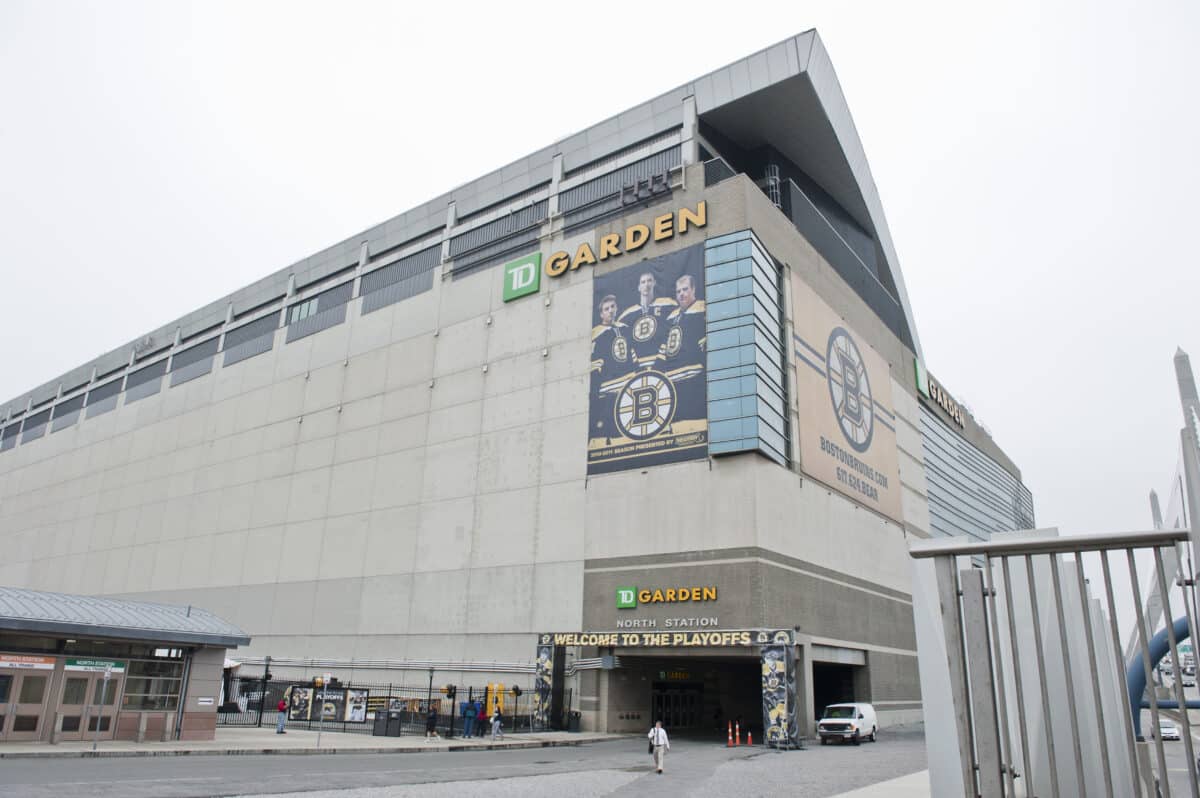
Exterior of the TD Garden in Boston. The TD Garden is home to the Celtics and Bruins. In the 1980s, the Boston Garden was in such poor condition that the team nearly left for New Hampshire.
The Political Fight Back
Massachusetts politicians responded with fury. State representative Marie Howe called for the legislature to “retaliate economically” against New Hampshire. Robert Ambler proposed flooding eastern Massachusetts with year-round horse and dog racing to destroy Salem’s financial prospects.
The Boston Arena Committee formed with major political figures: Senators Ted Kennedy and Paul Tsongas, Speaker Tip O’Neill Jr., and Governor Edward King. Senator Paul Tsongas declared: “We intend to make the arena in Salem economically unfeasible.”
“The most important factor in Boston’s retention of the Bruins downtown without spending public money was the formation of coalitions that all pushed back against the proposed relocation,” Bonsu explains. “United States Senator Paul Tsongas led a group of Massachusetts-affiliated leaders to challenge the Bruins’ potential move. Meanwhile, community groups and local politicians in both New Hampshire and Boston who opposed the move, wrote opinion pieces for local newspapers and otherwise kept up pressure to keep the Bruins in Boston.”
The political battle reflected deeper tensions in Boston during the 1970s and 1980s. The city was torn apart by school busing conflicts, with working-class white families forced to send their children across the city while wealthy suburban families remained untouched. The Bruins, nicknamed the “Lunch Pail Athletic Club,” embodied blue-collar Boston values. Losing the team to wealthy suburbs felt like another blow to communities already facing upheaval.
The Clever Counter-Strategy
Massachusetts politicians used a tactical move to kill the Salem project. “When the Bruins move was proposed, the team owners asked the New Hampshire legislature to pass a law forfeiting $5 million in tax revenues from the proposed arena,” Bonsu explains. But “politicians in Massachusetts proposed the construction of an arena in downtown Boston that was not slated to host either the Bruins or Celtics. Instead, it was proposed to host concerts and other events — the kind of events that keep sports venues occupied and make them profitable to operate even when sports are not in season.”
This threat worked. “The threat of the downtown Boston arena made the $5 million tax break look like it would not pay off for New Hampshire, and their legislature rejected the venue plan, effectively dooming the proposed move,” Bonsu says.
New Hampshire commissioned accounting firm Touche Ross to study the proposal. Their April 1981 report concluded that benefits to the state would be “negligible,” offset by an estimated $1.7 million loss at an existing dog track. The report also predicted Salem’s annual events would drop from 150 to 100 — inadequate for most arenas.
By May 1981, New Hampshire’s House committee rejected the dog racing proposal. “Once the move to New Hampshire was abandoned, the proposed arena in Boston was also abandoned. Eventually, the team owners funded a new arena in Boston,” Bonsu notes.
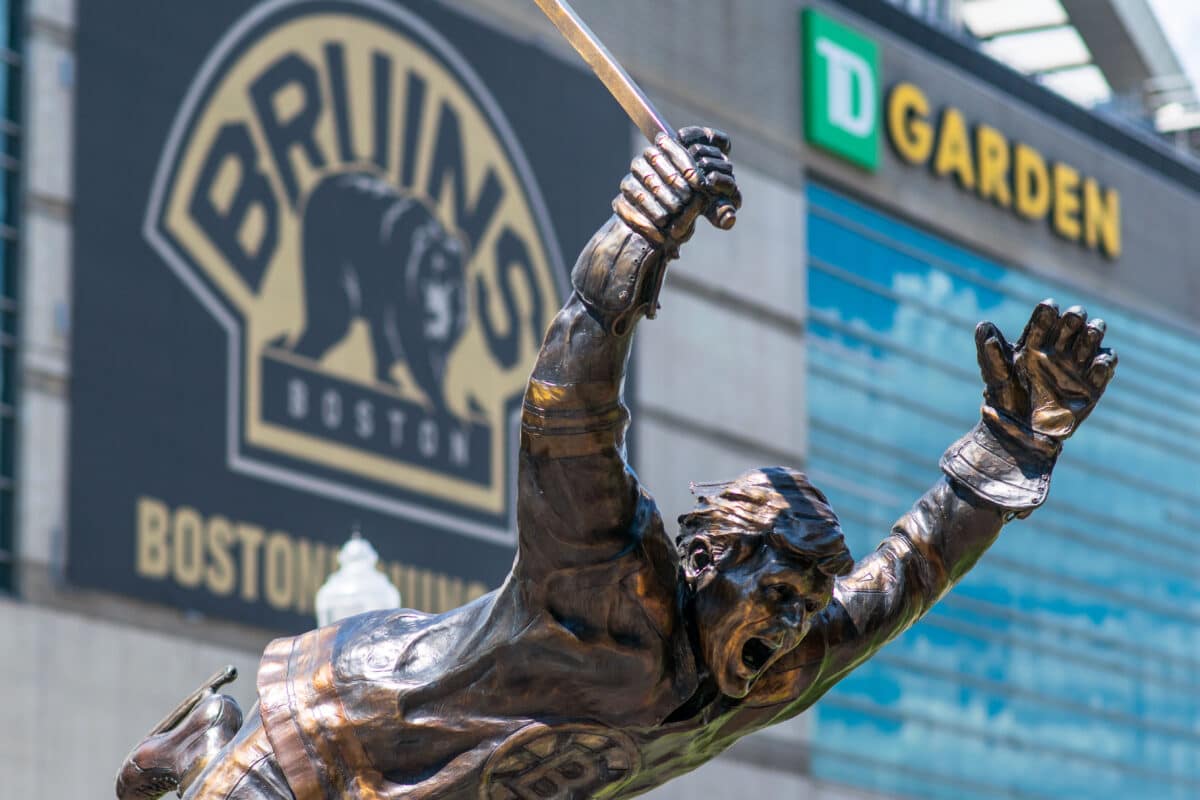
A statue of Bobby Orr outside the Boston Garden commemorates the Bruins player’s famous goal in the 1970 Stanley Cup. (Photo by Keith J Finks on Shutterstock)
Why This Still Matters Today
Sports teams wield enormous influence because they represent more than entertainment. “Sports teams are often referred to as their city,” Bonsu observes. “If someone said, ‘Pittsburgh is playing Baltimore this Sunday’ in the fall, many people would understand the reference to an NFL game between the Steelers and Ravens. By serving as proxies for their cities, the sports teams advertise the city where they reside.”
Politicians often believe losing a team means losing status. “Since the 1960s, many politicians have echoed the rhetoric of sports teams, saying things like, ‘Without this new stadium, our city will become a second-tier city on the national stage,’” Bonsu says. “For these reasons and others, many politicians believe that their constituents will vote them out if they do not work to retain a local franchise.”
But the financial reality is often harsh. “Research has shown that new stadiums provide minimal gains and can even harm the local economy if public money is pumped into the project without careful consideration of return on investment,” Bonsu warns.
Boston became an exception. “When the Bruins did eventually build a new arena in the 1990s, it was constructed next to the former site and paid for by team owners without any taxpayer funding,” Bonsu explains. “Boston is seen as something of an aspirational model because little to no public money was used in the construction of the venues for the Patriots, the Red Sox, the Bruins or the Celtics.”
Cities facing similar threats have options. “Historically, there are two prominent options: A city can move aggressively to retain a team if that is realistic, or it can work to build a strong identity beyond sports,” Bonsu says. The key lesson: “If there is one takeaway lesson from Boston, it is that everyone needs to work towards a common goal if a city wants to maintain leverage in its negotiations with a team over a new arena.”
The 1981 Bruins battle proves that communities can successfully challenge powerful sports owners — but only when they unite behind a smart strategy and understand that the real fight is about who controls a city’s future.
Paper Summary
Methodology
Bonsu used historical research methods, examining newspaper articles, government documents, legislative records, and archival materials from the early 1980s. He reviewed coverage from publications like the Boston Globe, Concord Monitor, and New York Times, plus official reports like the economic analysis commissioned by New Hampshire. The study used qualitative analysis to understand the political, social, and economic factors behind the failed relocation.
Results
The Bruins’ relocation failed due to several connected factors: strong political opposition from Massachusetts leaders who formed the Boston Arena Committee, economic analysis showing the project would lose money, resistance from New Hampshire residents and politicians worried about crime and corporate influence, competition from a planned Boston arena, and broader social tensions around race, class, and urban-suburban conflicts in the Boston area.
Limitations
The study relies mainly on newspaper coverage and government documents from the period, which may contain biases or miss some perspectives. The research focuses on one 1981 case study, so findings may not apply to all sports relocation attempts. The analysis depends on historical sources that might not capture all private negotiations or behind-the-scenes decisions.
Funding and Disclosures
The paper states “No potential conflict of interest was reported by the author(s).” No specific funding sources are mentioned.
Publication Information
Aaron Bonsu (2025): “Pucks, Politics, and Parochialism: The Collapse of the Boston Bruins’ 1981 Move to Salem, New Hampshire,” The International Journal of the History of Sport, DOI: 10.1080/09523367.2025.2486663. Published online April 19, 2025.