
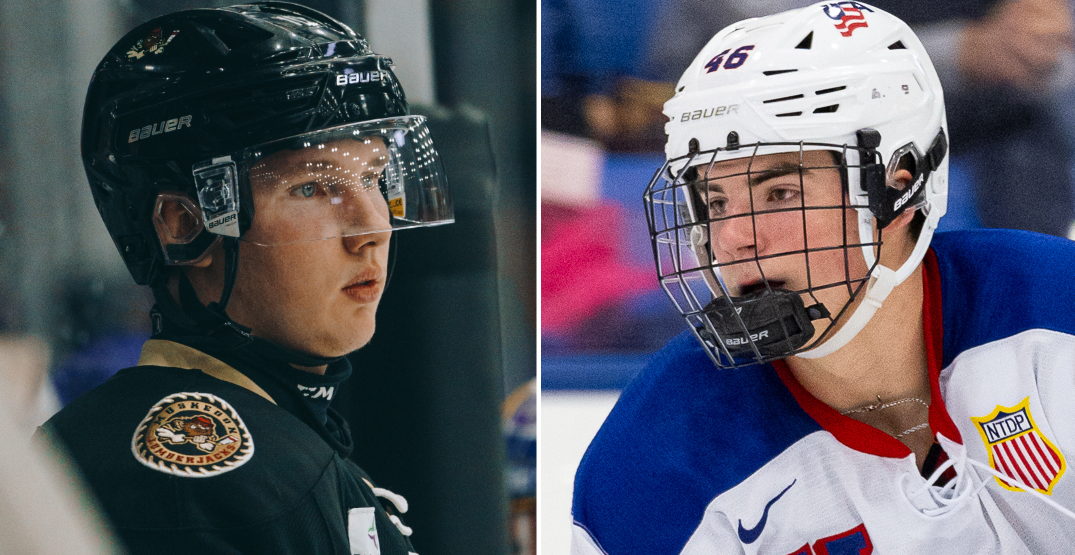
An important question that arises every year for NHL teams at the draft is whether to draft a player with higher upside or one with a clearer path to an NHL job.
That quandary presents itself in the evaluation of these two players that plied their trade partially in the United States Hockey League for their draft seasons.
Cole McKinney of the United States National Team Development Program finished as the No. 20 ranked player in FCHockey’s Final ranking for the 2025 draft. Ivan Ryabkin of Muskegon in the USHL saw his stock fall massively during the season; the Russian center was the No. 6 player in FCHockey’s Preliminary ranking, and tumbled down to No. 49 in the final ranking.
“McKinney is a late first-round option for me, while Ryabkin has fallen completely towards the mid-to-late second round, so there’s a bit of a gap there,” FCHockey regional scout Kyle Pereira said. “There are two main reasons behind this. First, Ryabkin’s sometimes lacklustre play on the ice and poor results from the NHL Scouting Combine are a bit of a red flag. Second, his style is very much risk versus reward.
“If he hits, he could be a top-six forward who can make his mark as a point producer and high-end playmaker. But if he doesn’t hit, he may never see the NHL. McKinney, meanwhile, is such a smart player in all three zones and has great size, which makes him a far easier player to translate to the next level.”
Here’s how the two pivots compare:
McKinney’s Standout Traits
At 6-foot, 201 pounds, McKinney brings pro-ready size and a high-effort, two-way game that allows him to influence all three zones. The 18-year-old is a smart, competitive center with a tenacious motor, known for stripping pucks from opponents and applying consistent pressure across the ice. His strengths begin with high-end hockey sense and a heads-up style that enables him to make quick reads and drive play. He excels in transition, using smart routes and strong edgework to gain zone entries and exits.
Offensively, McKinney blends sharp stickhandling with soft hands to create space in tight areas, while his shot features a quick, deceptive release. He’s adept at finding soft ice and engaging physically at the net front. Defensively, his structure, positioning, and active stick make him a trusted penalty killer. Technically sound at the faceoff dot and relentless in puck pursuit, McKinney is a coach’s staple in critical moments and special teams deployment.
“What stands out most to me about McKinney is his consistency and ability to affect the game in all three zones,” FCHockey scout Jacob Roth said. “He always showed up, whether in USHL or international tournaments for the US, and was always a top performer for his team. As far as physical skills go, his skating and stickhandling are his best weapons. They allow him to be super effective in transition, moving the puck from the defensive zone to the offensive zone.”
McKinney’s Areas of Improvement
McKinney had a solid level of production in his draft year, but nothing earth-shattering. He scored 26 points (15 goals, 11 assists) in 23 games against USHL competition and had 61 points (27 goals, 34 assists) in 60 games of international junior play. The University of Michigan commit also contributed five points (three goals, two assists) in seven games to help Team USA claim a bronze medal at the 2025 IIHF World Under-18 Championship.
If McKinney can discover another gear offensively, it could change his pro projection.
“I think the next step for McKinney is to stand out more on the offensive end of the ice,” Roth said. “He has strong offensive skills and is a key part of his team’s transition game, but his dedication to his two-way game leads him to be a little passive once in the offensive zone. I think there is room for him to be a little more aggressive without hurting his defensive game.”
Ryabkin’s Standout Traits
The big reason Ryabkin entered the 2025 draft with the fanfare he did is the offensive toolkit he possesses. As a 16-year-old in Russia’s top junior league, the MHL, he scored 58 points (24 goals, 24 assists) in 44 games to surpass totals posted by Nikita Kucherov and Matvei Michkov at that age. After crossing the ocean to join Muskegon in late December, he was a key member of their power play, registering 10 points (six goals, four assists) on the man advantage. He also finished second on his team in playoff scoring with 16 points (seven goals, nine assists) en route to winning the Clark Cup as USHL Champions.
At 5-foot-11 and 201 pounds, Ryabkin is a poised, stocky Russian forward who combines a high-end offensive toolkit with a physical edge. A gifted playmaker, he possesses elite vision and an innate sense of spatial awareness, often appearing one step ahead of the play. His puck distribution is his hallmark—threading passes through tight seams with accuracy and composure, particularly when quarterbacking the power play from the half wall. Ryabkin handles the puck with confidence under pressure, dictating pace and exploiting defensive lapses with sharp reads and quick execution. While more pass-first in nature, he owns a hard one-timer and doesn’t shy from shooting when space opens up. Off the puck, he finds quiet ice well and positions himself for high-danger chances. Physically engaged, he regularly finishes checks and wins puck battles. Though his straight-line speed is limited, his intelligence, maturity, and ability to control play make him a strong offensive contributor.
“Ryabkin’s standout traits have to be his playmaking and sandpaper style,” Pereira said. “His vision and timing as a playmaker can be elite at times, while he also plays a fiery style, throwing his weight around.”
Ryabkin’s Areas of Improvement
The biggest thing that NHL teams will wrestle with for Ryabkin lies in his effort level. When he’s going and fully engaged, he can be the best player on the ice. Unfortunately, he hasn’t shown that consistently. Defensively, his play fluctuates with effort. He can be good in support one shift and appear absent in the next. Ryabkin still has room to grow as a skater also. He lacks explosiveness and real high-end speed, which leaves him lagging in races.
“Effort, consistency, and defensive play are major areas of improvement for Ryabkin,” Roth said. “Even offensively, he looks disengaged at times, but that especially goes when on the defensive end. Often coasting and just going through the motions, his lack of effort is concerning. His skating also is an area that could stand to improve.”
The Deciding Factor
Ryabkin, No. 34 ranked North American skater on NHL Central Scouting’s final ranking for the 2025 draft, might be in a class above McKinney if the evaluation was based solely on talent and upside.
Teams, however, have to take other factors like effort level and consistency into account along with NHL projectability, and Ryabkin presents a complete boom or bust case. If he can marry a more consistent effort level with some growth in the skating department, he could be a strong middle-six option in the NHL. If he can’t, he’ll likely struggle to be in the NHL at all.
McKinney, ranked No. 32 by NHL Central Scouting, has a more well-rounded game that is easily translatable to the NHL. While adding another level offensively could push him up a team’s depth chart, his dedication to a strong two-way game projects well to playing in an NHL bottom six.
“In terms of pure talent, I think Ryabkin has much higher upside, especially offensively,” Roth said. “However, there are legitimate off-ice and effort concerns surrounding Ryabkin. Reports from the Combine indicate his interviews with teams did not go well and have done nothing to ease the concerns that have built around him all year. McKinney, on the other hand, plays a very well-rounded and projectable pro game and is a high-floor prospect. This should get him picked in the 25-40 range. While Ryabkin may be a top-20 talent, the concerns push his draft stock far below McKinney’s.”
PEREIRA BREAKDOWN
Who is the better skater? Ryabkin
Who is the better shooter? McKinney
Who is the better puckhandler? Ryabkin
Who is the better playmaker? Ryabkin
Who has the higher offensive IQ? Ryabkin
Who has the better defensive IQ? McKinney
Who has the better compete? McKinney
ROTH BREAKDOWN
Who is the better skater? McKinney
Who is the better shooter? Ryabkin
Who is the better puckhandler? McKinney
Who is the better playmaker? Ryabkin
Who has the higher offensive IQ? Ryabkin
Who has the better defensive IQ? McKinney
Who has the better compete? McKinney
YOU MIGHT ALSO LIKE: