
Editor’s Note: This story is a part of Peak, The Athletic’s desk covering leadership, personal development and success through the lens of sports. Follow Peak here.
It’s natural to try to learn from the winners. We study John Wooden’s pyramid of success to see if anything in there can offer a glimpse at how Wooden helped UCLA’s men’s basketball team win 10 national championships. The sports section of the bookstore is filled with titles authored by the greatest achievers.
But what if we could also learn from those who have failed? If it’s true that you either win or you learn, those who lose should have plenty of lessons to share.
Over the last 14 seasons, the Buffalo Sabres have failed to reach the NHL playoffs. No team in the history of the NHL has gone through a playoff drought this long. And there are plenty of lessons we can extract from the Sabres’ decade-plus of struggling. During that time, the Sabres have had seven coaches and four general managers. Some have come closer than others to getting the Sabres back to the playoffs, but all have come up short for different reasons.
Based on The Athletic’s story about Terry Pegula’s ownership, Kevyn Adams’ rise to general manager and the “hamster wheel” of the Sabres’ playoff drought, here are three key leadership lessons we can learn from the Sabres’ struggles.
1. Culture matters. So does sticking with a plan
Early in his ownership, Pegula was a willing spender. He boldly declared there would be no financial mandates on the Sabres’ hockey operation. He spent freely on big-name free agents such as Christian Ehrhoff and Ville Leino. He poured money into the scouting staff and travel budgets. But he quickly found out that spending your way to a winner has its limits.
The Sabres missed the playoffs in his first two seasons as owner, and that’s when he tried to take another shortcut.
Starting in 2013, the Sabres began a two-season tank toward the bottom of the NHL standings. Then-general manager Darcy Regier warned fans that there would be some “suffering” on the way to the team’s ultimate goal of being Stanley Cup champions.
Buffalo stripped the roster of aging veterans in an effort to get the highest draft pick possible. In the process, Regier was fired, and so was coach Ron Rolston. Buffalo got the No. 2 pick in consecutive drafts, in 2014 and 2015, selecting Sam Reinhart and Jack Eichel. The two were supposed to be franchise cornerstones who would lead the Sabres back to being a Stanley Cup contender.
The problem is that the Sabres then hit fast forward again, swinging aggressive trades under new general manager Tim Murray that created a volatile environment around their two top draft picks.
By tanking, the Sabres wiped out their culture. Eichel became the captain of the team before he was fully ready for the role. Too much of the pressure to get Buffalo back to the playoffs was squarely on Eichel and Reinhart.
“Jack Eichel and Sam Reinhart were able to run the show there at a young age when they hadn’t won anything,” one Sabres scout from that era said.
The crux of the most recent plan under Adams is to build the Sabres through drafting and developing their own talent. But the problem is that so many players have been inserted into big roles or signed to big contracts before fully earning them. Mattias Samuelsson got a seven-year contract worth more than $4 million per season after just 54 games. Owen Power got a seven-year deal worth more than $8 million per year after one full NHL season. The Sabres tried to make Devon Levi their starting goalie as a rookie in 2023-24 before he had ever played a game in the AHL.
The list goes on. The lesson: It’s hard to create a culture of competition and accountability when young players are thrust into critical roles before they’re ready.
“Make them earn the right to be a Buffalo Sabre,” one former scout said. “Don’t just give it to them.”
During this playoff drought, the Sabres have made 10 top-10 draft picks. They’ve picked first twice and second twice.
Eichel and Reinhart have both won the Stanley Cup with other franchises. Both finished in the top five of the voting this season for the Selke Trophy, awarded to the league’s best defensive forward. Linus Ullmark, drafted by the Sabres, won a Vezina Trophy as the league’s best goaltender after leaving Buffalo. Five of the last six Stanley Cup champions have had drought-era Sabres players on their roster. There are multiple former Sabres on the Edmonton Oilers and Florida Panthers, the two Stanley Cup finalists this year.
Last season, when asked about the Panthers’ culture and why players thrive in it, Reinhart pointed to “a very clear sense of direction” that starts with the coaching staff and the team’s core players.
That’s something that’s been lacking in Buffalo. There is no single reason players find more success once they leave the Sabres, but the lesson is that environment matters. Culture matters.
You need to have the patience and vision to set players up for success. Growth, both personal and professional, is not guaranteed just because of talent. And development is rarely a straight line. The Sabres haven’t stuck to one single plan for long enough, and that’s part of why they’ve been stuck on the hamster wheel.
2. Surround yourself with people who will make you better
When the Sabres hired Adams as general manager in 2020, they did so without running a search or interviewing other candidates. They then had the first-time general manager fire more than 20 people and take over a front office with no assistant general managers. Over the last five years, Adams has slowly built out a bigger staff that is more in line with other NHL teams, including the recent hires of Jarmo Kekäläinen as senior adviser and Eric Staal as special assistant to the general manager.
But when Pegula hired Adams, he did so because he wanted to be heard. Prioritizing that over finding the right candidate and surrounding him with an experienced staff hurt both Adams and the team, as he’s gone through the predictable ups and downs as an inexperienced general manager.
The lesson is that leaders should always make an effort to surround themselves with people who are smart and experienced enough to challenge them. That competition and accountability are how you grow individually and as an organization.
You could also extend this to Buffalo’s roster, which has been among the youngest in the NHL each of the last three seasons. How are young players supposed to learn about winning or how to build a culture when so few players in the locker room have experienced what that looks like in the NHL?
3. Communication matters
In December 2024, while the Sabres were in the early stages of what would become a 13-game winless streak, Adams delivered a quote that has come to haunt him. After saying that Buffalo was not a destination city for outside free agents, Adams said the Sabres would need to become a perennial playoff team to change that narrative.
He then added, “We don’t have palm trees. We have taxes in New York. Those are real. Those are things you deal with.”
He wasn’t wrong when he said it, but the timing of the comment angered an already frustrated fan base. It was a comment Adams needed to address with the team. The players and others had preached accountability all offseason, and that comment felt like excuse-making to a fan base that had heard one too many excuses during the postseason drought.
Part of the job of any leader is effective messaging. Pegula has not answered questions about the Sabres since 2020, when he said the goal of the organization was to be “effective, efficient and economic.”
Since then, Adams has operated with a smaller budget than many NHL teams and been the one to answer for the Sabres’ shortcomings. There have been times when he’s let his words get ahead of his actions. After the Sabres came up one point short of the postseason in 2022-23, Adams said the team’s window was open. But Adams wasn’t aggressive in free agency, left cap space on the table and again put out one of the youngest rosters in the league.
When the team underperformed based on expectations, it was coach Don Granato who took the fall, with Adams pointing to “accountability” as a key issue with his team.
When Adams and Pegula hired Lindy Ruff for his second stint as the franchise’s head coach, the message became that the Sabres were in a “win-now” situation. The roster changed more than it did the previous season, but cap space was still left unspent, and the Sabres were still among the youngest teams in the league. The outside expectation of a slow and patient rebuild became warped by inconsistent messaging.
That’s how you end up with way more “suffering” than Regier intended when he uttered that now-infamous line.
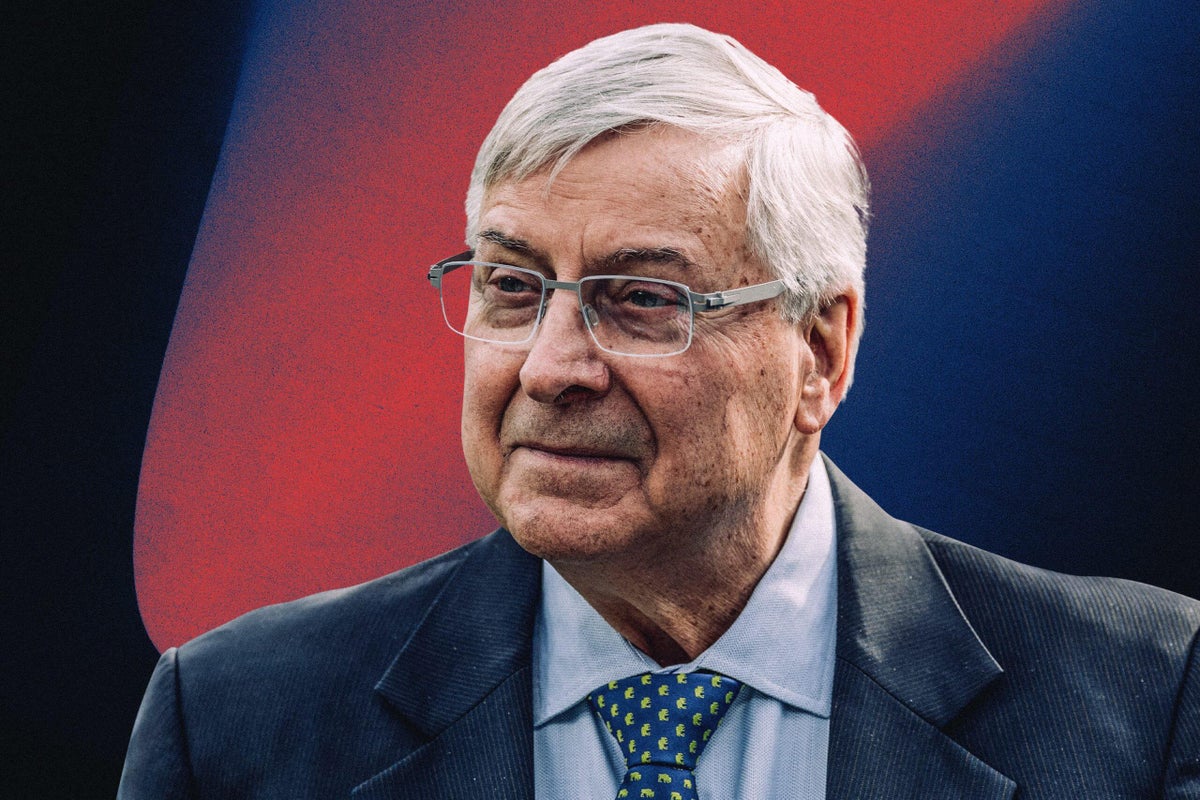
(Illustration: Dan Goldfarb / The Athletic; photo: Tony Ding / Icon Sportswire / Getty Images)