
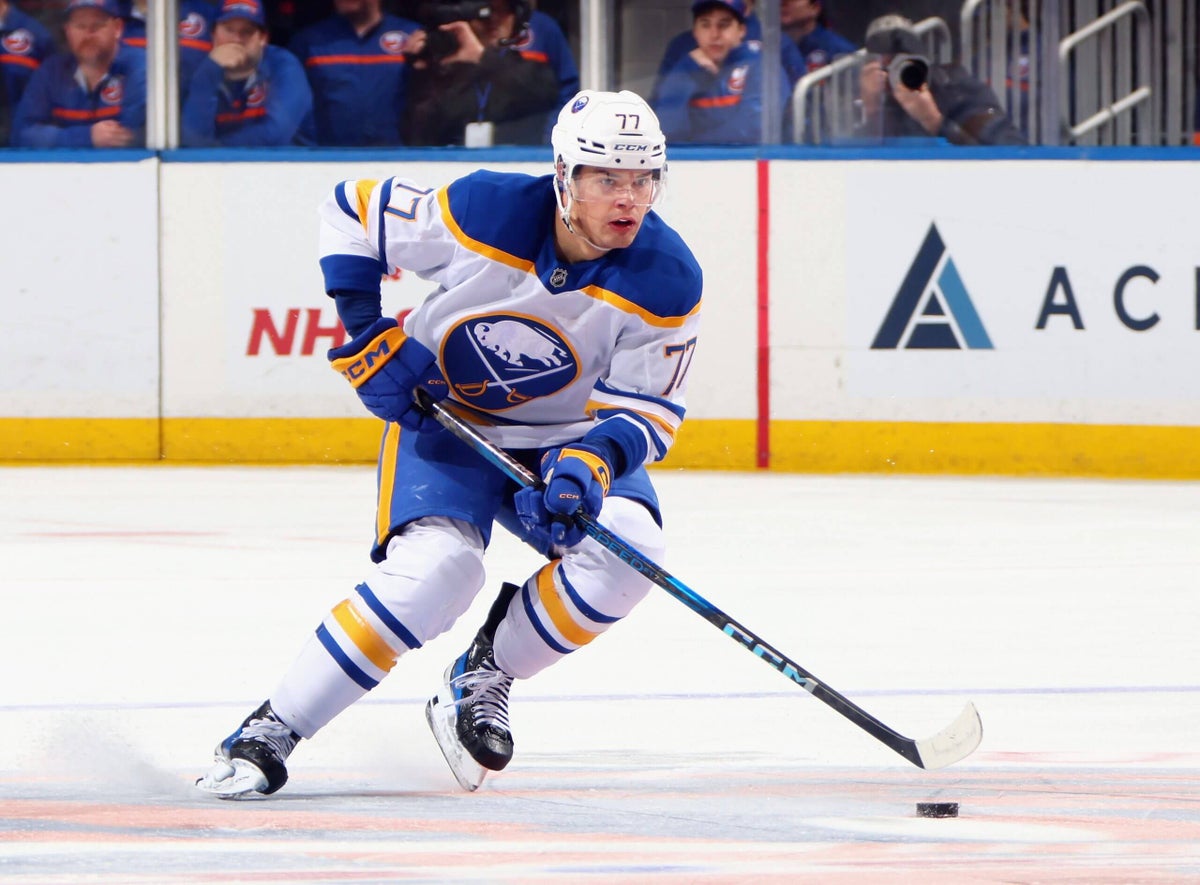
BUFFALO, N.Y. — When Buffalo Sabres general manager Kevyn Adams held his pre-draft press conference on Tuesday, he was short on specifics when it came to JJ Peterka and the trade rumors surrounding him. But he finished his answer by saying, “We have a plan.”
We saw the first piece of that plan late Wednesday night when Adams traded Peterka to the Utah Mammoth in exchange for right-handed defenseman Michael Kesselring and right wing Josh Doan. Peterka, who was unwilling to sign a long-term extension in Buffalo, immediately agreed to a five-year contract worth $7.7 million.
There’s a lot to unpack with this trade, one that will go down as one of the biggest of the offseason. It’s not often that a homegrown, 23-year-old fresh off a 68-point season gets traded. But Peterka was keen on a change of scenery. It’s hard to imagine he would have taken that same contract extension to stay in Buffalo.
The fact that Peterka, who is still four years away from unrestricted free agency, didn’t want to commit to playing for the Sabres can be viewed as a legitimate indictment on the organization, one that hasn’t made the playoffs in 14 years and is entering year six with Adams as general manager despite going backwards each of the last two seasons. It also put Adams in a position he hasn’t been in since Jack Eichel and Sam Reinhart asked for trades back in 2021. Adams had to know any trade involving Peterka would mean giving up a player perceived to be the best in the deal, just like those Eichel and Reinhart trades. He also had to know the longer the situation dragged on, the more he risked losing leverage in trade talks.
When the offseason started, dealing Peterka wasn’t necessarily on the top of Adams’ to-do list. Peterka’s name first popped up in trade rumors around the NHL trade deadline, but Adams said then that he viewed Peterka as part of the Sabres’ core. But by the time the NHL Scouting Combine rolled around, the Sabres were getting inundated with inquiries about Peterka’s availability. If Peterka was that unhappy, why wouldn’t Adams listen to those offers?
Setting aside how Peterka got to that point and what it means about the state of the Sabres under Adams, the question will be whether Adams got enough in return for Peterka. That depends on your view of Peterka and your view of the players the Sabres acquired.
In a vacuum, Peterka is the best player in this deal. He had 68 points last season and set a career high with 41 assists. He had 28 goals two seasons ago and 27 goals last season. He’s a legitimate top-six winger with the speed and shooting ability to create a ton of offense off the rush. Peterka got a lot of opportunity to do just that in Buffalo, where he spent a lot of time on the first line and got a healthy dose of power-play minutes. It’s worth noting, his five-on-five shooting percentage was also north of 14 percent last season. That may not be sustainable.
Peterka is also not a strong defensive player at this point in his career. Despite his offensive ability, the Sabres have only 46 percent of the expected goals when Peterka was on the ice at five-on-five last season. According to The Athletic’s Dom Luszczyszyn’s model, Peterka’s defensive impact was in the second percentile in the league. Peterka’s potential is obvious, but he still needs to round out his game. Here’s something else to consider:
Peterka while playing with Tage Thompson together at five-on-five: 50.34 percent expected goal share
Peterka without Thompson: 42.77 percent expected goal share
Thompson without Peterka: 53.31 percent expected goal share
None of this is to say Peterka isn’t a quality asset, but he’s far from a sure thing to develop into a star. Utah is placing a reasonable bet on a player who fits the way they want to play.
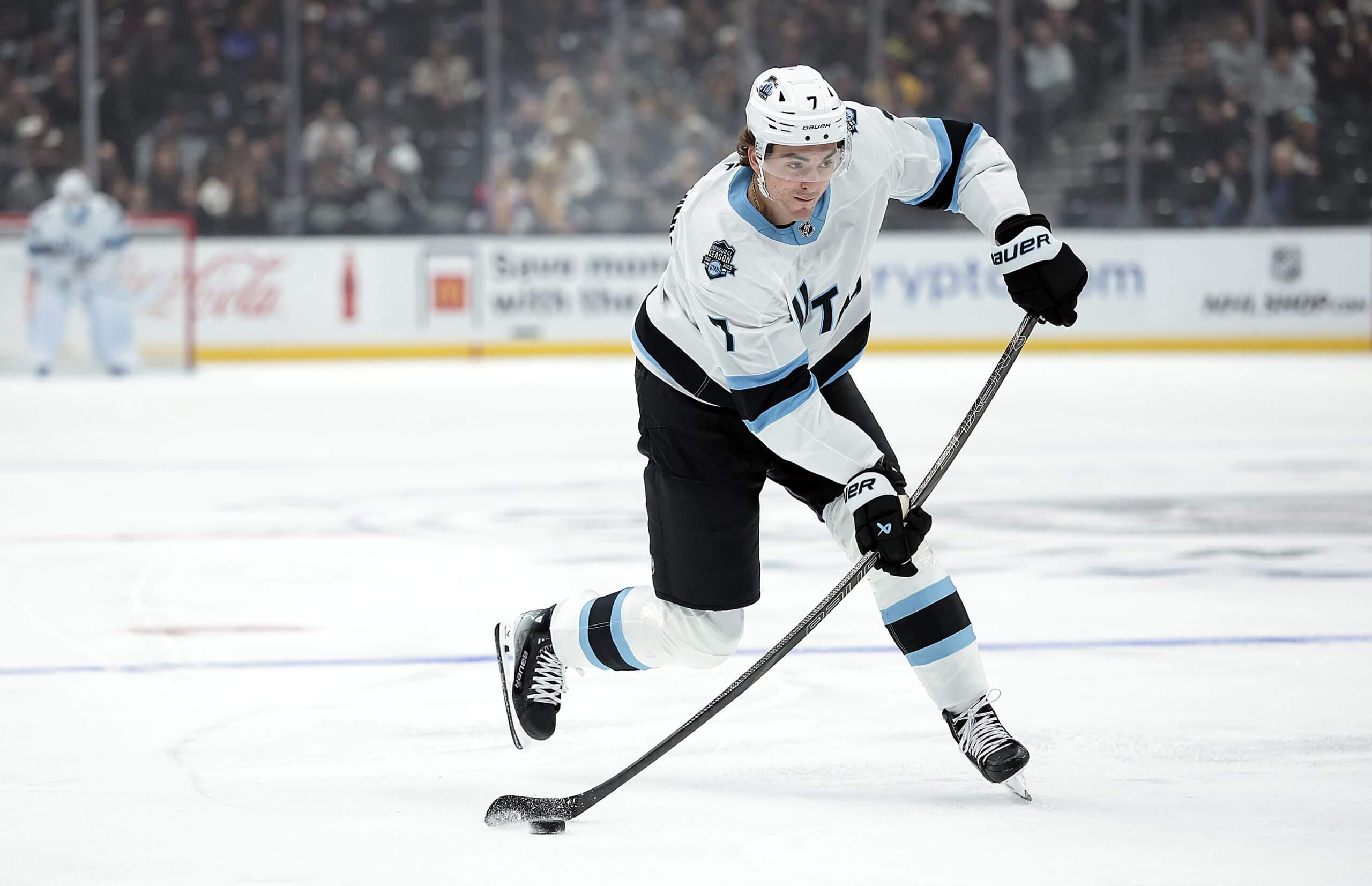
Michael Kesselring looks like an ideal partner for Buffalo’s Owen Power. (Ronald Martinez / Getty Images)
Meanwhile, the Sabres are adding two players who aren’t nearly as flashy as Peterka but who could help the Sabres in their aim to become a more well-rounded team.
Kesselring is the right-shot defenseman Adams has coveted for his entire tenure as general manager. He’s 25 years old, stands 6-foot-5 and 225 pounds and has the toughness to match. But he also skates well and has one of the heaviest shots in the league. He looks like an ideal partner for Owen Power and is under contract for one more year at $1.4 million before becoming a restricted free agent.
Right-handed defensemen tend to be among the most difficult players to find and acquire. The Sabres clearly needed to add a tough defender to their blue line this summer, and Kesselring is that.
Doan, the son of former NHLer Shane Doan, had only 19 points in what was mostly a bottom-six role for Utah last season. But the 23-year-old also acquitted himself as one of the most tenacious forecheckers in the league last season. According to AllThreeZones, Doan was among the league leaders in forecheck pressures per 60 and recovered dump-ins per 60. Utah controlled 61 percent of the expected goals when Doan was on the ice at five-on-five. He plays a smart, well-rounded game and has room to get better offensively. He’s in the third year of his entry-level contract.
The Sabres were one of the worst teams in the league at generating chances off the forecheck last season and have habitually struggled to convert chances around the front of the net. Doan can do both of those things, but how big a role he has could determine how much of an impact he’s able to make.
In a team statement, Adams said the Sabres came into the offseason with the goal of becoming “more competitive and tougher to play against. The additions of Michael and Josh will help us tremendously in both of those categories.”
Another previously stated goal of the offseason was fixing the team culture. Sabres coach Lindy Ruff noted it multiple times during a behind-the-scenes video of the team’s trade deadline process. It was a talking point after the season, too. Keeping a disgruntled player doesn’t necessarily contribute to that goal.
The Sabres have developed a reputation for high-profile trades that don’t age particularly well. The list of drought-era Sabres who have won a Stanley Cup elsewhere is a long one. So it’s easy to look at this trade and think Peterka will be the next talented Sabre to hit his ceiling in another uniform.
But the Sabres are getting back two players who could make them a more complete team next season. The key to all of this is what comes next. The Sabres saved more than $5 million in cap space based on Peterka’s new extension. The Sabres now have roughly $20 million in cap space with 18 players under contract. For a team that hasn’t spent within $6 million of the cap ceiling since 2019-20, that gives off the scent of a cost-savings move. One way to dispel that is by using those savings to improve the roster elsewhere.
Adams still has a lot to get done over the next few weeks. Bowen Byram, Ryan McLeod, Jack Quinn, Jacob Bernard-Docker and Devon Levi are all restricted free agents. Alex Tuch is also eligible to sign an extension on July 1 and that should be a priority for the Sabres.
Byram is another name that has been in trade rumors all offseason. Will Adams keep him to have a top four on defense of Byram, Rasmus Dahlin, Power and Kesselring? Or will he move Byram to try to add some offense to replace Peterka’s production? Could Adams move the No. 9 pick or some of his prospects for more NHL help? Is there a free-agent swing in the cards?
The answers to those questions will help us judge the totality of Adams’ offseason plan. Adams hasn’t earned the benefit of the doubt with Sabres fans after the last five years. And this trade with Utah is a risky one. But it’s just the first piece of what should be an eventful offseason for Adams and the Sabres.
(Top photo: Bruce Bennett / Getty Images)