

Editor’s Note: This story is a part of Peak, The Athletic’s new desk covering leadership, personal development and success through the lens of sports. Peak aims to connect readers to ideas they can implement in their own personal and professional lives. Follow Peak here.
Moments before overtime of Game 6 between Sidney Crosby’s Pittsburgh Penguins and Alex Ovechkin’s Washington Capitals in 2016, the Penguins all sat in the silent home locker room. No one moved. No one uttered a word.
The Penguins, despite enjoying a 3-2 series advantage, had just blown a 3-0 lead because they had choked. Three trusted veterans — Chris Kunitz, Ian Cole and Nick Bonino — had fired pucks over the glass in a stunning third-period meltdown, awarding the Capitals three power plays. Washington had the momentum. According to then-Capitals assistant coach Todd Reirden, Ovechkin paced the Capitals locker room “like a caged animal” in the moments before overtime began.
Over the years, the Penguins had been mentally tougher than the Capitals, which explained why they owned their bitter rival in the biggest games. Now, the tables appeared to have turned and the Penguins were rattled. It was all silent in the Pittsburgh room, until only a few intermission minutes remained.
Then Crosby, the soft-spoken captain of the Penguins, stood up and addressed his team.
“Hey guys,” Crosby said. “We’re better than that f—ing team. This ends now.”
It took only 6 minutes, 32 seconds of overtime for Bonino to score the game-winner, ending the series and paving the way for Crosby and the Penguins to win their second of three championships. But Crosby’s message left a lasting impression.
“No one could believe it when he did it,” Cole said. “Bones scored the goal, but it was Sid. We needed to hear it. It was all Sid. That’s the kind of leader he is.”
Crosby has been the captain of Team Canada since 2014, and for almost half of his life, the 37-year-old Crosby has skated with the “C” stitched on his chest in Pittsburgh. Along the way, he has developed a reputation for leadership that is second to none. There is a family atmosphere and a charitable spirit within the Penguins organization that largely exists because of him.
Even this season, as Crosby’s Penguins miss the playoffs for a third straight season, his leadership attributes have never dimmed. The results and on-ice success may vary from year to year; Crosby does not.
What’s his secret? What makes him unique? What makes him a great leader?
Those who have shared a locker room with Crosby swear by him and talk about a set of common principles:
He treats everyone the same and insists that he’s treated like everyone else.
He makes everyone feel welcome and does so with personal touches.
His competitiveness rubs off on everyone else.
His work ethic and consistency inspire others to be better.
“There’s never been anyone like him, and there never will be,” said former Penguins general manager Jim Rutherford. “I’ve been around a while and I’ve met a lot of people. I’ve never met anyone like him.”
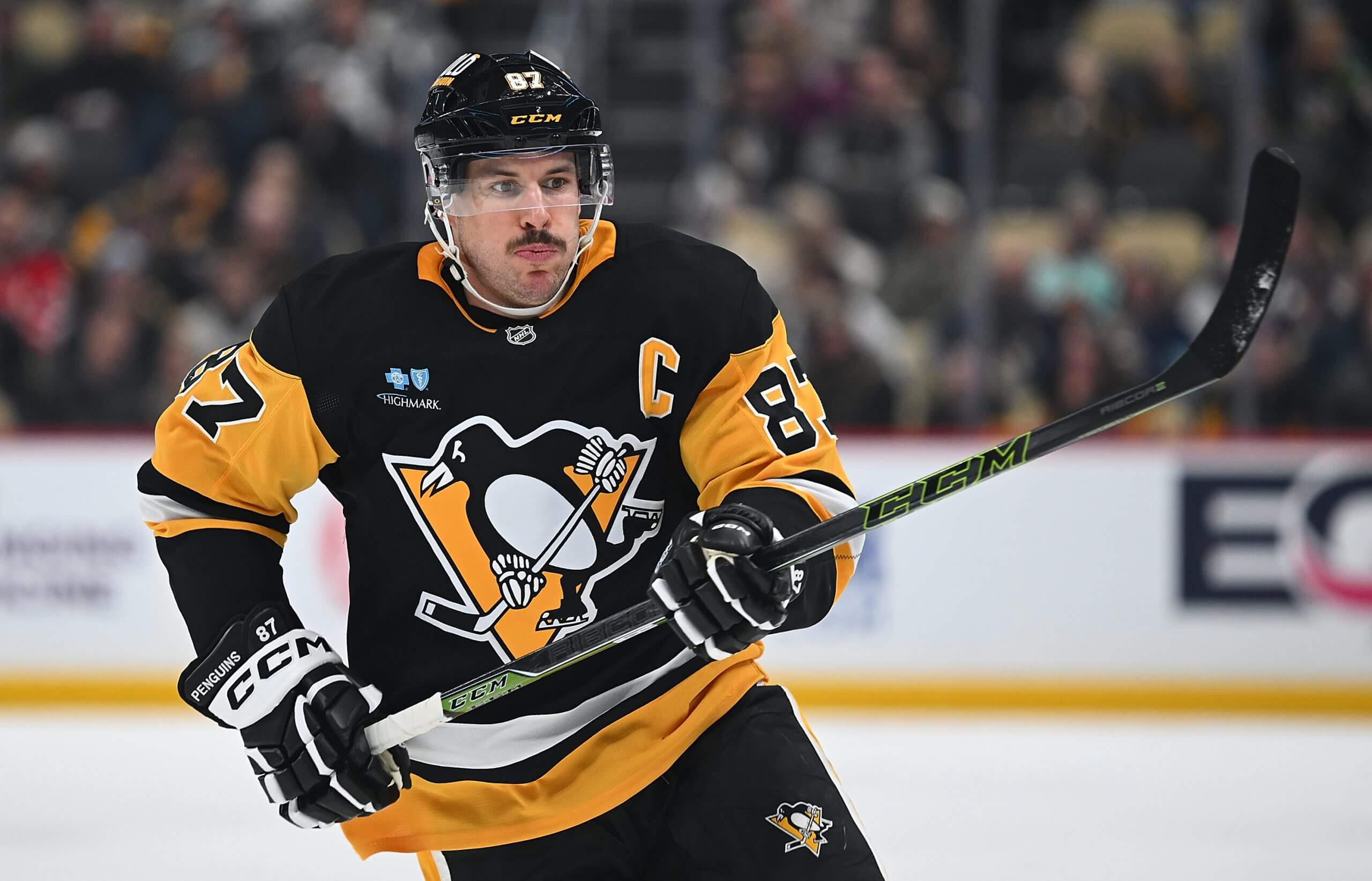
Sidney Crosby has worn the captain’s “C” in Pittsburgh for almost half of his life. (Photo by Justin Berl / Getty Images)
In 2014 the Penguins acquired Lee Stempniak and Marcel Goc at the trade deadline, and the pair was set to play in San Jose the following day. Goc and Stempniak were en route to the SAP Center in San Jose.
The rest of the Penguins had long since departed the arena in San Jose for the hotel to engage in the standard pre-game afternoon nap. Stempniak and Goc, however, were headed straight to the arena, so Crosby sat for hours in the Penguins locker room, waiting for the new players to arrive. He had already welcomed them to the team via text, but he prefers to add the personal touch.
“That’s what I noticed when the Penguins first traded for me,” said Ryan Pohling, who played one season for the Penguins before moving on to Philadelphia. “I get a text from Sid. And he’s chatting you up, making you feel so comfortable. And you’re like, ‘Sidney Crosby is talking to me.’ It just gets your attention because of who he is. But he just wants to make you feel welcome immediately. He’s different than anyone else.”
There is a long trail of evidence of Crosby making new guys feel welcome.
“It’s crazy,” said Rutger McGroarty, one of the youngest Penguins. “You’re barely in the NHL, and Sidney Crosby is chatting you up.”
But those personal touches extend to longtime teammates as well.
“If you’re having a bad day or having a problem, he’ll take care of you,” said Marc-Andre Fleury, his former teammate. “He’d talk in French to make me feel better.”
Crosby’s leadership skills blossomed during the 2016 and 2017 Penguins Stanley Cup runs. He was still in his 20s then and had already been the captain for a decade.
It took a while for him to get comfortable in that role, even though you’d never know it.
“I was never the captain anywhere when I was young,” Crosby said.
Say what?
It’s true. Crosby, so advanced at a young age, always played in older age groups. Thus, even though he was always the best, he was never the captain because he was always the youngest.
During a transitional period in 2015 and 2016, the Penguins had rid themselves of many older players and replaced them with young players such as Bryan Rust, Tom Kuhnhackl, Matt Murray, Scott Wilson and Conor Sheary. The five young players had all arrived from Wilkes-Barre, Pa., where the Penguins’ American Hockey League affiliate plays. During the 2016 Stanley Cup run, Crosby frequently took the young players out to dinner, wanting them to feel comfortable in a new city.
Sometimes they’d be itching for a nap on the road. Too bad.
“We usually have these team lounges at hotels,” Rust said. “Trust me, he was always encouraging us to get down there. He wanted everybody there, but especially the younger guys. So you would go down to the lounge, and he’d be there waiting. Shoot the bull, play cards, whatever. I think he just wanted everyone hanging out together. It was important to him, and it still is. We’d have team dinners, stuff like that, and he’d always make sure the young guys attended. He went out of his way to make us feel comfortable during that time.”
That, Rust said, led to the Penguins’ back-to-back championships as much as their talent.
“It’s 100 percent a real thing, and Sid always understood that,” Rust said. “It can be the missing piece to the puzzle.”
Just because he wants to make people feel welcome doesn’t mean Crosby wants them to stay too relaxed. Not for long, anyway.
Crosby makes those around him better simply by challenging them.
“He doesn’t even mean to do it,” former teammate Mike Rupp said. “At least, I don’t think he does.”
In 2010, the Penguins were conducting their annual team testing at the beginning of training camp. Rupp, a 6-foot-5, 230-pound power forward and menacing physical presence, had earlier in the day thrown the medicine ball further than any of his teammates.
Rupp was feeling good about the accomplishment when Crosby walked up to him.
“So I heard you have the record for today?” Crosby said. “Not anymore.”
“So we started throwing the medicine ball back and forth after this,” Rupp said. “I throw it the first time, and it goes maybe 25 feet. Then he gets 26. Then I throw one 27. So then he throws one that goes 30 feet. I think we got up to 33 feet.”
“The point is,” Rupp said, “I had thought, at that time, that I had thrown it as far as I could. That I gave everything that I could. But I hadn’t. That’s how Sid brings you to another level.”
On or off the ice, Rupp had never seen anyone who could inspire greatness from those around him like that. The oldest of his former teammates agrees.
Matt Cullen was almost 40 when the Penguins won those championships in 2016 and 2017. Even he found himself looking up to Crosby.
“I think his drive to constantly improve his own game and his unmatched work ethic leaves teammates no choice but to follow,” Cullen explained.
Crosby possesses the unique ability to have his hand in everything without dictating anything. Rutherford often speaks of the reality that Crosby understands the impact he has on people but doesn’t let that knowledge go to his head.
“I get to do what I love,” Crosby said. “The least I can do is treat people well along the way.”
Crosby nearly lost his career in 2011 because of a concussion that ultimately cost him more than 100 games. During this time, he researched concussions and spoke with so many doctors on so many occasions that he essentially became an expert on the subject. In the years that followed, any time one of the Penguins sustained a concussion, they’d be greeted with a conversation from Crosby. He wanted to know what they were feeling, wanted to educate them and, more than anything, wanted to make sure they didn’t return from the brain injury too soon.
From serving as medical consultant, to organizing rookie parties on road trips, to quietly meeting with general managers to offer his opinion on offseason plans, Crosby’s influence is gentle but consistent.
“I’d call him into my office after every season,” Rutherford said. “I wanted his opinion on the team, on players out there we could get, on what we should do. He never told me to get rid of anyone, or to fire anyone, or anything like that. That wouldn’t be his way. He just wanted what was best for the organization, and I knew this, so I’d have him sit down to talk with me.”
The conclusion from those who have worked with him closely is, very simply, that Crosby wants the best for people, on and off the ice.
Even through all of the losing in the past few years, Crosby’s leadership remains steady.
When the Penguins recently recalled top prospects McGroarty and Ville Koivunen, Crosby stayed on the ice with them for more than 30 minutes after practice, getting to know them and making them comfortable.
He often makes himself present in Pittsburgh in early July, during Penguins rookie camp. He never ignores the present, but the Penguins are currently rebuilding, and Crosby clearly wants to show the way for the next wave of great Penguins, no matter how much longer he intends to play.
“I just think Sid is the most selfless leader I’ve been around,” Cullen said. “He cares about each guy on the team no matter their role. He has a unique awareness of everything going on in the room and a great feel for what the group needs. When your best player is your hardest worker, you have something special. And that’s what Sid is.”
(Illustration: Eamonn Dalton / The Athletic; Steph Chambers / Getty Images)