

The Montreal Canadiens own a pair of first-round picks heading into the 2025 NHL Entry Draft, however, few fans are expecting the team to make both selections.
With the 16th and 17th overall picks in the draft, the Habs may want to trade one or both of them for an established NHL player, or to move up to select a player they identified as a good-value pick.
That was the case last season, when the Canadiens traded the 26th overall pick (2025), a second-round pick (57th, 2025), and a seventh-round pick (198th) to the Los Angeles Kings in exchange for the 21st overall pick (2025).
Montreal used the 21st overall pick to nab Michael Hage, one of the most interesting players in their current prospect pool.
ON TOPIC: Canadiens Prospect Michael Hage Is Setting The NCAA On Fire
All things considered, the trade provided fantastic value to the Canadiens, especially since the second-round pick they sent to the Kings was very late, and thus carried very low value. The seventh-round pick’s value was negligible. I would have quickly shut down the trade discussion if I worked for the Kings, but I digress.
The trade does provide some sort of framework when discussing a potential move this offseason.
It will likely cost the Canadiens more to move up this season, but their initial pick value is higher, mitigating some of the potential cost.
Moving Up In The First Round Of The 2025 NHL Entry Draft
The first thing we need to establish is the value of picks. I tend to describe draft-pick value as a reverse Richter Scale. Picks start off with high value, but quickly lose steam. Midway through the first round, picks lose roughly 75 percent of their value.
We’ll use the Matt Perri’s pick values this time around, but there are several good options out there, including Michael Schucker‘s original pick-value chart, as well as Dom Luszczyszyn’s more modern chart.
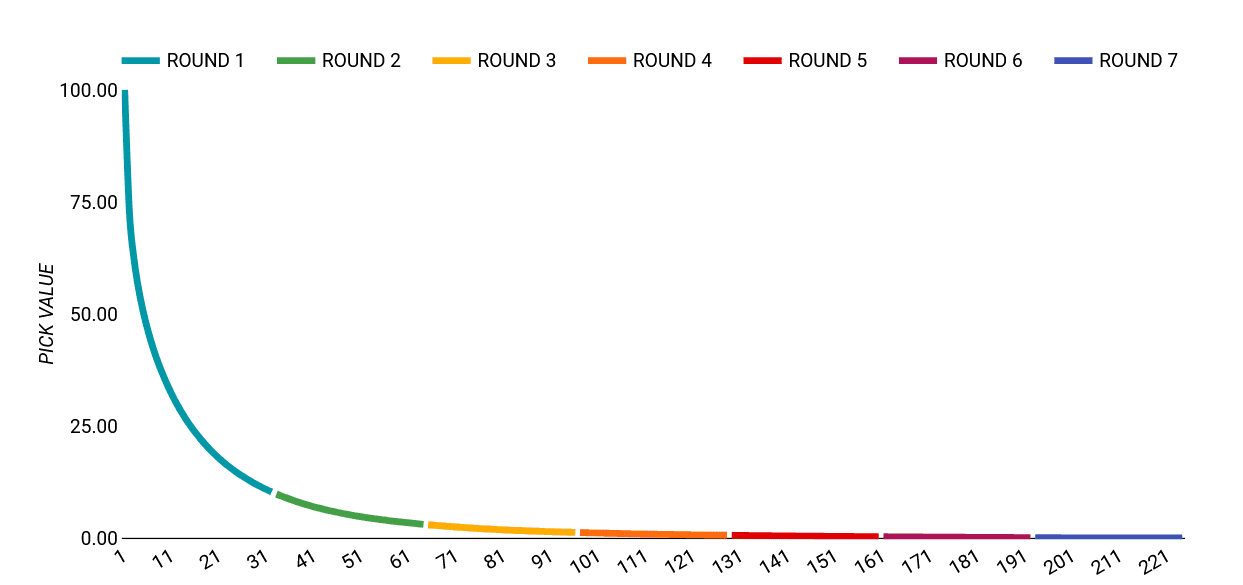
via puckpedia.com
Let’s say the Habs are attempting a trade to move up to 11th overall, a draft position currently held by the Pittsburgh Penguins.
The 11th overall pick holds a value of 31.99 whereas the 17th overall pick holds a value of 22.18. Montreal needs to make up 9.81 in draft pick-value.
The 41st overall pick is worth 7.04, which means we’re getting closer, but we’re yet to offer fair value. Adding the 79th overall (2.03) and 113th overall (0.95) picks should do the trick. I’m not suggesting Pittsburgh would accept the trade, but according to pick values, it is a fair deal.
The trade would be as follows:
The Pittsburgh Penguins trade the 11th overall pick to the Montreal Canadiens in exchange for the 17th, 41st, 79th, and 113th overall picks.
Moving up six spots in the first round may not be realistic, as there’s a significant drop-off in value from 11th to 16th or 17th, and teams are starting to realize receiving the sum of the parts in a trade centred on draft picks rarely works out.
If the Canadiens wanted to move up a few spots, say from 16th to 13th, the cost would be a little more reasonable.
The 13th overall pick holds a value of 28.14, while the 16th overall pick holds a value of 23.51. To make up the difference, Montreal would have to add the 49th overall pick to the mix (5.19).
The trade would be as follows:
The Detroit Red Wings trade the 13th overall pick to the Montreal Canadiens in exchange for the 16th overall and 49th overall picks.
Montreal Canadiens Brass Tacks
Given the discrepancy in talent in the first round, moving up seems to almost always add more value to the organization that is acquiring the better pick. Receiving the sum of the parts may be fair value from a raw data point of view, but we also have to consider that players drafted outside the first round rarely enjoy a long career in the NHL.
With that in mind, if the Canadiens cannot use their picks to trade for an NHL-ready player, moving up in the draft, as they did last season, is probably the best way to add value to the prospect cupboard.
All Draft Pick Value via Matt Perri. Click here to see the individual draft-pick values.