
Matthew Schaefer could be the first OHL player to be chosen first overall in the NHL draft since Connor McDavid in 2015. Recent changes to the NCAA’s eligibility system will allow top NHL prospects in the Canadian Hockey League to play college hockey in the U.S.Bruce Bennett/Getty Images
For the first time since Connor McDavid heard his name called by the Edmonton Oilers 10 years ago, the Ontario Hockey League is expected to have one of its players selected with the first overall pick in the National Hockey League entry draft on Friday night.
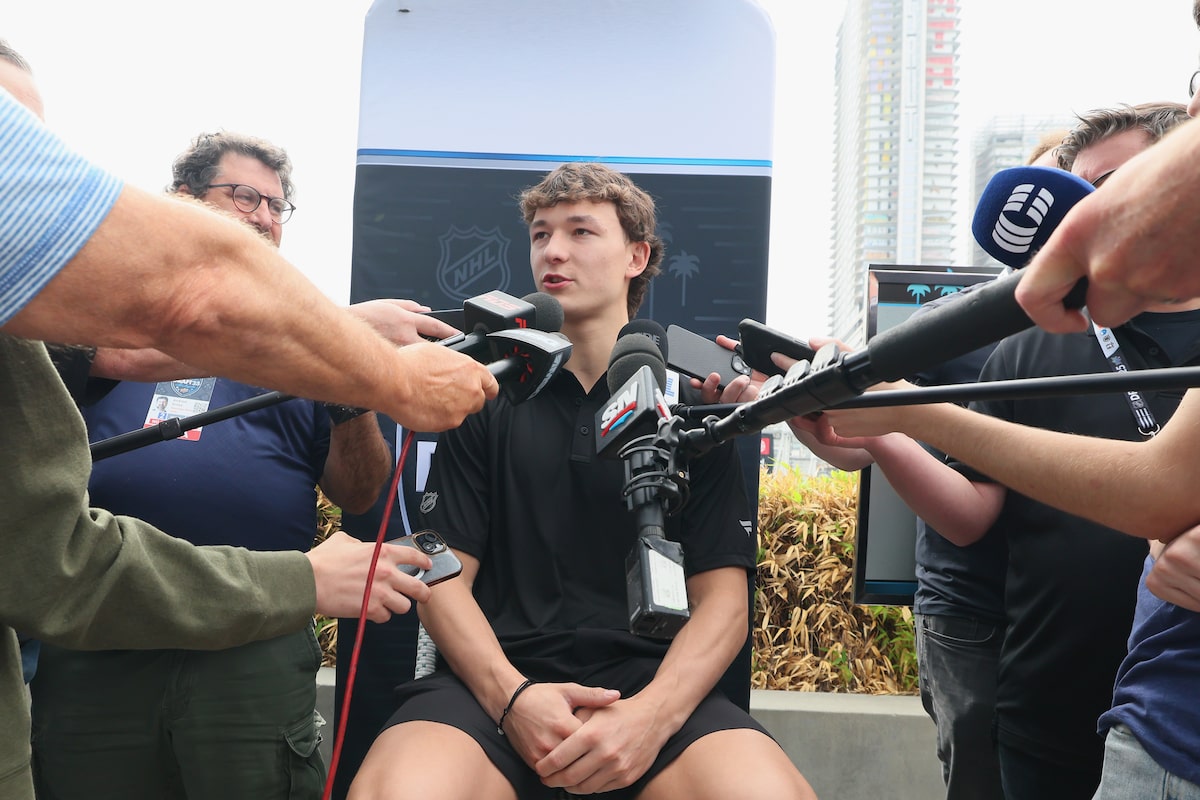
Defenceman Matthew Schaefer, who also followed McDavid’s lead as a standout player for the OHL’s Erie Otters, is widely expected to be that player, with the New York Islanders holding the first selection.
Saginaw Spirit forward Michael Misa is also attracting attention from many draft analysts, with the pair ranked first and second respectively by the NHL Central Scouting Bureau.
While 10 years might not seem like a long time, for a junior hockey league that has produced 21 of the 56 first overall picks (37.5 per cent) since the 1969 NHL draft – the first conducted without NHL team sponsorship of junior teams – a decade could be viewed as an eternity.
Recent changes to NCAA eligibility rules, which beginning this fall will allow CHL players to move south of the border to play for U.S. colleges, will only threaten to make those kinds of draft droughts more commonplace.
Not that it has affected the overall pipeline of talent coming out of the OHL. The league has produced 2,552 NHL draft picks since 1969 – the most by any league in the world – including 416 first-rounders in that time.
It’s partly that track record as an NHL pathway that attracted players like Schaefer and Misa to the OHL in the first place.
“The OHL has set us up,” Schaefer said after accepting the Canadian Hockey League’s top draft prospect award earlier this month. “You’re playing a lot of games. It’s like the NHL, you’re travelling, you’re going on bus trips. You’re playing against a lot of top-level guys.”
Misa, who was awarded exceptional player status to enter the OHL as a 15-year-old – joining the likes of McDavid and John Tavares in that exclusive, eight-player club – led the entire Canadian Hockey League in scoring this past season, recording 134 points in 65 games. The 18-year-old, who won the Red Tilson Award as the OHL’s most valuable player earlier this month, says that the OHL’s success at the NHL draft speaks for itself.
“I think it says a lot about that league and the players that come out of there,” he said. “It’s a tough league to play in. And I think for them they’re going to keep producing good players like this.”
Projected 2026 top pick Gavin McKenna is reportedly considering leaving the Medicine Hat Tigers of the Western Hockey League to play NCAA hockey.Christopher Katsarov/The Canadian Press
Given its track record in developing players such as Wayne Gretzky, Eric Lindros, Patrick Kane and McDavid – all winners of the Hart Trophy as the NHL’s most valuable player – that production line looks set to continue to run.
But a look to the West suggests that the OHL would be wise not to rest on its laurels.
There Gavin McKenna, the Whitehorse native who became the third-youngest winner of the CHL’s player of the year award this month after leading the Medicine Hat Tigers to the Memorial Cup final, looks set to depart the Western Hockey League for the NCAA.
Reports suggest that the 17-year-old, the favourite to be the No. 1 pick in the 2026 NHL draft, is choosing between a quartet of U.S. colleges, with Michigan State and Penn State as the favourites.
“That’s a concern, right?” says OHL commissioner Bryan Crawford. “I mean, we’ve always fought a recruiting battle, and before, the kids had to decide before they even came into the league, whether they were going to come and play in our league or not.”
Having replaced long-time CHL executive David Branch in the OHL corner office last August, the former Toronto Argonauts running back came into the job aware of the “spectre” of NCAA eligibility changes, but even he was surprised at how quickly they came online.
The NCAA Division I Council voted last November to permit players from the CHL’s three member leagues – the OHL, the WHL and the Quebec Maritimes Junior Hockey League – to play NCAA hockey effective Aug. 1, 2025, provided they were not compensated above actual and necessary expenses prior to enrolling in college.
Ever the competitor – Crawford ran track as well as playing football during his four years at Queen’s University – the 43-year-old Hamilton native welcomed the changes as an opportunity to better the OHL’s offering. Having already embarked on a comprehensive program to upgrade both the player facilities and the standard player agreements in his league, Crawford feels the NCAA changes only add a little more urgency.
He points to new arenas on tap in Brantford, Sudbury and Ottawa, as well as renovated player facilities in Oshawa, Kitchener, Sault St. Marie and Brampton. These will contribute to an upgraded player experience that will include greater access to strength coaches and nutritionists, sports medicine and player lounges, as well as helping billet families provide quality nutrition to the players away from the rink as well.
Leading into the NHL draft, Michael Misa (66) said that the OHL prepared him for the pro ranks.Chris Young/The Associated Press
“It’s a multiyear project, and our first kind of wave of recommendations will go forward to our [annual general meeting] in August and begin to start to get implemented in the coming season,” Crawford said.
“It’s all part of ensuring that we’re offering a development environment that is second to none for the players and that we’re not getting complacent.”
The changes to the standard player agreements revolve around making sure that they are not compensated above and beyond what is necessary to maintain their eligibility for the NCAA.
In practice that means submitting receipts for gas and meals that they pay for outside of team activities. It also meant an end to bonuses that players would normally get paid for winning each round of the playoffs “because it didn’t fall under the kind of necessary and reasonable expenses.”
Exactly how the new NCAA eligibility rules play out is still to be determined. However, Crawford feels that the NCAA is an older league, and points to Western Michigan, this year’s Frozen Four winner, which had an average age of 22.4 years.
“We contend that it is not the right pathway for a young player to enter the NCAA at 18,” he said, “and that it’s the right pathway for them to play through their 19-year-old seasons [in the CHL] and then go on from there.”
However, despite the competition for talent – and NHL draft recognition – Crawford sees no reason why the two routes of development can’t become complementary, rather than incompatible, pathways.
“It’s a great thing for our league, because there were players that before, they wanted to choose a different path, and they had to make that decision really early on,” he said.
“Now they can go the path of the OHL and decide what’s right for them when they’re 19, and so that’s the thing that I think is so positive for everyone.”