

While overall series wins don’t seem to be driven too much by hits, PIM, or size, we see something slightly different with Stanley Cup winners.
Zeroing in on championship teams reduces our overall sample from 150 series’ to 40. This should be taken with a grain of salt, but champions, particularly recent ones, appeared to be more physical than their competition.
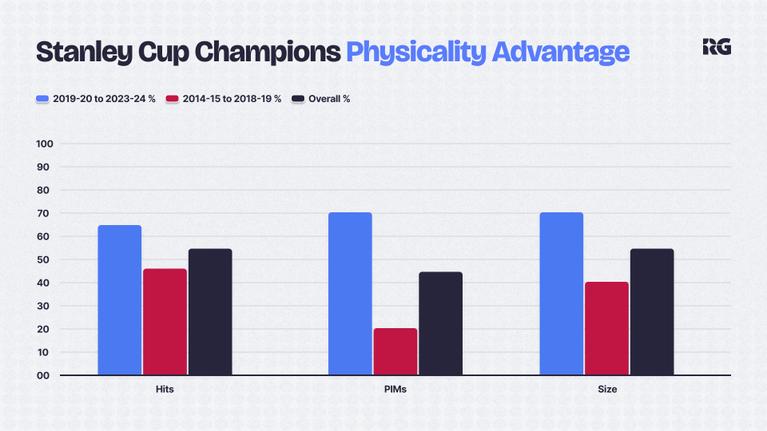
The last 10 NHL champions have had an advantage in size and hits in 55% of the series they’ve played. The previous five have been more physical than their opponents according to these measures in a significant majority of their series:
Hits AdvantagePIM AdvantageSize Advantage65%70%70%
It is intriguing that, overall, the sample of champions had more PIM than their opponents less than half of the time (45%), which could be a nod to the downside associated with penalties.
Of the ten championship teams, three — the 2015-16 and 2016-17 Pittsburgh Penguins and the 2022-23 Golden Knights — were in the top half of the NHL in hits during the regular season but bottom third in PIM. This measured physicality could be a good recipe for playoff success, and there are no counterexamples of high-PIM, low-hit teams that won it all.
There has been a notable trend of more physical teams performing better recently, and that’s also true with the latest Stanley Cup winners. Each of the last five champions has been in the top half of NHL leaderboards in either hits or PIM, with three in the top five in penalty minutes.
Meanwhile, four of the five Stanley Cup champs between 2014-15 and 2018-19 were in the bottom third of the NHL in PIM.
Regarding the Stanley Cup Finals, it is difficult to draw too many conclusions from just 10 series’. Still, it is notable that six of the last seven winners have had a size advantage over their opponents, supporting the idea that the playoffs have become more hospitable for tougher teams as of late.