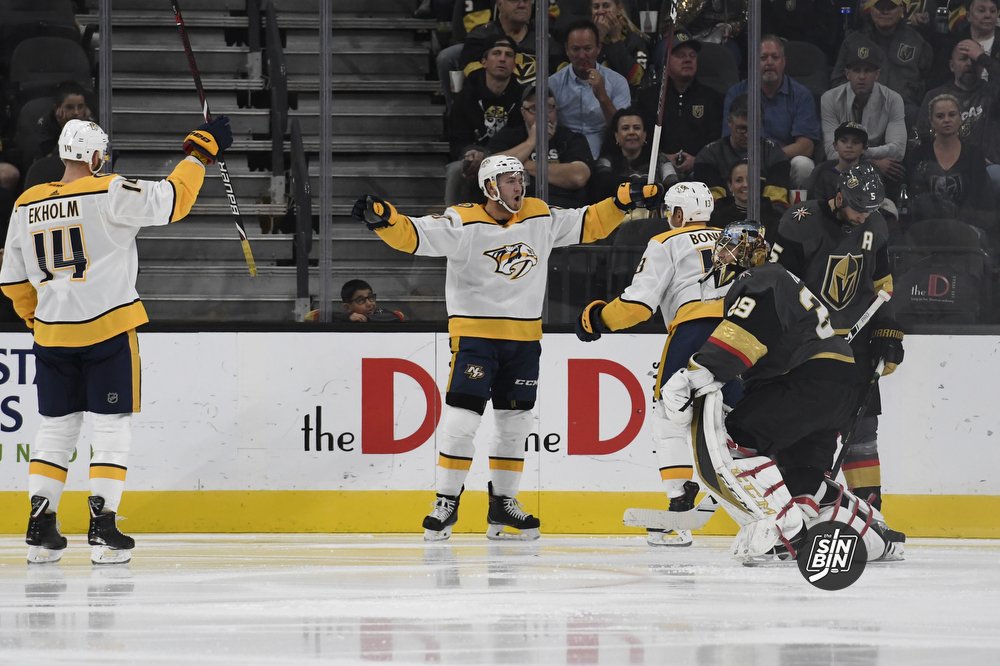

(Photo Credit: SinBin.vegas Photographer Brandon Andreasen)
During a recent press conference, general manager Kelly McCrimmon made an interesting comment that piqued my interest regarding Colton Sissons and the penalty kill.
He’s really good on faceoffs. He’s right-handed and when you start the penalty kill, I think 80% of NHL teams start the faceoff with a left-handed centerman on the strong side. Colton Sissons is very good at that. Things like that matter to Bruce Cassidy, and they matter to a team. -McCrimmon
As a noted hater of the importance of faceoffs to winning hockey games (many studies on the topic helped shape my opinion on this, feel free to read a few), I admittedly get quite skeptical when faceoffs are used as a rationale to acquire a player. So, I couldn’t wait to dig into the data on shorthanded faceoffs to see how much of an upgrade Colton Sissons will actually be.
Since 2017-18, Sissons has taken 1,576 faceoffs with his team shorthanded. This is the most by any player in the entire NHL over that span. The players behind him are standout defensive centers Jordan Staal, Adam Lowry, Anze Kopitar, and Philip Danault. This is extremely impressive, especially considering the fact that the Predators have had three different coaches during this time. However, Sissons has only won 47.7% of those draws, a percentage good for just 41st of 102 centers to take at least 300 shorthanded faceoffs.
In the past eight seasons, Sissons has finished above 50% just three times, including last year, in which he registered a career-high 52.1% win percentage. However, last season, Sissons wasn’t even the best shorthanded faceoff taker on his own team, the Nashville Predators; that distinction went to Michael McCarron who won 55.1% of his shorthanded draws. The number of faceoffs each competed in was nearly identical too; Sissons took 142, while McCarron took 138. Sissons was just 43.7% two years ago, and has been under 47% in five of the last eight seasons.
In the playoffs, when the numbers matter the most, Sissons is a career 48 of 106, or 47.7%. Since 2014-15, when Sissons entered the league, he ranks 38th of 55 centers to take at least 75 postseason faceoffs.
Overall, these numbers are not terribly impressive. However, when we compare them to the Golden Knights, they do look slightly better.
William Karlsson has been Vegas’ most-used shorthanded center since its inception. He’s participated in 718 faceoffs, about half of Sissons, and has won 45.1% of them, around 2.5% worse than Sissons. Tomas Hertl is slightly better having won 45.6% of his 612 while Nic Roy was a poor 44.0% and Jack Eichel has won just 42.2%. So, Sissons is definitely better than what VGK have been using, especially recently (Paul Stastny was excellent).
But, the impact Sissons will have based on how much better he is than Karlsson, Hertl, Eichel, and Roy is negligible, at best.
If Karlsson took the same number of shorthanded faceoffs as Sissons over the last eight seasons and maintained his 45.1% win rate, he would have won 41 fewer in 555 games. That’s about one in every 14 games or about six per season.
To put this into context, VGK participated in 295 shorthanded faceoffs, the fewest in the NHL. They finished the season in 15th, going 134-161 for 45.4%. If they had won six more, they’d have been 140-155, 47.5%, and would have moved up to a tie for 11th. Four places, leapfrogging Buffalo, Boston, and Pittsburgh, none of whom finished in the top half of the league in penalty kill percentage.
Of course, the postseason is when this really matters. The Golden Knights went a paltry 36.8% on shorthanded draws in the series against the Oilers. Had they used Sissons in every draw and won his 45.3% career playoff mark, they would have gone 9 for 19 instead of 7 for 19. Yep, two more in five games.
VGK allowed one goal on 11 power play chances for the Oilers. The single goal came in Game 3, and Eichel won the faceoff before the goal. Against Minnesota, when VGK’s penalty kill struggled a bit, allowing three goals on 13 chances, they won 50% of the shorthanded faceoffs in the series, but lost all three directly before Minnesota goals.
Finally, most of this becomes a moot point unless Sissons is trusted by Bruce Cassidy to be the first penalty killer over the boards to start each opposing power play. As good as Sissons may be on the faceoff, if he’s not better than Karlsson or Eichel (or even Hertl) at killing penalties, he’ll rarely see shorthanded faceoffs anyway. Knowing the level at which both Karlsson and Eichel kill penalties, it seems like a stretch that he’ll keep them both on the bench to play Sissons, especially in the most important moments of the season and postseason.
None of this is to say Colton Sissons can’t be a useful player for the Golden Knights. But, the impact he will add as a right-handed centerman who is about 2.5% better than Karlsson and 3.7% better than Eichel will be extremely minimal, even if he matches his career high from last season, which, based on history, is highly unlikely.