

The Edmonton Oilers have already done much this summer, signing star d-man Evan Bouchard, moving out Viktor Arvidsson and Evander Kane for cap space, and signing forwards Andrew Mangianpane and Curtis Lazar.
But they’re still in pursuit of that most valuable of all assets in the modern NHL: cap space. At least it’s the most valuable asset if you’re a top team already, pressed up against the cap, and trying to figure out how you can upgrade your team both in the short term and the long term, such as the coming 2026 NHL trade deadline.
It’s extra cap space that brought Edmonton Jake Walman and brought Florida Brad Marchand and Seth Jones at the 2025 deadline. That cap space came through key players being injured late in the season, allowing Edmonton and Florida to bring in more salary at the trade deadline, but if the NHL cracks down on that practice for the 2026 playoffs, building up cap space through careful cap management through the season will become all important in any team’s Stanley Cup hopes.
No careful management, no star goalie or top forward for the Oilers at the 2026 deadline, you know what I mean?
The Oilers are looking forward to that eventuality, hoping to build up cap space this season, as team insider Bob Stauffer, host of Oilers Now, described on today’s show.
Said Stauffer: “The Oilers, I think, are gonna try to find a way to have a little bit of cap space from the opening day of the season. Right now, they got about $150,000, and I’m thinking they’re gonna try to find a way to get in the $1.5 to $2 million range, and if they can do that, then it accrues during the course of the year and multiply it basically by four (at the time of the trade deadline), and away you go.”
Of course, Edmonton could get cap space by going with a tight roster as they did last year, limiting the number of players on the NHL roster to 20, 21 or 22, not the full 23-player allowed.
It might be difficult to pull off that this season, as Ty Emberson or Troy Stecher would likely be scooped up if they were sent to the minors, meaning the team needs to go with seven d-men, and the same could well apply to forwards David Tomasek and/or Noah Philp.
Edmonton could well go with a 22-man roster, with one extra forward and one extra d-man on the roster, but it’s hard to imagine them running tighter than that.
So how to find that extra cap space? Stauffer is talking about $1.35 to $1.85 million here.
If the Oilers traded Adam Henrique and his $3 million per salary and replaced him with a player earning $1 million per that would get the team an additional $2 million in cap space. But Henrique still has much to offer, and has even been talked about playing as a top line winger with Connor McDavid.
If Henrique was bought out, the Oilers would pay him $1 million this year and next year, bringing the team a $2 million cap saving this year, but an extra $1 million cap hit the following year, 2026-27.
Mattias Janmark makes $1.45 million this year and next. If he was traded, and replaced by a player making the NHL minimum such as Philp or Curtis Lazar, Edmonton would save $630,000 in cap hit this year and next year.
Of course, I can’t read Stauffer’s mind to know what the plan is — and maybe he only knows the goal of the plan and not the details — but the best bet for the Oilers would be to move out Janmark for a younger, more aggressive player.
Janmark has a 10-team no-trade list so moving him might be difficult, but not impossible. He still has value as checker and penalty killer, but his cap space is likely more valuable to the Oilers, especially as the Oilers accrue space as the season goes along, getting ready to bring in a top player early in the winter of 2026.
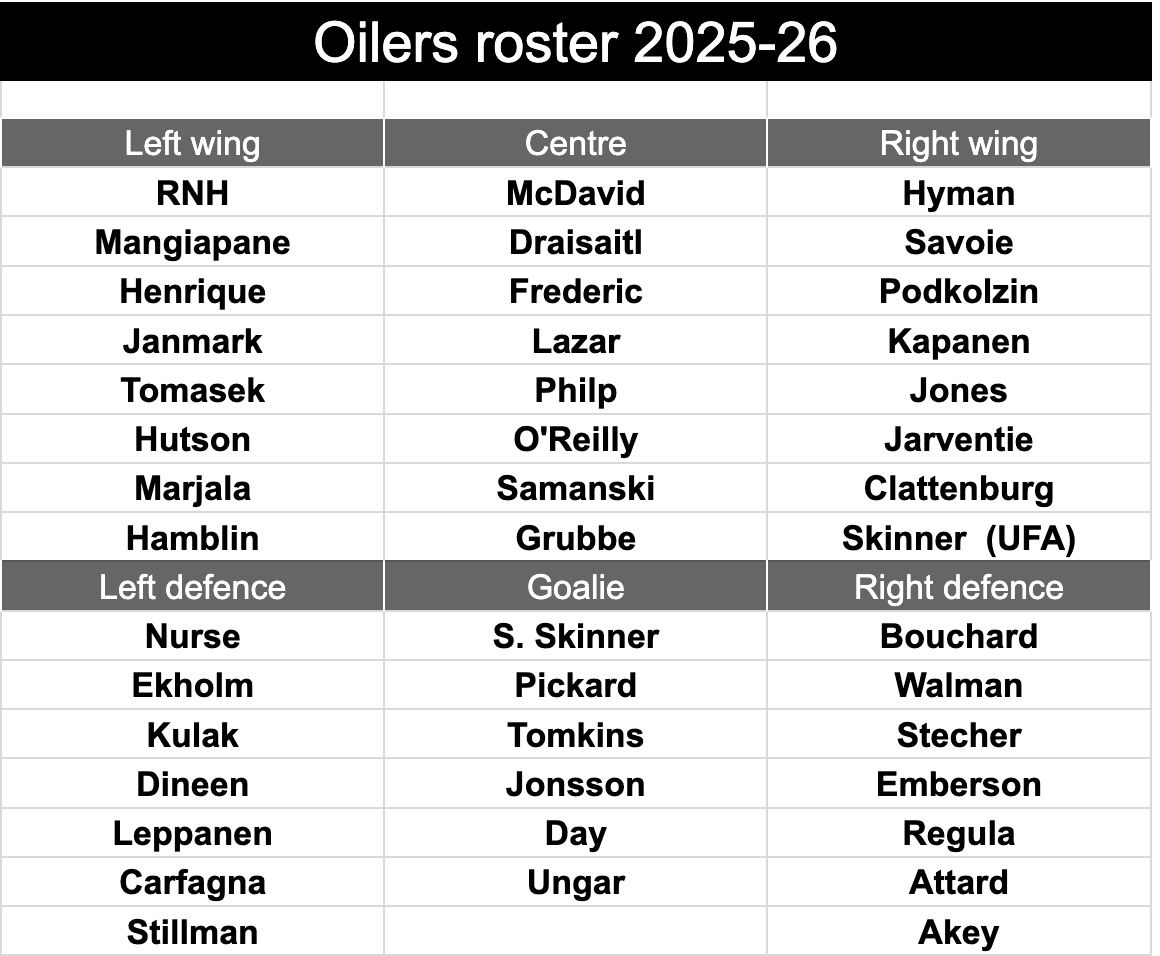
roster
At the Cult of HockeySTAPLES: ‘Starting to cooooooook!’: Oil country react as Oilers sign hometown heroStaples: ‘Brutal’: New Oilers GM stepped up but old Oilers GM fell flat in free agent frenzy
STAPLES: ‘Wow’: Hockey world reacts as Oilers sign winger to play with Draisaitl
STAPLES ‘Very concerned’: Hockey world reacts as Edmonton Oilers sign star defenceman