
It was a little note in a much longer press conference. Pittsburgh Penguins general manager Kyle Dubas blossomed when talking about player development and what the organization was able to do last season.
The team helped Joona Koppanen gain 12% on his skating in his first year with the organization.
That’s it. That’s the headline. Last week, Dubas spoke at length about the player development efforts, quickly mentioning that success with a smile radiating pride.
It skipped past most people, as it sounds like a small improvement on a depth player. So, most would have a little reason to amplify the gain or make much of a fuss.
But that’s just what should be done.
Under Dubas, the Penguins are investing heavily in player development and associated technology. Director of player development Tom Kosptopoulos has been through a few general managers and had high praise for his current situation.
“That would be the goal (to get 12% more from everyone). My staff is amazing. My development staff is fantastic. I feel like the LA Dodgers– we’ve got a lineup of overly qualified people that I can use to send out to visit our prospects that (we) can use to go to Wheeling, Wilkes-Barre, and Pittsburgh,” said Kostopoulos. “So, I think the ownership and management have built out a ton of resources available to players that can only help them. And if the players are willing to use that and to help them develop, that’s where we’re seeing growth in some of the players. So it’s been a lot of fun to watch the growth in the staff and the results and helping the players develop.”
Of note, vice president of player personnel Wes Clark referred to the Penguins organizational goalie coach as “Sir Jon Elkins.” AGM Jason Spezza offered similar praise for his insights at the draft when the team selected Gabriel D’Aigle in the third round. When Pittsburgh Hockey Now covered the Wilkes-Barre/Scranton Penguins last spring, the development coaches were on the ice with players each morning. Multiple players and team coaches offered hearty praise for development coach Chris Butler and Sheldon Brookbank.
It would seem the Penguins are ahead of the curve and pouring resources into an overlooked facet of rebuilding. It’s one of those under-the-radar efforts by the organization that slips past most. If they can get real gains from a player like Koppanen, perhaps they will be able to get even more from others?
In addition to overqualified people, the org is also tapping into technology. At various points last season, wearable sensors were seen hanging in the players’ dressing stalls. However, it goes beyond the Player Development department. According to Kostopoulos, the organization also has a performance department.
The performance department is big into technology; video use has also expanded.
“I think our performance Department uses technology probably a lot more than I do, but then the video side of it has grown,” Kostopoulos said. “Our video department has grown what we can offer the players through video, and then giving them quick feedback on their games and their fitness testing and results, and how to improve in those areas.”
It’s not the most exciting thing an organization can discuss, but it may be the most important for a team embarking on a rebuild with a bevy of free agents, such as Parker Wortherspoon and Justin Brazeau, who are fighting to emerge from the obscurity of depth roles and healthy scratches with other organizations.
A Bryan Rust Trade Could Hurt?
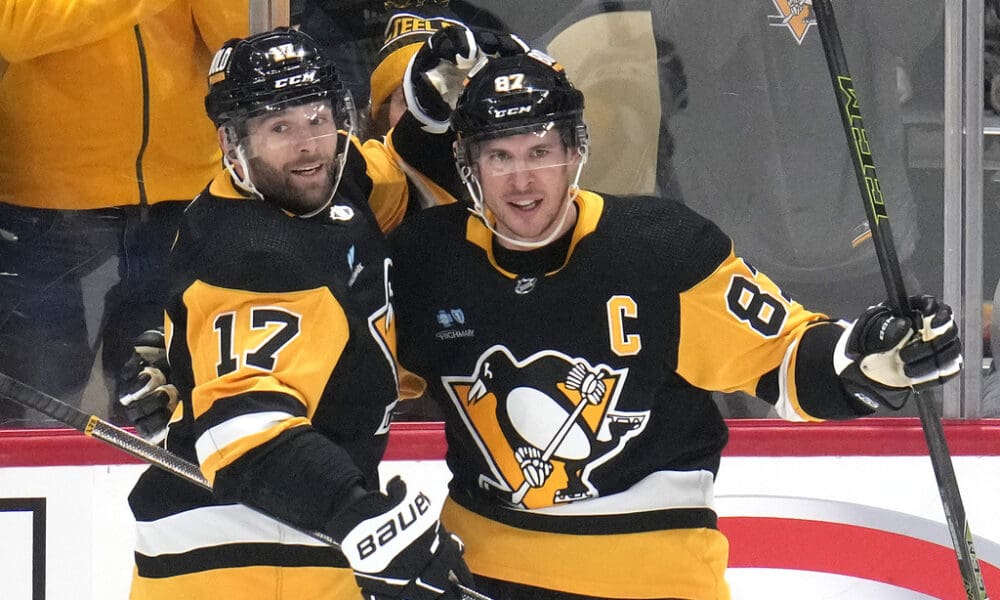
The risk of a Bryan Rust trade has nothing to do with Sidney Crosby’s emotions.
Last week, Dubas freely admitted that he could trade Rust. In fact, there isn’t a person inside hockey or a fan who doesn’t know the situation. Rickard Rakell, Erik Karlsson, Rust, and any other veteran without a no-movement clause could be moved at a moment’s notice as soon as Dubas gets his price.
Dubas termed his trade cost for Rust to be “Sky high,” and by all accounts, he meant it.
The Penguins aren’t in sell-off mode, but they are selling to clear space and acquire assets for the next generation of Penguins hockey. The only person who isn’t available, yet still the subject of reality-impervious trade rumors, is Crosby, the Penguins’ captain.
Crosby is an icon. An all-time great. A hero and idol to many, including players, who get as nervous meeting him as do many fans.
With that backdrop, that’s what makes trading Rust a risky proposition. Of course, on the surface, it is quite easy to demand everyone be traded, everything must go, all sales final. After all, what value could a 33-year-old gritty winger have for a team that is several years away from contention?
First, watch the video the Penguins posted of 2025 first-round pick Will Horcoff. It should be noted that Horcoff grew up in an NHL family; his father is Shawn Horcoff, who played 1008 NHL games and is currently the assistant GM of the Detroit Red Wings. If there is a person who should be somewhat immune to being starstruck, it would be him.
However, he clearly was.
When Sidney Crosby texts you and suddenly you forget how to function 🫣 pic.twitter.com/dZxx3d5a5v
— Pittsburgh Penguins (@penguins) July 7, 2025
Make no mistake, over the next few years, players who are in awe, starstruck, and perhaps even a little bit intimidated will surround Crosby. It’s yet another challenge of rebuilding around an elder statesman who is one of the greats. It will also be a challenge to be the captain of a team that looks up to him in a reverential way.
A leader like Rust, who has achieved and accomplished more than anyone envisioned when he began cracking the NHL lineup back in 2014-15, is essential for the young players. While the youngsters tiptoe around Crosby or do things like force the puck to him, a player like Rust can keep their head in the proper space. He will be able to say things, sometimes harshly, that Crosby could not and do so with credibility and conviction.
Rust might be the best keeper of the flame regarding the Penguins’ culture and tradition. While Crosby is an enduring symbol, Rust is the sentry at the door.
Of course, if or when a team meets the asking price, Dubas will trade Rust. That part isn’t in question, but what seems to be missed is the importance of having him. It goes beyond goals and some vague notion of leadership or locker room presence. Horcoff’s reaction very tangibly showed the importance of Rust … for those who want to see it.