
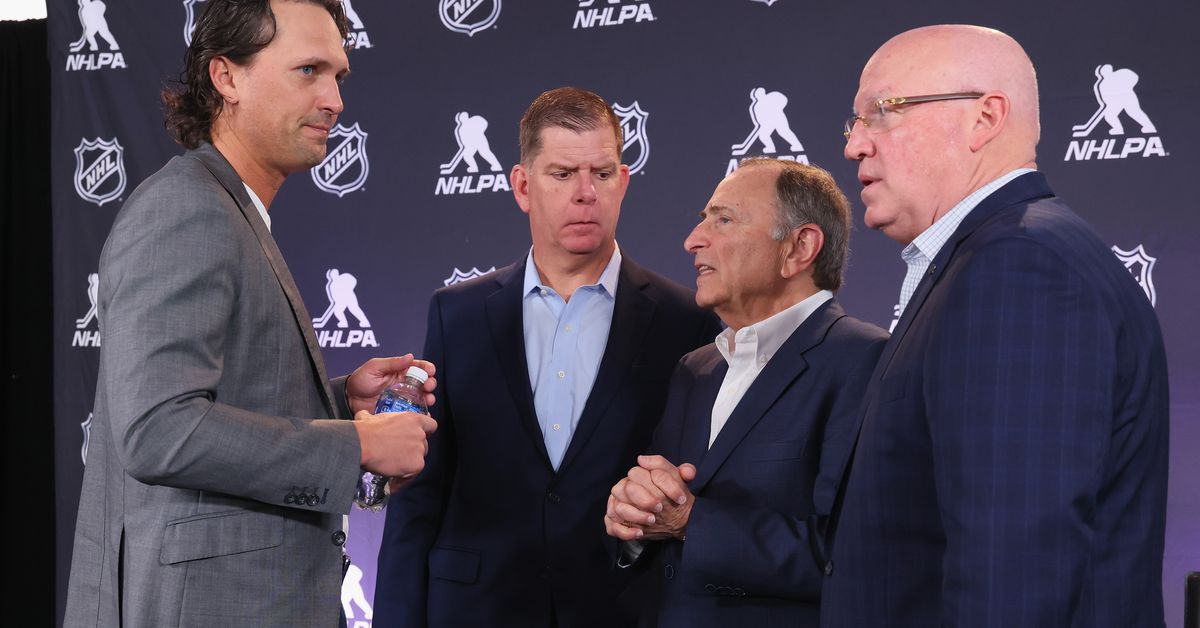
The NHL and NHLPA have ratified a new collective bargaining agreement, over a year out from when the current one expires. Given the contentious history of labor negotiations in the Gary Bettman era (partial seasons lockouts in 1994 and 2012 and the loss of the full 2004-05 season), that’s a minor miracle in and of itself that relations between league and union is so aligned at the present.
The full document has not yet been released, but based on the details that have come out, let’s go over some key areas.
Extended Regular Season and Shortened Preseason:
The regular season will increase from 82 to 84 games per team, providing more games for fans. To accommodate this, the preseason will be reduced to 4 games per team, addressing concerns about excessive exhibition play and player injuries during meaningless games.
This is good business for everyone. The initial fan reaction might be to grumble that an already long season gets extended, but for the ticket holders and players it’s nothing but good to shorten the exhibition schedule. The Penguins play seven preseason games this year. Seven! That’s way too many and inefficient for everyone’s time.
The added bonus is now the current 82-game schedule means that teams play two division rivals 3x per year and the other five division opponents 4x. Now at least that can be smoothed out for 4x per season for all division teams. However, that’s a minor victory in balance at best — a 33rd and 34th NHL franchise are happening sooner than later, which will reconfigure the scheduling anyways.
The NHL has had 84-games seasons way back in 1992 until 1995, so there’s a precedent for such a long year. It would, of course, be nicer to make it shorter but the basic function of more games = more money is going to push that in the other direction.
Playoff Salary Cap and LTIR Loophole Closure:
A new playoff salary cap mechanism ensures that the lineup dressed for playoff games must be cap-compliant
Details on this will be interesting, since calculating the salary cap on a daily basis and allowing teams to accrue cap space over the year and load up at the deadline has been a staple of the NHL for 20 years. Teams have famously used LTIR opportunities to zoom by the cap, which needed addressing but seeing just how they applied mechanics to accomplish what was needed without going too far will be interesting.
Salary Retention Trade Rule:
A new rule prevents a second salary retention on a player’s contract in a trade until 75 regular season days have passed. This effectively eliminates double retention deals involving a third team in a single transaction, simplifying trade mechanics and reducing cap circumvention strategies.
This is kind of sad to see a management tweak leave, but it essentially was another form of salary cap manipulation. There have been plenty of examples of this, the Patrick Kane trade from Chicago to the Rangers in 2023 might show it the best. The Blackhawks retained 50% of Kane’s cap hit, the maximum allowed. Chicago traded Kane to Arizona, who retained 50% of what was left ($2.625 million) and then officially traded him to NYR for a third round pick.
In essence, Arizona sold $2.625 million of cap space for a third round pick and the Rangers end up picking up a player with a $10.5 million cap hit for only $2.625 million against the cap. It’s understandable why the league doesn’t like that strategy, but it helped the playoff teams load up on as much talent as possible. Some big trade deadline deals as we know them these days are not feasible without bringing a third team in to eat some cap.
Contract Term Limits and Signing Bonus Restrictions:
Maximum contract lengths have been reduced by one year: 7 years for players re-signing with their current team (down from 8) and 6 years for free agents signing with a new team (down from 7). This aims to increase player mobility and roster flexibility.
A 60% ceiling on signing bonus money has been introduced, and year-to-year salary variance is now limited to 20%, reducing front-loaded contracts and ensuring more consistent salary structures. These changes balance player earnings with team cap management.
A classic “save teams from themselves” adjustment to limit contract term and the bonus amounts. That slightly helps for buyout structure, but as always teams who want the best free agents will have to extend offers to the limits to get them.
Elimination of Player Dress Code:
The NHL has removed the player dress code, allowing players to express individuality through their attire when arriving at games or attending team events. This modernizes the league’s image and aligns with player preferences for personal expression.
Bill Guerin jokingly called this the Ron Hainsey special to add to the legend of the former player and PA man. Nice for everyone, some young NHL players coming up with the Penguins talked about the internal pressure to dress a certain way, get suits or winter coats of high quality and price to fit in and look like they belonged in the “national”. All of society is getting a little more casual, no real gain or loss in players getting some slack in this area.
Full-Time Emergency Backup Goaltenders (EBUGs):
The league will now employ full-time Emergency Backup Goaltenders at each game, replacing the previous system of relying on local amateurs or team staff. This ensures professional readiness and consistency in emergency situations, enhancing game integrity.
Two goalies on the same team both getting hurt or sick during the same game presents a major problem and has been cropping up more than might be expected lately.
Emergency Healthcare and Wellness Fund for Retired Players:
A $4 million annual fund has been established to provide emergency healthcare and wellness support for retired NHL players. This addresses long-term player welfare, recognizing the physical toll of the sport and supporting former players in need.
Nice gesture and good start but probably a lot more is needed. There are plenty of reports of former players going through tough times or living on the streets or suffering the after effects of their playing careers. That shouldn’t happen period, but especially not when the current game is making billions of dollars per year.
No Deferred Salary:
The agreement prohibits deferred salary arrangements, ensuring players are paid in full during their contract term. This protects players from financial uncertainty and simplifies contract structures for teams.
This was only explored occasionally, since time value of money concepts gave the players little incentive to accept deferring money to the end of a contract when those in demand could get it quicker. The biggest example might be Seth Jarvis, who delays a $15 million payment in 2032 when his contract ends. As a result, Carolina carries a $7.4 million cap hit for him, instead of the $7.9 million that it would have been if paid straight up. Not the biggest deal in the world, but another effort to close off a loophole before it might get expanded upon.
Revenue Split Continuity:
The CBA maintains the 50-50 split of hockey-related revenue between players and owners, with no significant changes to the financial structure.
If it’s not broke, don’t fix it and this time they won’t. In 2012, Bettman and the owners wanted a bigger piece of the pie. But they’ve been getting franchise fees and seeing their valuations rise exponentially lately, the yearly revenue made is a side issue compared to the bigger amounts that they have their eyes on.