
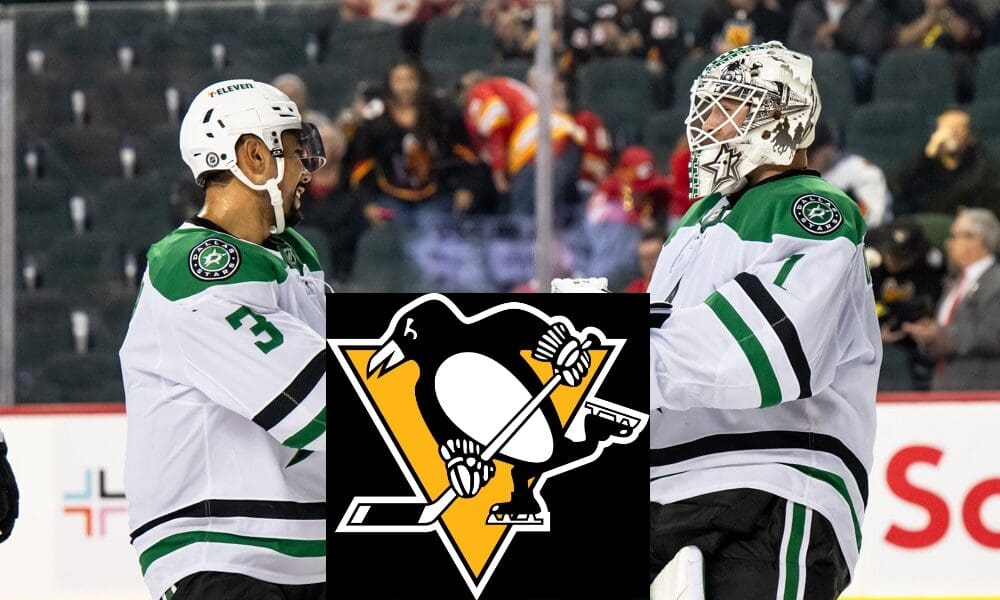
The Pittsburgh Penguins acquired Matt Dumba in a quick and easy salary dump trade from the Dallas Stars Thursday. With Dumba came a 2028 second-rounder, and out the door went disposable right-side defenseman Vladislav Kolyachonok.
The Penguins took on Dumba’s $3.75 million salary, which expires after this season. The trade allows Dallas more breathing room as they’re now under the salary cap, sporting a razor-thin $1.9 million in cap space, but that’s of little concern to the Penguins and Penguins fans.
It seems quite obvious that another Penguins trade is coming. In other words, pack your bags, Erik Karlsson.
Since July 1, Dubas has flashed his cards, though they’re hardly a surprise. He signed free-agent winger Anthony Mantha to a one-year, $2.5 million deal, an obvious replacement for Rickard Rakell or Bryan Rust when one or both are dealt.
Now, it is the same scenario for Dumba and the blue line. By accepting Dallas’s salary dump, the Penguins acquired one more player at the only position in which they have a surplus: Right-side defense.
With Dumba, the Penguins now have six righties. Kris Letang, Karlsson, newly acquired Connor Clifton, Jack St. Ivany, and Harrison Brunicke.
Of course, Brunicke can return to junior hockey, but on Monday, even Penguins director of player development Tom Kostopoulos admitted that Brunicke has likely outgrown juniors. Brunicke could return to juniors, but that would go against every bit of the general manager Kyle Dubas’s intentions.
The Penguins are in the midst of a rebuild, looking for younger players at every position. To thwart Brunicke’s ascension would be the managerial version of shooting oneself in the foot to acquire a second-round pick.
At the draft, Dubas seemed happy to acquire Clifton. Clifton is a scrappy, physical defenseman, and the Penguins have far too little sandpaper in their lineup.
So, too, is St. Ivany tough. He regained his form later last season with the Wilkes-Barre/Scranton Penguins after losing his confidence and game in the NHL early last season. Following the season, both WBS Penguins coach Kirk MacDonald and Dubas spoke of seeing St. Ivany take that final step to the NHL this season.
To blunt him wouldn’t quite be malfescence, but it, too, would go against the stated goals. Four spots, six defensemen. If you’re not good with numbers, friendly or otherwise, that’s two too many.
Now, Dumba is in the mix.
At his best, Dumba is a great skater with some offensive flair and physicality, though over the last several years, he’s not been close to his best. Dumba last hit the 50-point mark with the Minnesota Wild in 2017-18. He hasn’t exceeded 27 points since.
The Dumba Fallout
The first potential with Dumba is nothing. If he does not improve his game, he can be waived and sent to WBS, where he becomes another project for the player development department. Or, Dumbas is merely a body in the AHL on call to the NHL until his contract expires after this season.
Thursday afternoon, PHN spoke with Dallas colleagues and people who work inside the organization to get a scouting report on Dumba. In short, he had a disastrous 2024-25 season. It was not bad, it was terrible. We were told coaches “tried everything” to get him on track, but in the playoffs, coaches surrendered and Dumba was a healthy scratch in favor of a minor league call-up.
Given the Penguins’ push toward youth, it would seem St. Ivany and Brunicke would be primary targets to make the NHL roster. However, the Penguins can let assistant coach Mike Stothers work with Dumba. Perhaps the Penguins can reclaim his previously dynamic game, or at least some measure of it, and then they hold a valuable trade chip at the 2026 NHL trade deadline.
Last season, Cody Glass fetched the Penguins a pair of third-round picks. First, Nashville delivered a third-rounder with Glass in a salary dump. Then Dubas flipped Glass near the deadline to the New Jersey Devils for another third.
If Dubas and coaches can do the same for the 30-year-old Dumba, it would be a big win. If nothing else comes of the trade, the Penguins simply bought another second-round pick with salary cap space they didn’t need. That, too, would be a win.
It’s not the type of win that Penguins fans are used to seeing. In these parts, the public is used to seeing trade returns such as Ron Francis and Ulf Samuelsson, or Rick Tocchet and Ken Wregget, Marian Hossa, or even Billy Guerin. But for at least a couple more seasons, if not a few, get used to winning trades without any immediate tangible return.