
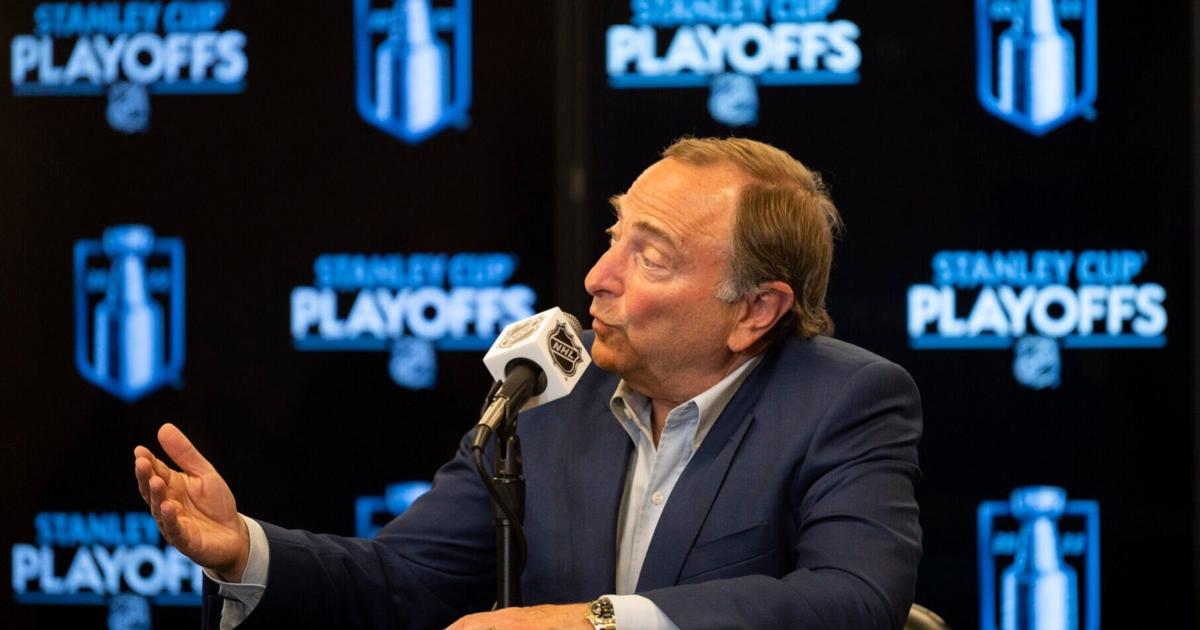
The NHL actually has done what previously seemed unattainable for the league.
The NHL managed to avoid a work stoppage for over a decade.
Can you believe it?
Hold back on the applause, as every other league seems to avoid work stoppages. Still, it’s progress. And with the NHL and NHLPA recently working out a new CBA, fans can rest easy knowing the league won’t be shutting down until 2030 at the earliest.
The current CBA will run through the 2025-26 season, but after that, there will be changes, big and small. Here are the most important ones everyone should know:
Longer regular season and shorter preseason
Right now, each NHL team plays at least six preseason games, with some playing as many as eight. That’s too many, especially when the best players only suit up for one or two of them. That will change in 2026, as no team will play more than four preseason games.
The trade-off? The regular season is getting longer, with the season jumping from 82 to 84 games. Those extra two games will be played against divisional opponents as the league continues to push divisional rivalries.
A shorter preseason also gives the NHL an earlier start to the regular season, perhaps at the end of September. The 2025-26 season is set to kick-off on Oct. 7, for reference.
Change in maximum contract lengths
Teams looking to re-sign their own unrestricted free agents will still have the advantage of offering an extra contract year to their players, but those maximum contract lengths will be one year shorter under the next CBA.
Seven years will be the max contract for players re-signing with their current team, while six will be the max for external free agents. That’s a change from the current CBA, which sets a max of eight years for internal free agents and seven for external.
The new CBA technically is not supposed to kick-in until Sept. 16, 2026. Unless the league says otherwise, Cale Makar could still sign an eight-year extension with the Avalanche. He has two years left on his current deal but is eligible to sign a contract extension on July 1, 2026.
And it will be a big one, regardless if it is seven or eight years.
Playoff salary cap
The new CBA changes the long-term injury reserve system during the regular season, but for years folks have complained about teams icing playoff rosters that are well over the salary cap because of the abuse of the LTIR system.
The league is finally trying to put a stop to that practice.
Now, there is no roster limit in the postseason, so you can’t exactly have a salary cap for the entire roster at that time of year. The new CBA will make it so the 20 players dressing for a playoff game must be cap compliant. A team could have a roster comprised of $140 million in players but as long as the actual roster of players are cap compliant, it’s OK.
Your daily report on everything sports in Colorado – covering the Denver Broncos, Denver Nuggets, Colorado Avalanche, and columns from Woody Paige and Paul Klee.
Success! Thank you for subscribing to our newsletter.
League minimum salary changes
A rising salary cap means the league minimum salary will change a lot. Next season the league minimum will be $775,000, but by 2030, that number will rise to $1 million.
Neck protection
After the tragic death of Adam Johnson in 2023 due to a neck laceration from a skate blade, we’ve seen more NHL players opt for neck protection. It’s still used by only a small percentage of the league.
Starting in 2026-27, players with zero NHL experience will be required to wear cut-resistant neck protection, while players with experience will not be.
No more EBUG
No more accountants or Zamboni drivers stepping into NHL games. Teams will now be able to carry a permanent EBUG (emergency backup goaltender) who will travel with the team on road trips. These EBUG’s can’t just be anyone, as teams won’t be allowed to have an EBUG who has played an NHL game under an NHL contract, but it will make it so teams are in a better position if they’re forced into the situation where both their goaltenders have to leave the game.
It will eliminate some of those fun EBUG moments we’ve had in the past.
What I’m hearing
—What are we hearing right now? Not a whole heck of a lot. The end of July is when a lot of teams click on their “out of office” messages. There are a few arbitration dates set over the next 10 days, but don’t expect a ton of news around the league anytime soon.
If you’re currently a free agent, at this point you might as well stay patient and wait for the right offer from the right team to come along.
What I’m seeing
—We’re still waiting for that contract that is going to reset the market for elite players. It might end up being Kirill Kaprizov. Reports out of Minnesota say contract talks with him have stalled, but if he does sign an extension, his cap hit might end up around $15 million. That would make him the highest-paid player in the league, at least until Connor McDavid signs an extension.
—There’s been a rise the last few years in 3-on-3 and 4-on-4 leagues, like Da Beauty League, that include NHL players. If the NHL wants to keep its product visible over the summer, they’d find ways to broadcast these to the public. I’m sure diehard fans would tune in. Sam Malinski and Brock Nelson are two Avalanche players set to play in Da Beauty League.
What I’m thinking
—Bowen Byram was supposed to be traded this summer. That didn’t happen and he has since signed a two-year extension with the Buffalo Sabres that will send him straight to unrestricted free agency. A new deal doesn’t mean he can’t be traded, but it does take away some of the control from whatever team would have acquired him, so it seems likely he’ll start the season in Buffalo.
—Florida might avoid trading Evan Rodrigues because Matthew Tkachuk could start the season on LTIR. If the Panthers move him, plenty of teams will be interested. Rodrigues leaving as a free agent worked out for him as he’s won two Stanley Cups. It hasn’t worked out as well for the Avalanche. Rodrigues signed for four years at $3 million, while the Avalanche gave Miles Wood $2.5 million and six years that same summer.