
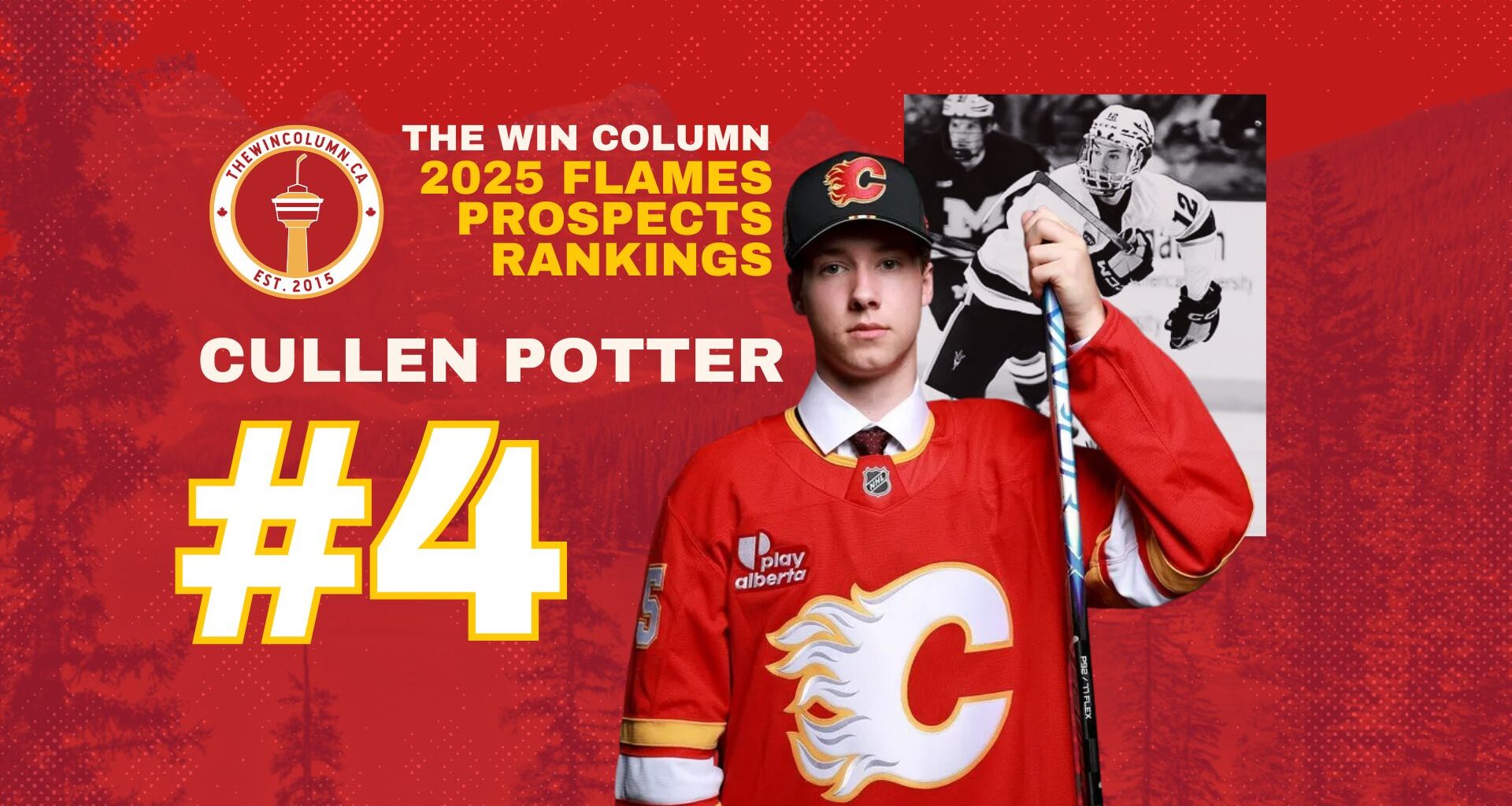
Welcome back to The Win Column Calgary Flames Prospect Rankings. At number four is a new face to the rankings in 5’10” centre Cullen Potter from Arizona State University.
As a Leafs fan who has a couple of Flames fan friends, and someone who has gained a lot of Calgary Flames followers over the last few months on Twitter (@RyanMaScouting), something I’ve picked up on is that there seems to be a constantly ongoing debate amongst the fanbase.
To tank, or not to tank?
Those who are in favour of tanking will tell you that it’s nearly impossible to get superstars if you’re picking outside of the top five to ten every year. Those who aren’t in favour of tanking will say that situations like the Buffalo Sabres show that tanking is by no means a guarantee.
I’m here to provide a third option. What if you compete for the playoffs and just draft a guy who could become a star at pick 32?
That’s right, outside of Matthew Schaefer, Michael Misa, and James Hagens, Cullen Potter is the next player who I think exudes the most star upside in this draft. There’s a reason why the 5’10” centre from Arizona State was my seventh-ranked player in the 2025 NHL Draft. Yes, you heard me, everyone, seventh.
Now I know these are lofty expectations for Potter, who saw 20 teams pass on him in the first round, including Calgary. But by the time you’re done reading this prospect profile, hopefully, we’ll all be on the same page.
PositionYear DraftedHighest RankingLowest Ranking2024 Ranking4th20254th4thUNR
Potter’s development so far
SeasonTeamLeagueGPGAP2023–24U.S. National U17 TeamNTDP54172946USNTDP JuniorsUSHL35913222024–25U.S. National U18 TeamNTDP9448Arizona State Univ.NCAA3513922
Potter deciding to skip another year with the USNTDP to go play for Arizona State University in the vaunted NCHC was a storyline I immediately picked up on early in the year. At 5’9”, the biggest question facing Potter headed into his draft year was whether the pace and skill would translate against more physical players. Secondly, would he be good enough defensively to allow him to play centre at just 5’9”, 161 lbs? Note: his height and weight were updated at the combine to 5’10”, 172 lbs.
It was why I had him ranked just 33rd in my early-season rankings. Playing for ASU could either raise his stock for me or tank it, depending on how well he adapted to his surroundings. It’s challenging for 17-year-olds to step into the NCAA and have success, much less the NCHC, which I believe is currently its toughest conference.
I had high hopes for Potter, but he smashed even my expectations out of the water this season for ASU.
For context, since the 2020 NHL Draft, these are the following draft eligibles who had a higher points per game rate than Cullen Potter did this year for ASU in the NCAA:
Matthew Beniers, C (2021 pick #2)
Kent Johnson, C/LW (2021 pick #5)
Adam Fantilli, C (2023 pick #3)
Matthew Wood, LW (2023 pick #15)
Macklin Celebrini, C (2024 pick #1)
Artyom Levshunov, RD (2024 pick #2)
Zeev Buium, LD (2024 pick #12)
James Hagens, C (2025 pick #7)
That’s eight players, all of whom were drafted in the top 15, and five of whom were taken in the top five. That’s not bad company, even if Potter is a somewhat distant ninth.
Of the eight, only Zeev Buium (University of Denver) played in the NCHC, and only Matthew Wood (University of Connecticut) didn’t have a top-15 ranked team as a supporting cast per USCHO.
Potter’s strengths and weaknesses
Strengths
Skating
Cullen Potter might have the best skating in the 2025 NHL Draft. He flashes on your screen every time you turn on an ASU game, and he’s one of the most dangerous transition threats in college this year. The edgework and explosiveness are insane; he comes barreling down the ice with the puck, effortlessly settling pucks and pulling between-the-leg moves in motion with the puck while maintaining his speed.
Defenders at the NCAA level have found it difficult to close the gap on Potter, who, despite his smaller frame, is more than capable of lowering his shoulder, putting out an arm to ward off pressure, and, with one stride, gaining a step on the bigger player. He usually finishes these rushes off with a quick, snappy shot on goal.
These obvious strengths are part of why I actually prefer Potter at centre. His ability to receive the puck in the centre of the ice, whether that’s a pass from a defenceman or a quick one-touch off the boards from the winger, and then immediately being able to shake pressure, turn up ice and create a rush opportunity off his skating is some of the best I’ve seen in my time watching prospects.
Defence
His skating also really helps him defensively. He’s not a super physical player (no surprise there), but his speed allows him to close quickly on opponents, where his active stick and understanding of leverage allow him to get in and strip pucks away or beat opponents in puck races even if they have the positional advantage.
In-zone offence
When he’s in the zone, he’s also got an arsenal of head fakes, sudden starts, and stops that allow him to find space to attack the middle of the ice, which is where he does most of his damage as an in-zone offensive player. He gets a lot of puck touches in the offensive zone for ASU, and he pairs it with great movement with and without the puck. It’s not uncommon to see him move from the slot to the half wall, up top to the blue line, and then back in the slot in one shift. I find this important to point out because there is a bit of a perception that he’s just a skater who can exploit defenders for rush shots, but doesn’t have the hockey IQ or awareness elsewhere to translate effectively.
I disagree with this statement, as I think Potter actually has a pretty well-rounded secondary aspect to his offensive arsenal. His goal against Miami of Ohio in January is the perfect representation of all of this.
Example
He pounces on a loose puck in the neutral zone, builds speed across the blue line, and immediately attacks the defenceman trying to step up on him. He’ll cut inside, get partially erased by the defenceman, but get the puck deep into the far corner. He gets up in the high slot, where a bounce sends the puck from the opposite corner towards the nearside face-off dot.
Miami’s defenceman has a good five, maybe six feet of space from Potter when he turns to retrieve this loose puck. By the time he can settle it near the boards, Potter has closed the distance down to maybe a foot and a half.
This forces a blind chip up the boards, where ASU wins the puck back, Potter then helps win a puck battle along the near-side half wall. ASU rims it to the far corner, where Potter then gets to the left point to support his pinching defenceman. He gets the puck, wires a snappy shot through traffic that doesn’t get to the net.
ASU gets the rebound, and as the puck moves around and ends up in the corner, Potter sneaks down from the blueline all the way into the low slot uncovered, where he buries a nice between-the-legs feed from Lucius.
All this to say, there’s a pro-activeness to how Potter plays; he’s always driving the middle of the ice when he doesn’t have the puck to create rush lanes and rush opportunities. He’s constantly moving in the offensive zone to find soft spots in coverage and trying to push the pace with the puck in transition, which are tools that make him an extremely viable all-around offensive player.
Potter already possesses a ton of dynamic and natural skill sets that you just can’t teach, and with some ironing out of his details and tendencies, there are the makings of a heliocentric, offensive dynamo here for Calgary.
Weaknesses
Passing & decision-making
My friend David Saad over at Dobber (@SaadScouting) is a day one Potter fan, and he said in his draft guide that, “Even though his counting stats don’t suggest it, I’d say [Potter] actually leans more as a playmaker.”
I can see where David is coming from, even if I ultimately disagree; there are flashes of real creativity from Potter, a no-look behind-the-back pass, or a quick play up the board, or a neat saucer pass into the slot through traffic. The tools are there, but the consistency and reads need to be better.
I’ve seen him loosely turn the puck over in the offensive zone because he’s assuming that a pass is there when it wasn’t. I’ve seen him hold the puck too long at times on the power play when there was a slot opening, but by the time he realizes it and tries the pass, it’s closed up.
Overall, I really just want to see a more balanced approach for Potter from a shot–pass ratio perspective. A lot of the time, when I see Potter with the puck, I can almost sense the shot coming. There’s a lot of mano a mano to his game right now, where he seems to trust his own shot and skillset more than anyone else’s. Lots of moments of tunnel vision, where he chooses a low percentage shot over deferring to a teammate who may have a better opportunity or more space to work with.
It’s an area of the game he’ll have to vastly improve next season. His ceiling for me at the NHL level is a heliocentric play-driving star who can use his speed and agility to carve out space for himself while creating scoring chances for both him and his teammates. Right now, he’s not doing enough as a facilitator.
Potter’s next steps
I do foresee Potter spending another year or two with ASU. He’s a highly exciting prospect whose offensive production and two-way play have been primarily buoyed by his elite-level skating this season. There are some details that he needs to work out, and I imagine that playing for a few more years in college will help round out those details. All the fundamental skills and tools are there, and I think a targeted development plan focused on his passing and his continued growth defensively will be pivotal in him reaching his ceiling.
It’ll be particularly interesting to see what happens in 2026–27 when Ben Kevan joins ASU’s program. Another highly creative forward, I’m interested to see if maybe the introduction of another talent that can create offence will allow Potter to loosen his grip a little bit. He was the straw that stirred ASU’s drink all season long, and I wonder if that responsibility and pressure to be the main creator caused the tunnel vision mentality we saw frequently this season.
Comparing Potter to Flames legend Johnny Gaudreau would be setting the young player up for failure, given how ridiculously high a bar that would be… but there is an existing roadmap for an uber-skilled, undersized American forward to come up to Calgary and steal the hearts of its fanbase.
While Potter ended up fourth on our compiled prospect rankings this season, I personally had him ranked second, and I wouldn’t be surprised if, in 10 years, we’ll look back at this group of players and see a case for him to be first.
Related