
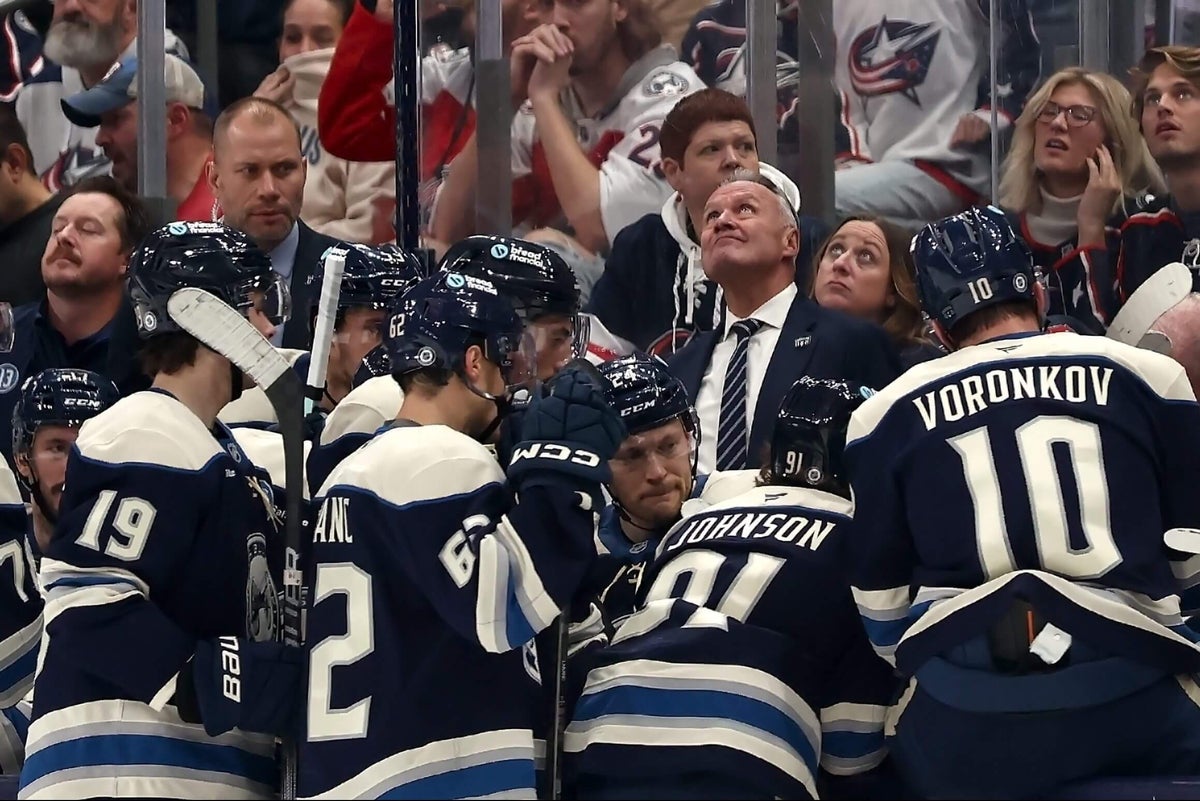
To fully appreciate what Dean Evason has already done in Columbus, it’s wise to look back at what he accomplished in Minnesota right from the jump. Evason appears to be repeating history, and that’s been Columbus’ gain early.
When the Wild hired Evason in 2020, they were a middling team playing at an 87-point pace. Offense was an afterthought.
That immediately changed when Evason took over. The Wild went 8-4-0 to close the season and saw an immediate boost to their offense, earning 2.5 xGF per 60 (up from 2.2) and scoring 3.8 goals per 60 (up from 2.6). Hot shooting? Maybe. But it also lasted for two years after that, directly contrasting with what the Wild were capable of before Evason showed up.
Two seasons before Evason
xGF per 60: 2.29
GF per 60: 2.32
Two seasons with Evason
xGF per 60: 2.36
GF per 60: 3.11
Obviously there’s a lot of context that goes into that. For starters, the Wild had a pretty notable rookie debut in Evason’s first full season and again the year after. That, and the offensive magic did evaporate in Year 3 of his tenure. Still, it was a notable bump that carried through for a decent length of time across the roster. Marcus Foligno, Ryan Hartman, Joel Eriksson Ek and Kevin Fiala all found a new offensive groove under Evason. The Wild played faster, harder and were much more creative with the puck.
It’s still early, but we’re starting to see the same thing play out in Columbus, a team that’s surprisingly second in five-on-five goals per 60 with 3.06, up from 2.61 last season. That jump, partially driven by an increased shooting percentage, has Evason’s fingerprints all over it. The man knows how to manufacture offense and he’s getting a lot more than expected out of a growing group of young forwards. Kent Johnson, Kirill Marchenko, Dmitri Voronkov and Yegor Chinakhov have all thrived in bigger roles and look like real offensive difference-makers. Last year that quartet averaged 0.91 goals per 60. This year they’re at 1.4.
It’s not just offense either, far from it. For the last few years, Columbus’ biggest issue has been a leaky defensive game, something that Evason — using all his experience with a stingy Wild team — has plugged up immediately. The Blue Jackets have allowed a middling 2.56 xGA per 60 this season, a huge improvement from last season’s 3.02 which ranked third-last. The team’s big three defensemen — Zach Werenski, Damon Severson, Ivan Provorov — have all made big strides on that front.
At both ends of the ice, Evason has made a big difference under challenging circumstances. On paper, the Blue Jackets weren’t expected to do much, mostly because that’s all we’ve ever seen from this group. The sign of a good coach is his ability to get the most out of what he has and there’s no doubt that Evason is doing just that with this Columbus team — a roster finally playing up to its potential.
Night in and night out, the Blue Jackets have shown they’re a competitive group that can hang with any team in this league. At five-on-five, they have a 51.3 percent xG (13th) and 53.5 percent goal rate (10th). Compare that to last season (45.6 percent, 28th and 47.2 percent, 25th respectively) and it’s night and day. According to the model, no team has improved more than the Blue Jackets this season who have gone from a Net Rating of minus-75 before the season to minus-43 now.

Some of that is internal growth, but it takes good coaching to nurture that growth. That’s the Dean Evason effect, and it’s just the beginning for the Blue Jackets.
16 stats
1. Zach Werenski, Norris dark horse
As good as Zach Werenski is, I don’t think many had him on their Norris radar to start the season. After an incredible start to the season, he’s next up after Cale Makar and Quinn Hughes in the race thanks to some incredible production that’s led to the Blue Jackets massively outscoring teams with him on the ice in tough minutes. There’s room for regression, sure, but it’s clear Werenski has found a new level this season. He’s Columbus’ engine. Add “unlocking Werenski’s full offensive potential” to the Evason list.
2. Dante Fabbro stuns in new city
Werenski’s average Game Score on November 11 was 1.38. Since then it’s 2.52 and that might not be a coincidence either. That’s the day the Blue Jackets picked up Dante Fabbro off waivers and immediately placed him on the top pair.
Fabbro had a decent resume of success in Nashville next to Roman Josi, as a steady presence that allowed Josi to rove the ice at will. He’s brought that same energy to Columbus and it’s helped unlock Werenski, pushing his game to a new level. In 161 minutes together, the Blue Jackets have outscored teams 12-4 with the top pair on the ice while earning a 51 percent xG rate. Fabbro has six points since becoming a member of the Blue Jackets and is averaging 22:30 per night.
Nashville putting Fabbro on waivers was a baffling decision at the time and looks even worse now.
3. Lost points on Long Island
On seven different occasions this year, the Islanders have had a third-period lead where their odds of winning the game were above 75 percent according to MoneyPuck’s in-game win probability model. Based on their peak expected win probabilities in those games, the Islanders should’ve earned nearly 13 points in those games. They earned four instead and it’s been the difference between sitting in a playoff spot and the current mess they’re in.

GO DEEPER
What I’m seeing from the Islanders: Loser points, Bo Horvat’s slump, injury timelines
4. Carolina’s Corsi crisis
That’s three straight losses now for the Hurricanes, but perhaps more alarming is how they’ve looked over the last four periods at five-on-five. In that span, they’ve lost the xG battle 3.3 to 1.2 — a 27 percent rate. Woof.
The team’s performance against Seattle was the fourth game in the last 10 the Hurricanes have earned 40 percent of the expected goals or less, something they haven’t done since 2019-20. During this stretch, the Hurricanes have an uncharacteristic 49.1 percent xG rate, their lowest over a 10-game stretch since the start of 2021-22. Needless to say, this recent run of games is extremely unlike the Hurricanes.
And that perhaps is the greatest endorsement of The System. Every team goes through lulls, but the Hurricanes are able to minimize them by controlling games to an elite and consistent degree. Since Rod Brind’Amour took over the Hurricanes they’ve played 413 distinct 10-game stretches; Carolina was out-chanced in only 29 of those stretches (seven percent). Their lowest mark: 46.5 percent.
The Canes are a machine and they should get out of this funk quickly.
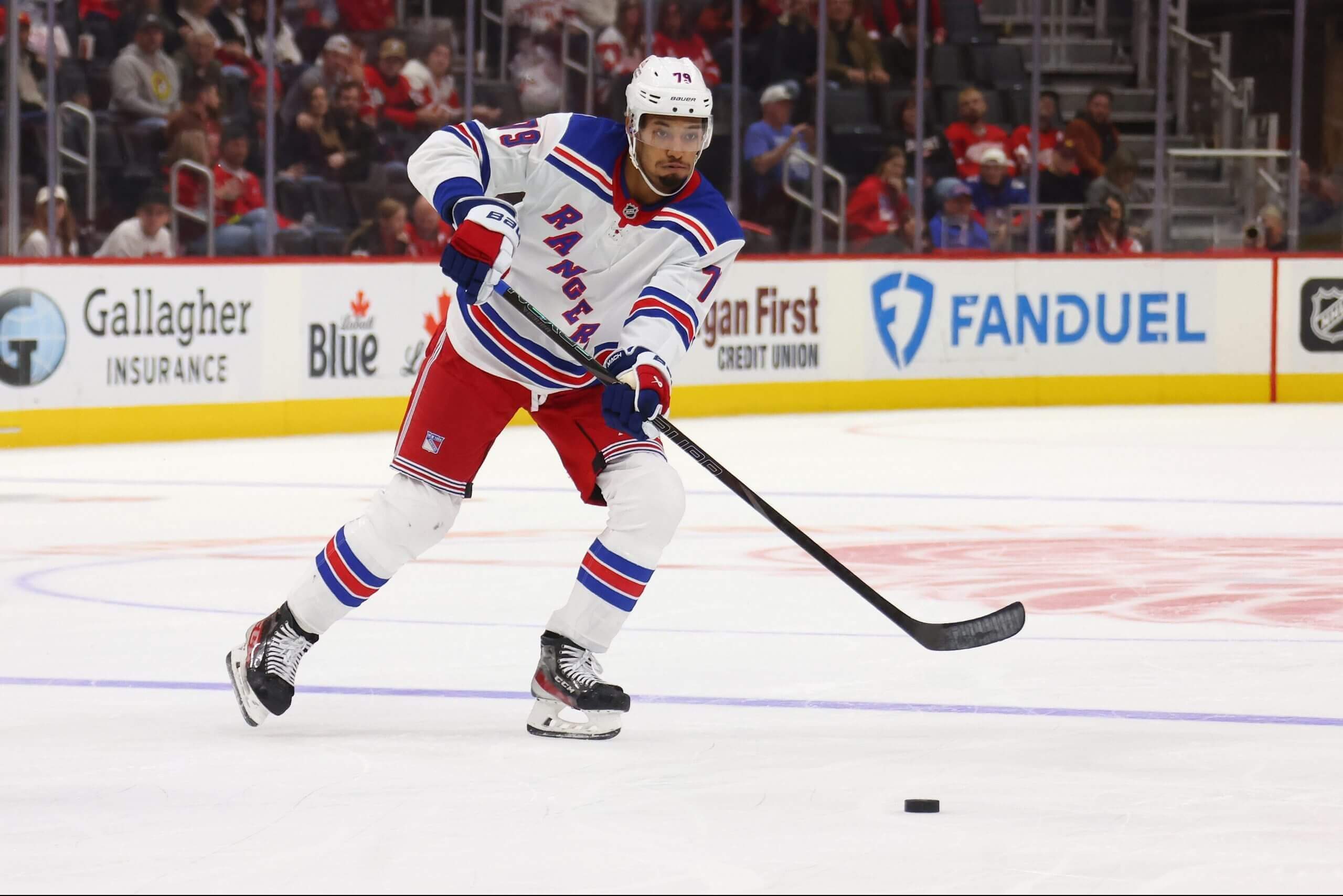
K’Andre Miller’s play of late has been troubling. (Gregory Shamus / Getty Images)
5. K’Andre Miller needs to step up
A lot of things are going wrong for the Rangers right now, but one of the more underrated aspects of their collapse is Miller’s play. Before the season the model rated him as a solid No. 2/3 defender with a projected Net Rating of plus-2.0. This year, Miller’s Net Rating on the year is minus-2.6 thanks primarily to being outscored 22-14 at five-on-five. A middling five-on-five xG rate also isn’t that impressive given how much time he’s spent next to Adam Fox and how soft New York’s schedule has been this year.
Miller’s play of late has been especially troubling and is the major driver of that slide. Since November 1, the Rangers have a 40 percent xG rate with Miller on the ice and have been outscored 17-8. That slide is reflected in his current projection: a minus-0.5 Net Rating. Essentially, Miller’s recent play means the model currently believes he’s closer to a No. 3/4. It also would suggest the Rangers only have one above-average defenseman at the moment. That’s a low only matched by Anaheim, which is obviously bad company. While I do think Miller is an above-average defenseman, he’s simply not playing like one at the moment.
A lot of Rangers players need to step up and get back on track — the team as a whole is last in xG since November 1 at 43 percent. Still, Miller is near the top of that list. He’s better than what he’s shown of late.
6. Moritz Seider and Simon Edvinsson: shutdown force
With Seider and Edvinsson on the ice this year, the Red Wings have allowed just 2.1 xGA per 60 and 0.95 GA per 60. That’s truly incredible work considering how difficult their minutes are and how poor the rest of the team looks. It’s a great sign that this pair is going to be a foundational force for Detroit for years to come. Now it’s up to Steve Yzerman and Co. to actually build a proper back end behind them …
7. Ice cold Quinn
I don’t think there’s a more disappointing player this year than Jack Quinn. The 23-year-old seemed primed for a big year after scoring 19 points in 27 games last year, earning 2.93 points per 60 at five-on-five — the fourth-best mark (!) in the league. In 24 games this year he has just one goal and five points. Only two of those points were at five-on-five and both were secondary assists. Brutal.
8. Shorthanded snipers in Florida
Fun fact: the Panthers have scored 3.47 goals per 60 shorthanded this year. Not only is that more than they have at five-on-five (2.87), it’s more than every team except for the Capitals at 3.55. It’s also almost as much as the Islanders have scored on the power play (4.14) this season.
Shoutout to Sam Reinhart — he has four of the team’s six goals short-handed.
9. Logan Cooley breaking out
It feels like Logan Cooley is flying a bit under the radar this season, but he’s had an impressive stretch of games over the last couple of weeks. He’s really starting to get a hang of the NHL and is now up to 20 points in 25 games, a 66-point pace. More impressive is that a lot of that is coming at five-on-five, where he’s scored 2.53 points per 60, up from 1.48 last season. There are certainly sustainability concerns thanks to a 13.2 percent on-ice shooting percentage, but the jump in production is still encouraging. He had an especially good string of games to close out November.
10. Wake-up call for Jason Robertson
We’ve talked about Jason Robertson’s struggles a lot this year, but it bears repeating after Robertson was (deservingly) left off Team USA for the 4 Nations Face-Off.
Since November 1 he has just one goal and eight points in 15 games and has played opponents to a draw when it comes to xG. For the season, Robertson has just nine games with a Game Score higher than one.
This isn’t pretty either. No forward has fewer 18 mph speed bursts per 60 than Robertson this season — and it’s not particularly close.
Hockey’s a fast game, but you don’t need speed to succeed.
With that in mind, using the NHL’s tracking data here are the slowest forwards of 2024-25 so far: pic.twitter.com/39hds8siKt
— JFresh (@JFreshHockey) December 2, 2024
For context, Robertson was at 10.2 bursts per 60 last year. Still one of the slowest players in the league, but not this bad.
One other thing to note: at five-on-five Robertson has just 6.0 shots per 60 this season, down from 9.8 two seasons ago. And those shots have been less threatening, too, with an expected shooting percentage of eight percent.
11. Tyler Seguin injury
It’s really disheartening to see Seguin’s injury news, especially considering how strong he’s been this season. He’s looked like his vintage self on a line with Matt Duchene and Mason Marchment scoring 20 points in 19 games while dominating possession. Seguin had a plus-4.6 Net Rating this season, a pace that’s right in line with his best years. For the first time in a long time (thanks to his many injury issues), Seguin looked like a $10 million player.
While the Stars should still cruise into the playoffs without Seguin for the rest of the regular season, this news does hit their chances of topping the Central division pretty hard. Dallas entered Wednesday’s game with a 30 percent chance of catching Minnesota to win the Central with 106.1 projected points. That drops to 17 percent with 102.6 projected points without Seguin.
12. Big money Debrusk
After a really slow start, Jake DeBrusk is proving exactly why the Canucks were right to give him a massive deal in free agency. He’s driving play exactly as well as expected with 55 percent of the expected goals and 62 percent of the goals, and his production has increased as expected in a bigger role. He’s now up to 11 goals and 20 points in 24 games, a 38-goal, 68-point pace. His Net Rating of plus-4.0 on the season has him firmly in first-line territory.
Jake DeBrusk elevates one home in tight for his 11th goal of the season!#Canucks pic.twitter.com/qERzAKZxGJ
— Hockey Daily 365 l NHL Highlights & News (@HockeyDaily365) December 4, 2024
13. Elias Pettersson is so back
Unsurprisingly, a lot of this started when DeBrusk and Pettersson were paired back together. The two feel like a perfect fit together and while the duo didn’t start great, round two has gone much better. DeBrusk has scored eight of his 11 goals in the 12 games since being reunited with Pettersson.
As for Pettersson himself, his cold start appears to be just that: a cold start. He’s back to his usual self with 17 points in those 12 games with a 59 percent xG to boot. During that stretch, he has an average Game Score of 1.87, a top-10 mark among forwards.
14. Is Anaheim’s power play finally ready to break through?
For a long time, Anaheim has had one of the league’s absolute worst power plays. Since finishing with the league’s best power play in 2015-16, the Ducks have finished in the bottom third in all but one season (2021-22) and finished in the bottom five three times. Since 2019-20, only the Flyers have a worse power play than Anaheim’s 16.5 percent conversion rate. Look at the other teams at the bottom and a lack of high-end offensive talent is usually the common denominator.
This year the Ducks rank 28th, and while that may seem like business as usual, there are signs of life underneath the surface suggesting things may start turning around. And that could be a really bullish sign that the team’s youth movement is ready for lift-off.
Since November 1st, only two teams (New Jersey and Toronto) have earned more expected goals per 60 on the power play than Anaheim’s 10.5. That may seem like an insignificant figure in a small sample, especially considering the team doesn’t have any results to show for it, but it could be a signal of big things to come.
Chances usually mean goals and great power plays usually create a lot of chances — something Anaheim hasn’t been able to do in a very long time. The last time Anaheim had a 13-game stretch creating power play chances to this degree was December 2016. In other words, it’s been a long time, which coincides with the team’s long stretch of anemic play with the man advantage.
The Ducks are getting chances and that’s a great sign. Now they need to actually execute.
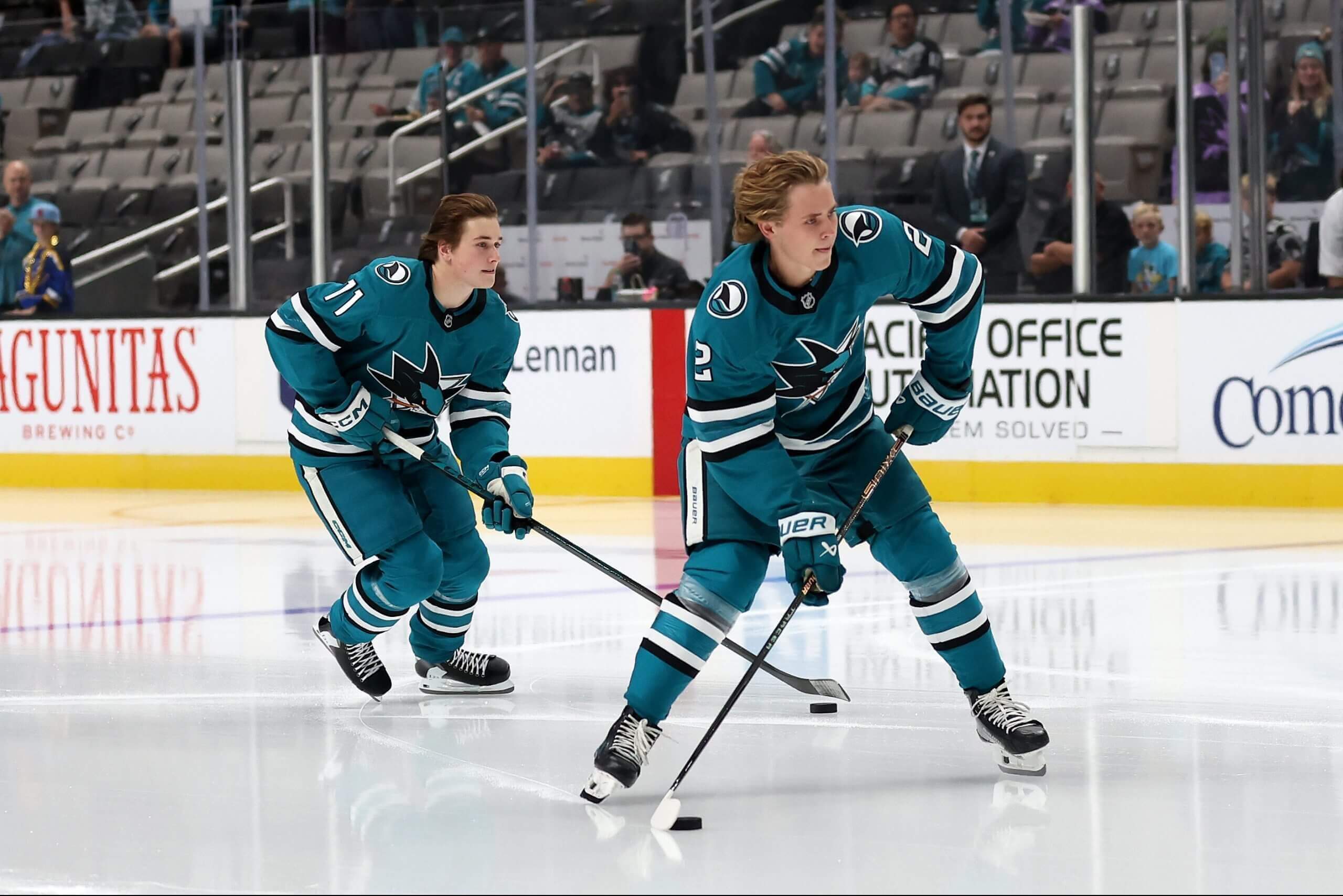
The Sharks’ two star rookies, Macklin Celebrini and Will Smith, have played their best hockey over the past five games. (Ezra Shaw / Getty Images)
15. Sharks surge
San Jose has won four of its last five and it’s probably no coincidence that the team’s two star rookies have played their best hockey during that stretch. Here are their stat lines over the last five games.
Macklin Celebrini
4G-4A-8PTS, 50% xG, 7-3 goals, 1.75 Game Score
Will Smith
3G-4A-7PTS, 57% xG, 8-2 goals, 1.87 Game Score
Both players have looked like superstars in the making, figuring out the big leagues in real time. The most impressive aspect has been their five-on-five growth as both were getting caved in regularly to start the year. If they can keep this up, the Sharks might be able to climb out of the basement a lot faster than many think.
16. Celebrini’s ceiling
While the model is still warming up to Smith due to his usage and pedestrian five-on-five numbers, it’s already all-in on Celebrini. His projected Net Rating is already at plus-8.2, a seriously impressive mark for an 18-year-old.
Based on that, the model is projecting some real superstar upside in his future with a forecast that peaks around plus-20 during his prime. That’s Aleksander Barkov-level, an incredible feat considering Celebrini only has 16 games to his name. Perhaps the model is being a tad overzealous, but it does point to just how good Celebrini’s start has been. He’s already got superstar in his DNA.
— Data via Evolving Hockey, Hockey Stat Cards, Natural Stat Trick and MoneyPuck
(Top photo of Dean Evason and the Blue Jackets: Kirk Irwin / NHLI via Getty Images)