
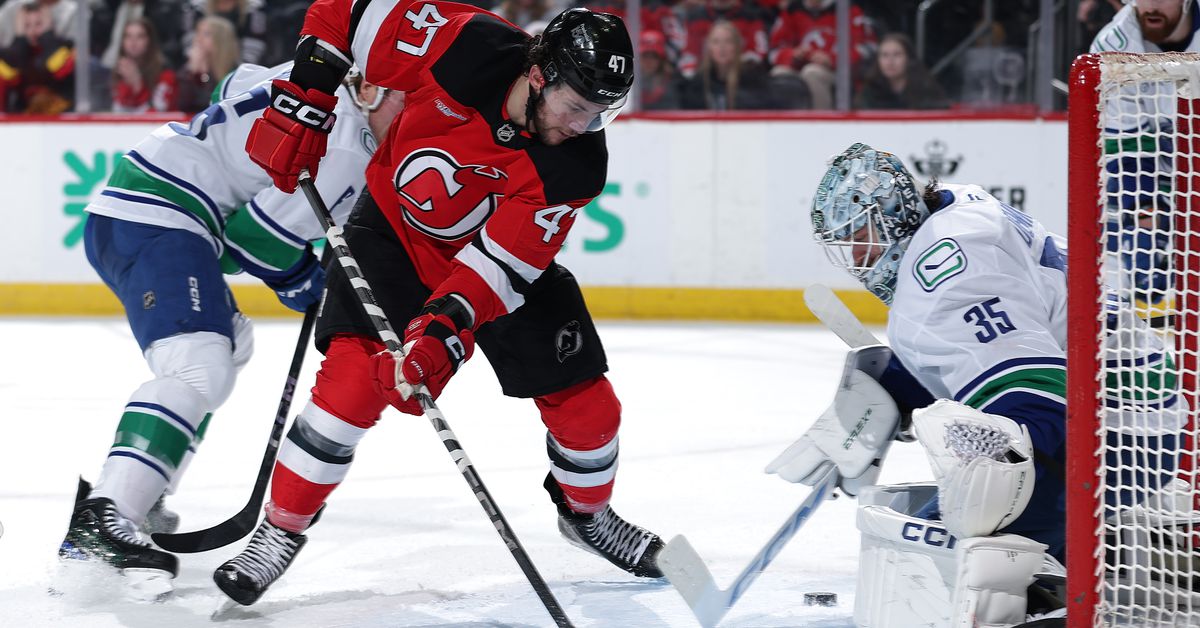
One of the most enthralling stories of the early 2024-25 New Jersey Devils season was Paul Cotter’s goal-scoring explosion for six goals in the first 12 games of the season. However, he did not pan out as a consistent scoring option, faltering into more of a fourth-line role, sometimes playing above his performance level on the third line. Here’s how his production broke up:
First 19 games: 7 goals, 5 assists, 52 hits, 12 PIMs, +2, 13:29 ATOI
Next 30 games: 3 goals, 1 assist, 112 hits, 29 PIMs, -9, 13:27 ATOI
Final 30 games: 6 goals, 0 assists, 81 hits, 21 PIMs, -7, 12:26 ATOI
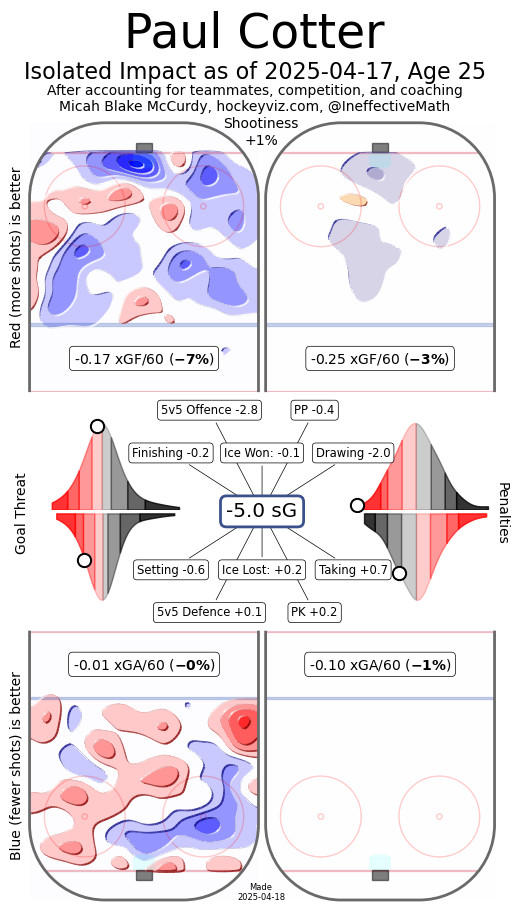
As a result of his drop in production, Cotter became one of the least effective skaters on the ice for the Devils as the season went on. In the final 60 games of the season, Cotter struggled to find consistency — and he really struggled to pass. Many of the Devils’ expected goals came off of Cotter’s stick, while his linemates struggled to find offense and goals, resulting in some wickedly bad goal ratios for the Devils. Goaltenders did not like playing behind Cotter, either. According to HockeyViz, Devils goaltenders gave up goals against at a rate of roughly 150 goals per 100 expected goals against. Only Brian Dumoulin was in Cotter’s area, there, and Dumoulin was only a Devil for a few weeks of regular season games. You can see Cotter’s full impact card from HockeyViz below:
HockeyViz
Cotter is a pretty good goal scorer in the NHL, but he is very limited, otherwise. He tracks as an exceptionally poor passer, as you can see with the “setting” impact deep into the red negatives. It’s hard to play 60 games at forward — often on the third line — and only come away with one assist. While 16 goals on a full season would be incredible for a regular fourth liner, Paul Cotter’s defensive results have hurt the team tremendously, while many onlookers know there is something more to his game than fourth-line ability. This is not a guy with stones for hands and bricks for feet, but a very talented and raw player.
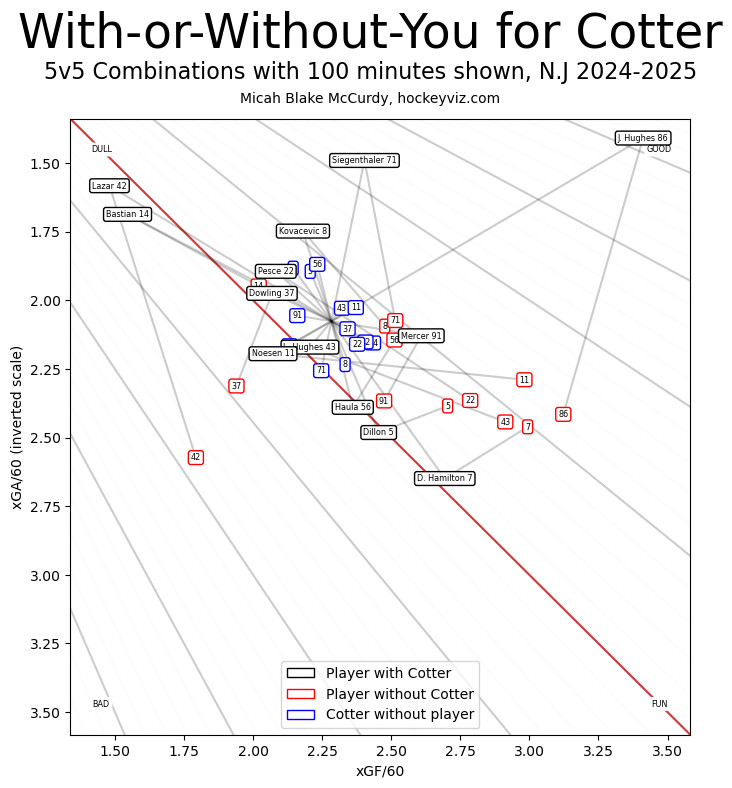
Interestingly, while most line combinations that involve Paul Cotter seem to fall apart defensively, there is one player who begins to dominate possession and scoring chance differential when on the ice with him: Jack Hughes. Still, however, they were outscored 4-2 in over 100 minutes of ice time together, with a whoppingly low 0.916 PDO (.886 SV% + 3.08 S%). You can see how much better of a place playing with Cotter put Hughes during the regular season last year in HockeyViz’s With-or-Without-You graphic below.
HockeyViz
In numerical terms, this is how Natural Stat Trick breaks this down in a per 60 minute average. Keep in mind that “CF%” roughly indicates the team’s percentage of total shot attempts taken, while “SF” and “GF” indicate the team’s shots on goal and goals scored, while the “SA” and “GA” stats indicate their shots and goals against.
Cotter without Hughes: 48.25 CF%, 22.5 SF/60, 23.98 SA/60, 1.76 GF/60, 2.74 GA/60, 1.98 xGF/60, 2.35 xGA/60
Hughes without Cotter: 54.33 CF%, 30.95 SF/60, 27.3 SA/60, 3.44 GF/60, 2.22 GA/60, 3.02 xGF/60, 2.48 xGA/60
Hughes and Cotter: 62.74 CF%, 34.19 SF/60, 18.41 SA/60, 1.05 GF/60, 2.1 GA/60, 3.31 GF/60, 1.52 xGA/60
As Tom Fitzgerald the Sheldon Keefe configure how to create an offensively-productive lineup while staying within the confines of the salary cap, finding Cotter a working line would be a tremendous boost to their effort. Now, Hughes and Cotter only played a bit over 100 minutes together, and Cotter did not show a ton in his other appearances up the lineup, but it is possible this is an example of two skillsets working well together. As skillful a game as Jack Hughes plays, Paul Cotter is on the opposite end of the physicality spectrum.
Still, to hang with a guy as good as Jack Hughes, Paul Cotter would have to vastly improve his passing ability and decisions with the puck. Far too often in the playoffs, Cotter would gain the offensive zone, but not pass to Cody Glass or Stefan Noesen, leading to a bad shot or outright turnover. Jack Hughes is a producer who wants to hit 50 goals and 100 points — he needs to play with people who pass the puck. For now, Cotter only brings goal-scoring highlights…but they are pretty good highlights.
There are other adjustments Paul Cotter can make to his game. Under Sheldon Keefe, despite having decent expected defensive numbers, the Devils gave up a ton of goals with Cotter on the ice. Perhaps related, Paul Cotter set the Devils franchise record for hits recorded in a season since hits became a stat in 2007 with 245. This put Cotter 11th in the league in hits, behind a slew of gritty veterans of varying ability levels. Of players Cotter’s age or younger, only Martin Pospisil and Will Cuylle (301 each) recorded more hits. Of the 10 players who outhit Cotter, only three — Mathieu Olivier (18), Kiefer Sherwood (19), and Cuylle (20) outscored him. It’s a rare skillset.
However, it’s also a very difficult lifestyle to manage. Paul Cotter’s greatest assets to the team are derived from his legs and hands — not his shoulders — and he needs to make sure that he sustains a certain level of play from opening night to the playoffs. To do so, I think he can start passing up some of his extra hits, focusing more on where he is on the ice. A bit more play in the passing lanes, a bit more puck hounding, and smarter defensive zone decisions might help Cotter stay fresher as seasons progress while keeping the team’s goals against more in line with the expected numbers with him on the ice. There’s nothing wrong with only throwing 100 hits in the regular season so he can score 25 goals in the regular season and hit twice as hard in late April.
I think Tom Fitzgerald was a little wrong to say that he does not care how many goals Cotter scores as long he’s a physical presence making the team harder to play against. I get why he said it — and Cotter filled his role more or less as expected from the time of acquisition — but Cotter has shown he can be more. He may be defensively responsible in pure numerical, expected terms, but the results of each of the lines he was tried on point to a pattern of untimely breakdowns and something that won’t be captured in just a scoring chance differential. Cotter needs to simplify his game, pass the puck more often, and try to get open as a shooter rather than will the play to the front as a puck carrier if he wants to maximize his ability. He might be able to blow past defenses left and right in other leagues, but he needs to foster more offensive chemistry with his teammates to be the best version of himself here. Putting him on a line where he is neither the primary transitional puck carrier nor the primary scoring presence will maximize his impact on the team — but Sheldon Keefe may need to work to figure that combination out.
Your Thoughts
What do you think of Paul Cotter’s future in New Jersey? Do you see him as a scoring option, a fourth liner, or an extra forward for next season? Do you think he should lean more into being a physical presence, or being a goal scorer? Leave your thoughts in the comments below, and thanks for reading.