
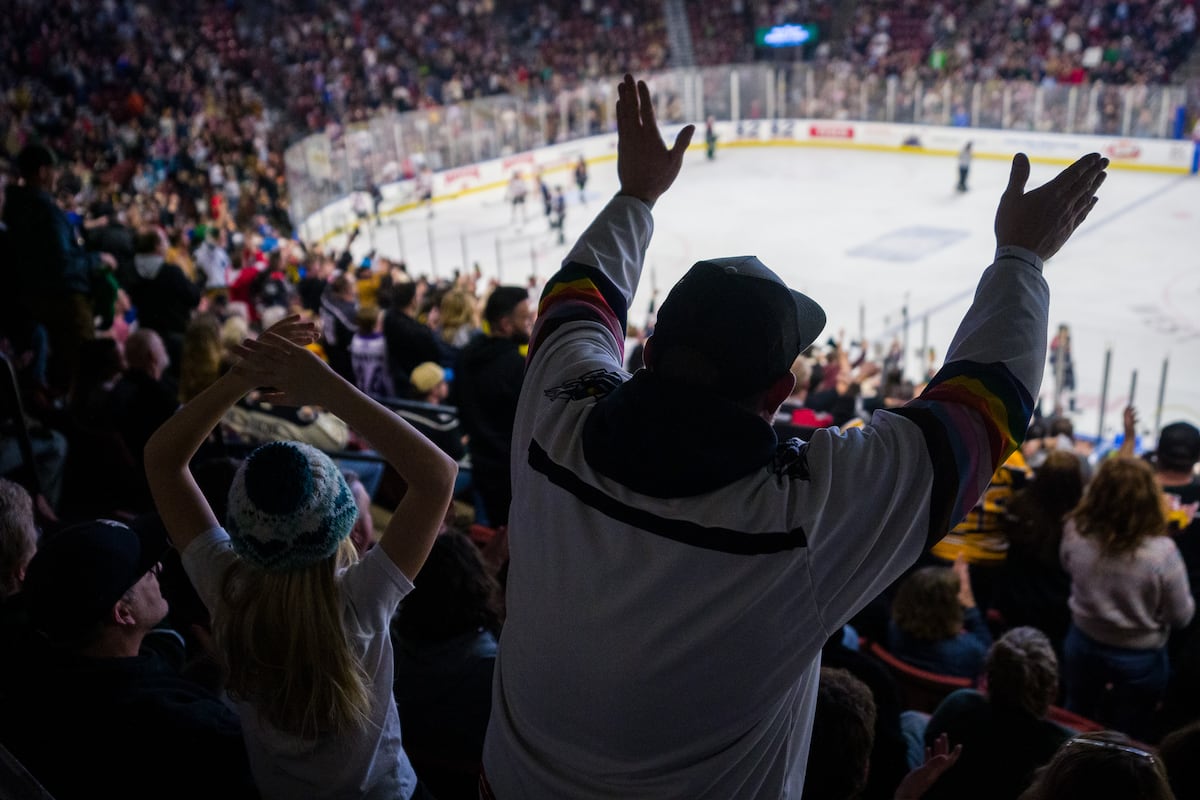
Chris Haggin stood at ice level in the public announcer booth at the Maverik Center.
It’s a spot Haggin knew well; he had been on the mic for the Utah Grizzlies for nearly 20 years at that point. On that night during the 2021-22 season, though, few expected Haggin to be there. His brother died earlier that day.
But with the memory of his brother top of mind, Haggin showed up for the job and community with which he felt a deep connection.
“There was just no question that I was going to do the game,” Haggin said.
That only grew when he saw the line of hockey players skating back onto the ice after the game had ended.
“I was like, ‘What’s going on here?’ They came, and every last one of them went into the announcers’ booth and hugged me and shook my hand,” Haggin said. “I was down there basically in tears, and these big, tough hockey players were coming up to me and saying, ‘We know what happened today, and thank you for what you do for us.’”
(Chris Haggin) Chris Haggin, third from the left on bottom row, with Utah Grizzlies employees at the Maverik Center.
Haggin landed his role as the Grizzlies’ PA around 2005 and — as a Utah native who got his start in the sport going to Salt Lake Golden Eagles games with his dad in the 1960s — has seen hockey in the state evolve.
What has stood out most, Haggin said, are the people. It is what makes the sale of the Utah Grizzlies “absolutely heartbreaking” for him and the fans.
He, and many others, are now trying to figure out how to say goodbye to a team that feels like family.
Grizzlies fans learn of the team’s departure
Cassandra Yohn White had to drag her husband to his first Utah Grizzlies game. It was before the couple had kids — so, accordingly, more free time — and she thought hockey at the Maverik Center would be the perfect evening activity.
“It was like pulling teeth to get him there originally,” Yohn White said. “But we went and had such a great time.”
Yohn White quickly became a season ticket holder, even looping her neighbors into the action. She and her husband now bring their kids to the games and joined the Grizzlies’ booster club last season to “adopt a player.”
“Now, that’s like our life,” Yohn White said. “Even everybody at work knows Cassi has the Grizzlies’ schedule on her desk.”
(Cassandra Yohn White) Cassandra Yohn White attends a Utah Grizzlies game at the Maverik Center with her husband.
When the Grizzlies announced in June that they had begun exploring the potential sale of the team, Yohn White was shook by the news. The ECHL organization will play the 2025-26 season at Maverik Center and will relocate afterward. West Valley City is a minor shareholder of the franchise and unanimously approved the sale of the Grizzlies to Pro Hockey Partners LLC during a July 23 city council meeting.
“Honestly, it was like a roller coaster of grief. And it still kind of is,” Yohn White said. “It was a blindside in a way.”
Alex Jackson, who has been a season ticket holder for five years, felt the same way. He grew up in West Jordan and was a 10-minute drive from the Maverik Center, he said. Jackson’s grandparents brought him to games when he was younger, and now, he has introduced hockey to his son through the Grizzlies.
“We have our own little fan base. My family sits in section 108, row 5. That whole area over there is primarily longtime season ticket holders. It is a family of all of us who aren’t necessarily blood [related], but it has become that,” Jackson said. “It has become much more than just hockey.”
Jackson said the news of the sale was unexpected. He knew a change in ownership would eventually come for the Grizzlies, but he thought it would be tied to the NHL’s Utah Mammoth or, at least, stay local.
“It was evident that something was going to happen,” Jackson said. “I honestly just hoped SEG (Smith Entertainment Group, which owns the Utah Mammoth) was going to step in and make Utah hockey — drag that in. But it never happened.”
(Alex Jackson) Alex Jackson and his son watch the Utah Grizzlies warm up at the Maverik Center.
The Grizzlies’ final year in Utah will close a chapter of hockey history in the state that made way for the Mammoth’s recent success.
David Elmore and Donna Tuttle founded the Denver Grizzlies in 1994 — they were part of the International Hockey League then. The couple moved the team to Utah the following year and worked with West Valley City to develop the Maverik Center. The IHL ceased operations in 2001, so the Grizzlies shifted to the AHL for four years before turning to the ECHL in June 2005.
The Grizzlies have been facing a transition period in ownership, which is the leading reason for the sale, the team said. Elmore died in June 2023, and Tuttle is now facing declining health. It is challenging for the family to remain actively involved in team operations.
“The Utah Grizzlies have been an important part of the West Valley City community for decades,” said West Valley City Mayor Karen Lang. “Our residents have supported and embraced the team through the years, and we wish them nothing but the best in their next chapter. They will always be part of the West Valley City family.”
Signs of needed change
Jackson’s young son was disappointed last season when the team’s mascot, Grizzbee, was absent from multiple games. Fans were sharing in Facebook groups that they had been wrongly double or triple charged at concession stands. Empty seats were puddled throughout the arena at times.
Despite the product on the ice, some said, the Grizzlies’ in-game experience had noticeably changed.
(Alex Jackson) Alex Jackson’s son with Grizzbee, the Utah Grizzlies’ mascot, at the Maverik Center.
“You could just tell there was a ripple effect that was going through the organization,” Jackson said. “I don’t want to talk badly about the organization. There were a lot of great years under Jared Youngman. You could tell, primarily last season, I hate to put it this way — but after numerous people within the organization had left, you could tell that love and admiration had left.”
Chris Lazar, who moved to Utah in 2018 and has followed the Grizzlies since, saw the switch, too.
“I would say we were shocked at first [about the sale]. But personally, I have noticed a decline in attendance all around. Even before the NHL hockey team was announced,” Lazar said.
He partially attributes that to the lack of publicity the Grizzlies get — or give themselves. The ECHL budget is obviously different from the NHL, and Lazar knows the impact that it can have on the sustainability of a fan base.
“The Mammoth are doing a great job of promoting the sport and growing the sport. If I could make one criticism about the Grizzlies, I don’t think that they did enough to promote the sport or the team,” Lazar said. “I feel like the only thing that we got was one or two billboards on each side of town. A radio ad and their social media.”
(Trent Nelson | The Salt Lake Tribune) The Utah Grizzlies host the Rapid City Rush, ECHL hockey at the Maverik Center in West Valley City on Saturday, Jan. 27, 2024.
Fans kept coming back because they wanted to support their players, Jackson said, and were tied to the close-knit Grizzlies circle. It could not last forever, though.
“You could sort of see the writing on the wall here,” Haggin said.
Loss of accessible hockey
For a lot of Utahns, the Grizzlies were their first introduction to hockey. A big reason for that is the affordability of being an ECHL fan. There is a fear that with only the NHL left in Utah after next year, fewer people will be exposed to the sport because of high prices.
“When the Mammoth moved here, everyone around me was like, ‘Oh, are you guys going to get rid of your season tickets for the Grizzlies and get season tickets for the Mammoth?’ I was like, ‘Absolutely not.’ Our two season tickets aren’t even one season ticket for the Mammoth,” Yohn White said.
Full season-ticket packages for the Grizzlies start at $476 and go up to $1,140 for rinkside seats. Center seats are $900 and end seats are $580. Without season tickets, fans can still get in the door for as low as $12 during the regular season. The most one would pay for a single-game ticket is around $40.
The Mammoth experience is, expectedly, more expensive given that they are in the NHL. Mammoth season ticket holders have to put down a $100 deposit per seat to secure their packages, which can range in the thousands for the full year.
(Cassandra Yohn White) Cassandra Yohn White and her family with Grizzlies forward Keaton Mastrodonato.
The cheapest ticket for the team’s opening night at Delta Center against the Calgary Flames on Oct. 15 is $171 (upper bowl) and goes up to $1,076 for the lower bowl. The second home game on Oct. 17 against the San Jose Sharks’ cheapest ticket is $87 for the upper bowl and goes up to $733 for the lower bowl.
These prices are not at all unprecedented for the NHL, but it is a significant difference compared to the ECHL — and it will make it harder for some Grizzlies fans to continue to follow the sport locally.
“The NHL team is more spendy,” said Christian Meador, who became a Grizzlies fan in 2010. “Downtown, I’ll be honest, is a horrible experience to go try to find parking and then try to save money by eating out, but that’s also a pain. It is just so expensive to go to a game.”
Jackson echoed that sentiment, especially as hockey games are usually a family affair for him.
“Affordable hockey has been pulled away,” he said.
Future of minor league hockey in Utah
The Utah Grizzlies have never actually been affiliated with the Utah Mammoth; the Grizzlies are the ECHL affiliate of the Colorado Avalanche. The Mammoth had a one-year affiliation agreement with the Allen Americans (based in Texas) as their ECHL team last season.
The Tucson Roadrunners — who are owned by Alex Meruelo (former owner of the Arizona Coyotes) — remain the AHL team for the Mammoth. Utah will be connected to Tucson for at least the duration of the 2025-26 season.
A report from Sportico last summer said Meruelo has plans to move the Roadrunners to Reno, Nevada, after the Arizona State Land Commission canceled the auction for the land that Meruelo wanted to build a $3 billion arena for hockey in Phoenix. The Roadrunners are entering the ninth year of their 10-year lease at Tucson Arena.
(Trent Nelson | The Salt Lake Tribune) The Utah Grizzlies host the Rapid City Rush, ECHL hockey at the Maverik Center in West Valley City on Saturday, Jan. 27, 2024.
“I know a lot of Grizzlies fans were hoping Ryan Smith was going to swoop in and save the day, buy the Grizzlies and turn them into an AHL team,” Haggin said. “Boy, that sounds great on paper, doesn’t it? But it’s very complicated.”
Haggin is right. One cannot simply elevate an ECHL franchise to the AHL. The AHL bylaws do not allow upward movement, and the league aims to maintain the same number of teams as the NHL (which is the 32 it has now).
Having affiliated minor league hockey in the state would likely benefit the Mammoth, though. Meador is from Seattle and saw how having junior hockey (like the CHL’s Seattle Thunderbirds and WHL’s Spokane Chiefs) helped build a hockey fan base for when the Seattle Kraken joined the NHL as an expansion team in 2021.
“I think having a team in the Maverik Center is super helpful for the Mammoth’s building of their fan base. I look at Seattle, they had three minor league hockey teams within 30 minutes of where the Kraken play. They’d been there for years, so that helped strengthen the Kraken’s fan base,” Meador said. “Here, we have just the Grizzlies. I know population-wise, we are way smaller than Seattle, but still having that minor league team helps build that local, younger fan base who want to experience hockey.”
While minor league hockey may be leaving Utah for now, the Maverik Center will stay. The West Valley City Council unanimously voted to move forward with planned upgrades to the arena (which opened in 1997) last month. Without the Grizzlies, the Maverik Center will still be used for concerts, family shows and, eventually, the 2034 winter Olympics.
(Francisco Kjolseth | The Salt Lake Tribune) Long lines of cars snake around the Maverik Center in West Valley City on Tuesday, Jan. 4, 2022, as people wait for COVID-19 testing.
“The Maverik Center is a great facility, and we are always reviewing ways to implement current technology and make better use of the space we have. We are looking at upgrades which are essential to updating the venue for long-term usage and viability, guest experiences, and sustainability,” Lang said. “The upgrades and renovation will provide a thriving venue to enjoy world-class music, sports, and other live events that create memorable experiences for families throughout Utah and the Intermountain West.”
Perhaps one day, an affiliate hockey team for the Utah Mammoth will skate at the Maverik Center. For now, though, Grizzlies fans are still mourning and coming to terms with the new reality of their team.
“I still have faith that somebody will come in and save the Grizzlies,” Lazar said.
Note to readers • This story is available to Salt Lake Tribune subscribers only. Thank you for supporting local journalism.